
Why carmakers switched to DOT 5.1 brake fluid
Why DOT 5.1 Brake Fluid is the Clear Winner for Modern Vehicles
As a former master technician, I’ve worked with every type of brake fluid over the years, and I can confidently say that DOT 5.1 brake fluid is one of the best advancements in braking technology. Modern vehicles demand more from their brake systems than ever before, and understanding why DOT 5.1 brake fluid outperforms older formulations like DOT 3 and DOT 4 is essential for maintaining safe, responsive braking under all conditions.
What Makes It Different
The DOT 5.1 brake fluid standard was introduced to meet the performance needs of today’s electronically controlled braking systems. Unlike DOT 5 silicone-based fluid, DOT 5.1 is glycol-ether-based, just like DOT 3 and DOT 4, which means it’s compatible with both. However, it’s chemically engineered to deliver lower viscosity and higher boiling points—two key properties that give it an edge.
Modern Anti-lock Braking Systems (ABS) and Electronic Stability Programs (ESP) rely on lightning-fast pressure modulation. These systems create rapid pulsing in the brake lines, generating heat that can degrade lower-grade fluids. DOT 5.1 flows more easily through these fine control valves, maintaining consistent pressure even during high-frequency ABS or traction control events.
The Boiling Point Advantage of DOT 5.1
Brake fluid performance boils down—literally—to its boiling point. When brake fluid overheats, it can vaporize and create compressible air pockets, leading to brake fade or complete loss of braking pressure. That’s why the boiling point ratings of DOT fluids are so critical.
Here’s how DOT 5.1 brake fluid compares:
Dry Boiling Point: 500°F (260°C)
Wet Boiling Point: 356°F (180°C)
For reference, typical DOT 3 brake fluid has a dry boiling point around 401°F and a wet point around 284°F. DOT 4 improves on that slightly, but neither can match DOT 5.1’s resistance to heat and moisture. The higher boiling point means better fade resistance during high-performance driving, towing, or mountain descents—situations where lesser fluids often fail.
Why Moisture Resistance Matters
All glycol-based brake fluids, including DOT 5.1 brake fluid, are hygroscopic—they absorb moisture from the air. Over time, the absorbed moisture lowers the fluid’s boiling point and can lead to internal corrosion in the master cylinder, calipers, and ABS module.
The difference with DOT 5.1 brake fluid is that it absorbs moisture more slowly and retains its high boiling point longer than DOT 3 or DOT 4. That means you can go longer between flushes while still maintaining consistent braking performance. I always recommend testing brake fluid for moisture using professional-grade test strips or a refractometer rather than relying on color alone.
DOT 5.1 Is NOT the Same as DOT 5
This is where many people make a costly mistake. Despite the similar names, DOT 5.1 brake fluid and DOT 5 are not interchangeable. DOT 5 is silicone-based and does not mix with any glycol-based fluid. Mixing the two will ruin the braking system.
If your vehicle originally specified DOT 3 or DOT 4, you can safely upgrade to DOT 5.1 brake fluid—but never to DOT 5. The “5.1” designation merely refers to its performance level, not its chemical base.
Brake Fluid Color and Condition
Fresh DOT 5.1 brake fluid is typically clear, yellow, or blue, while DOT 5 silicone fluid is purple. Over time, glycol-based fluids darken due to moisture and rubber seal degradation. But don’t rely on color to judge condition—the only accurate method is testing for moisture content.
If you see dark fluid, it’s not necessarily dangerous, but it’s a sign the flui
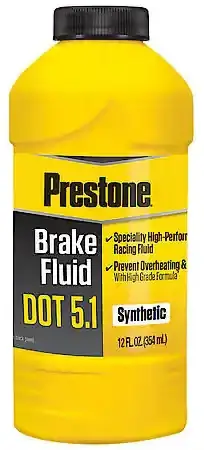
Click on the image to learn more about DOT 5.1
d has aged and may need replacement soon. Regular brake fluid maintenance is critical for long-term ABS reliability and corrosion prevention.
What Is LMA (Low Moisture Activity) Brake Fluid?
You may have seen LMA on some premium fluid labels. Low-Moisture Activity fluids are formulated to resist water absorption even better than standard glycol fluids, keeping the boiling point higher for longer periods. DOT 5.1 brake fluid naturally fits into this category because of its superior chemical formulation and resistance to moisture degradation.

When to Choose DOT 5.1 Brake Fluid
If you drive a performance vehicle, tow heavy loads, or live in an area with steep terrain, DOT 5.1 brake fluid is the right choice. It provides a consistent braking feel under high stress, resists vapor lock, and ensures ABS systems perform correctly. Even if you drive a regular car, upgrading to DOT 5.1 can give you peace of mind and more consistent pedal feel—especially as vehicles become more electronically integrated.
Final Thoughts
From my experience in the shop, DOT 5.1 brake fluid represents one of the smartest upgrades you can make to a modern braking system. It’s fully compatible with DOT 3 and DOT 4, delivers higher performance under heat, and resists moisture better than older formulations.
If you’re servicing your brakes or flushing the system, step up to DOT 5.1 brake fluid—it’s a small investment that pays big dividends in safety, performance, and brake longevity.
©, 2023 Rick Muscoplat
Posted on by Rick Muscoplat