
Why Your Car Won’t Start and How to Fix It Fast
Most Common Reasons a Car Won’t Start
Quick Summary
When a car won’t start, the problem almost always falls into one of three categories:
• No power — Dead battery, corroded battery cables
• No crank — Bad starter relay or bad starter, immobilizer issues
• No fuel/spark — Ignition coils/spark plugs, crank/cam sensor, fuel injectors
A professional technician doesn’t guess—they follow a structured diagnostic strategy, starting with an understanding of the system, then isolating the failure point using voltage, signal, and circuit testing.
Why Your Car Won’t Start (And How a Pro Diagnoses It)
I’ve diagnosed thousands of no-start conditions, and I can tell you this: when a car won’t start, the biggest mistake people make is jumping straight to parts replacement. Professionals don’t do that. We break the problem into systems and test our way to the root cause.
Let’s walk through the most common causes—and then I’ll show you exactly how a real diagnostic strategy works.
The Most Common Reasons a Car Won’t Start
1. Dead or Weak Battery — This is still the
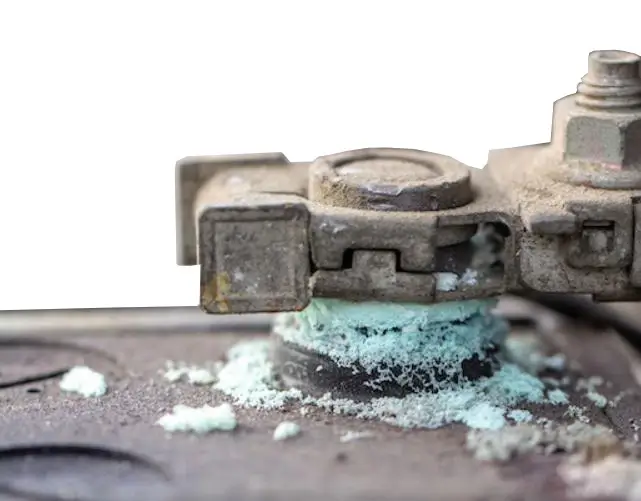
Corroded battery terminals due to cracked battery case and battery leak
number one reason a car won’t start. If the battery voltage drops below about 12.2 volts, you may get a slow crank—or no crank at all. Corroded terminals can mimic a dead battery. I’ve seen plenty of good batteries fail to deliver current because of poor connections.
2. Bad Starter Motor or Solenoid — If you turn the key and hear a single click—or nothing at all—the starter is suspect. Inside the starter are pull-in and hold coils that engage the drive gear. When those fail, the engine won’t crank.
3. Faulty Starter Relay or Fuse — Modern starting systems rely heavily on relays and fuse protection. A failed relay means the starter never receives power. The relay acts as a bridge between the battery and the starter motor, closing the circuit when commanded by the PCM.
4. Ignition Switch Failure — If the ignition switch doesn’t send the “start” signal, the entire system stays inactive. No signal means no crank—simple as that.
5. Neutral Safety Switch / Clutch Switch — Automatic transmissions must be in Park or Neutral. Manuals require the clutch pedal to be depressed. If the switch fails, the PCM blocks the start command.
6. Fuel Delivery Problems — If the engine cranks but doesn’t fire, now you’re dealing with fuel or spark. A failed fuel pump, clogged filter, or bad injector can all cause a car won’t start condition.
7. Ignition or Spark Issues — No spark means no combustion. This could be caused by a bad crankshaft position sensor, ignition coils, or PCM-related faults.
8. Engine Control Module (PCM) or Wiring Faults — Modern vehicles rely on communication between modules. If the PCM doesn’t see the right inputs, it won’t allow the engine to start.
How a Professional Diagnoses a Car That Won’t Start
This is where experience separates guesswork from real diagnostics.
Step 1: Identify the Type of No-Start — The first question I ask is simple:
• Does it crank?
• Does it click?
• Or is it completely dead?
This instantly narrows the system.
Step 2: Understand the Circuit Before Testing — Before touching a tool, I review how the system works. For example, in a typical starting system:
• The ignition switch sends a signal
• The PCM verifies that the right key is used and the shifter state and (park/neutral or clutch)
• If the correct key or fob is verified, the PCM activates the starter relay
• The relay sends battery power to the starter
If you don’t understand this sequence, you’re guessing.
Step 3: Test at Strategic Points — A pro doesn’t test everything—we test decision points. For example, checking the voltage at the starter relay control circuit tells me whether:
• The ignition switch is working
• The PCM is receiving the signal from the ignition switch and the immobilizer
• The PCM is commanding the relay
In this case, checking for 12 volts at the relay input immediately confirms whether the first half of the system is working . That’s how you cut diagnostic time in half.
Step 4: Divide the System Into Sections — This is critical. If I have voltage at the relay but the starter doesn’t engage, I ignore everything upstream and focus downstream:
• Relay function
• High-current circuit
• Starter motor
This prevents wasted time.
Step 5: Load Testing (Not Just Voltage Checks) — A circuit can show 12 volts and still fail under load. That’s why professionals:
• Perform voltage drop tests
• Check current flow
• Use tools like circuit testers or scopes
A weak connection often only shows up under load.
Step 6: Confirm Before Replacing Parts — Before I replace anything, I prove it’s faulty.
For example:
• Swap relays with identical ones
• Bench test the relay
• Verify starter operation directly
If you skip this step, you’re gambling.
Why Most DIY Diagnoses Fail
Most DIYers:
• Don’t understand the system
• Don’t isolate the circuit
• Replace parts based on symptoms
That’s why a car won’t start problem often turns into multiple unnecessary repairs.
Final Thoughts: Think Like a Technician
When a car won’t start, don’t think “what part is bad?”
Think: “Where is the signal or power stopping?”
That mindset is the difference between guessing and diagnosing.
©, 2026 Rick Muscoplat
Posted on by Rick Muscoplat