
Why Your Car’s AC Only Works While Driving
Learn Why Your AC Only Works While Driving Fast and Blows Warm When Stopped
If you’ve noticed that your car’s AC only works while driving or only kicks in when you’re at highway speeds, you’re not alone. I’ve diagnosed this exact complaint hundreds of times in the shop. Drivers will say, “The AC is cold on the freeway, but the second I hit a red light or sit in traffic, it blows warm.” That’s a textbook symptom of a system that’s struggling due to one of several common issues.
Let me walk you through the top four reasons why your AC only works while driving and what you can do to fix it.
#1: Radiator or Condenser Fans Aren’t Running at Idle or Aren’t Running at Full Speed—
The number one cause of AC that only works while driving is usually a radiator fan issue. When your vehicle is stopped, the radiator and condenser fans are responsible for pulling air across the AC condenser. If they’re not spinning fast enough — or not spinning at all — the condenser can’t cool the refrigerant properly. High pressure builds, and the high-pressure switch shuts off the compressor to protect the system.
But when you start driving, ram air from vehicle motion flows through the condenser, dropping the pressure and allowing the AC to work again. That’s why your AC only works while driving fast or at highway speeds.
I’ve seen everything from failed fan motors to blown relays or faulty solid-state fan controllers. Whatever the reason, if your radiator fans aren’t running full tilt when the AC is on, you’ll lose cooling performance at idle. Pop the hood, turn the AC on, and check both fans. If one is sluggish or not working, you’ve found the culprit.
Diagnosing radiator fans
Carmakers use three different setups for cooling the radiator and AC condenser: two separate fans running at a single speed, two fans running at two speeds or variable speed, or one fan that has multiple or variable speeds.
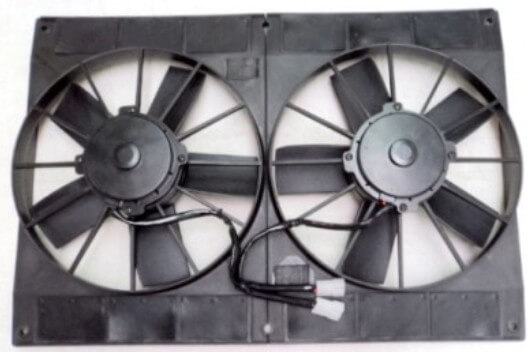 In a two-fan setup, carmakers often use one fan to cool the radiator and a second fan only when the AC is turned on. That pulls more air across the condenser and radiator. The condenser and radiator. In those setups, both fans are usually mounted on the engine side of the radiator.
But in others, one fan is on the engine side of the radiator, and the AC condenser fan is mounted in front of the condenser (behind the grille).
GM and others use either a three-relay setup to run the two fans at low speed for normal driving and high speed when the AC is on, or the low speed can adequately cool the radiator.
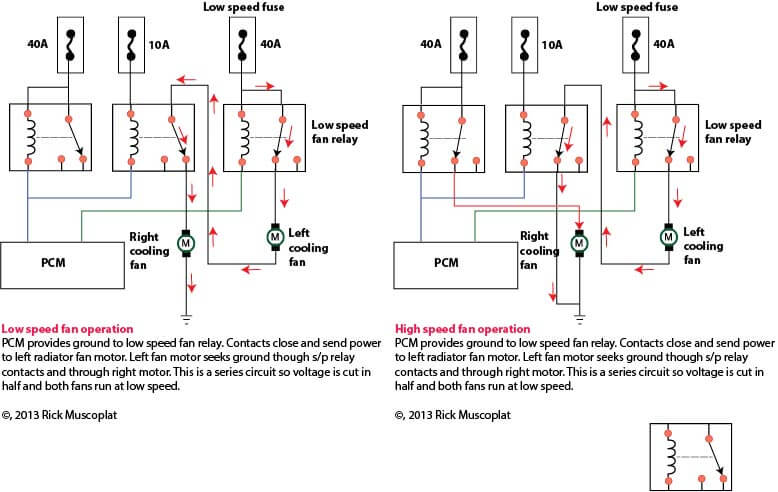
GM radiation fan wiring diagram. Click on the image to download the complete GM multi-speed radiator fan wiring diagram
Other carmakers use a solid-state speed relay that varies the speed of the fans based on engine cooling and AC needs.
What’s the point of this? If your AC is on and the fans aren’t running at high speed or one fan isn’t running at all, the AC condenser temperature and pressure will rise, and the high-pressure switch will turn off the compressor. If the fans aren’t running at high speed or one fan isn’t running, your AC may blow cold air when you’re moving because enough “ram” air is coming across the condenser coil to keep the temperature and pressures low. But when you stop moving, the temps rise, and the compressor shuts off.
So check both fans and make sure they’re both running a high speed if your AC blows warm at idle.
#2: Low Refrigerant Charge
A Low Refrigerant Charge is More Noticable at Idle Speeds— Here’s another issue I run into all the time: low refrigerant. When the AC system is undercharged, it simply doesn’t have the volume it needs to cool efficiently, especially at low RPMs. The compressor is engine-driven, so when you’re idling, it spins slower and moves less refrigerant. That can cause warm air to blow at stoplights, while cold air returns when you’re driving at speed.
This is a textbook scenario where AC only works while driving fast, because the compressor spins faster and manages to push more refrigerant through the system.
If your AC system hasn’t been professionally checked in a while, get the refrigerant levels tested before doing anything else.
#3 Your Car’s AC Compressor Is Worn Out
Worn piston or scroll seals can’t do an effective job when compressing refrigerant at low speeds. However, it can compress enough refrigerant when operating at driving speeds.
#4: Your Engine Is Overheating
Engine Heat Can Force the AC to Shut Down— Overheating is another sneaky cause of why your AC only works while driving. Here’s how it plays out: the engine gets too hot, and the PCM (Powertrain Control Module) decides to shed load. One of the fastest ways to reduce engine temperature is to disable the AC compressor, and that’s exactly what the computer does.
So, if your cooling system is borderline or you’re dealing with a partially clogged radiator, the system might work fine on the highway but struggle in traffic. Once you’re moving and airflow improves, the engine cools down, and the AC starts blowing cold again. This is another clear reason why your AC only works while driving fast and not at idle.
#4: A Clogged AC Condenser
Debris or Sludge Can Kill Low-Speed Performance— I’ve seen plenty of clogged condensers that can move refrigerant just fine under high flow (like when you’re at 2,000+ RPM), but they choke at idle. This can happen if you’ve been recharging your AC system repeatedly without addressing a leak. When moisture enters the system, it reacts with the refrigerant and oil, creating acids and sludge. That gunk often settles in the narrow condenser tubes, restricting flow.
When that happens, the system behaves exactly like you’d expect: AC only works while driving fast, and goes warm as soon as you slow down.
If you suspect a clogged condenser, a professional superheat/subcooling test will confirm poor condenser efficiency. Don’t just throw more refrigerant at the problem — that’s how you destroy a compressor.
Conduct a superheat test to determine condenser efficiency.
©, 2020 Rick Muscoplat
Posted on by Rick Muscoplat