
Best Brake Pads: The Complete Buying Guide
Best Brake Pads: How to Buy the Right Brake Pads for Your Vehicle
Quick Summary
Choosing the best brake pads isn’t about buying the most expensive set on the shelf. It’s about matching the brake pad material, construction, and friction characteristics to the way you drive. In this guide, I’ll explain what separates premium brake pads from bargain brands, why backing plate quality matters, and how to choose brake pads that deliver quieter operation, longer life, and safer stopping performance.
Best Brake Pads: What I Look for Before Buying
After performing hundreds of brake jobs over the years, I’ve learned that the cheapest brake pads almost always end up being the most expensive. They wear out faster, create more brake dust, squeal sooner, and often damage the rotors they’re supposed to protect.
When I’m buying brake pads for my own vehicles, I ignore flashy marketing and focus on engineering. That’s what separates a quality brake job from one you’ll be doing again next year.
Start With the Right Friction Material
The first decision is choosing the correct friction material.
Ceramic Brake Pads — For most passenger cars, crossovers, and light SUVs, ceramic brake pads are my first choice because they offer:
• Quiet operation
• Excellent stopping power for everyday driving
• Low brake dust
• Longer rotor life
• Consistent braking performance
That’s why roughly 70% of new vehicles leave the factory with ceramic brake pads.
Semi-Metallic Brake Pads — If you tow, haul heavy loads, or drive a truck or performance vehicle, semi-metallic brake pads are often the better option.
They provide:
• Better heat resistance
• Stronger braking under heavy loads
• Improved high-temperature performance
The tradeoff is that they generally produce more dust and can be noisier than ceramic pads.
Don’t Buy Brake Pads Based Only on the Box
One thing many DIYers don’t realize is that there are no industry standards for the words “Premium,” “Ceramic,” or “Ultra.” Almost any manufacturer can print those terms on the box.
Instead, I buy from manufacturers with proven OE experience and strong engineering reputations.
The Hidden Feature That Determines Brake Pad Life
Most people never look at the backing plate, but I always do. In multiple surveys, rusted backing plates have been identified as one of the leading causes of premature brake pad failure.
As corrosion builds underneath the friction material, it literally pushes the pad apart until chunks of friction material separate from the steel backing plate.
Premium brake pads solve this problem by using:
• Galvanized steel backing plates
• Heavy corrosion-resistant coatings
• Mechanical attachment systems instead of adhesive alone
Those features dramatically increase brake pad life in areas where road salt is common.
Mechanical Attachment Is Better Than Glue
Many inexpensive brake pads rely almost entirely on adhesive to hold the friction material to the backing plate.
Premium manufacturers often add mechanical retention systems that physically lock the friction material in place.
If the backing plate begins to corrode or the brakes experience extreme heat, mechanically retained pads are far less likely to separate.
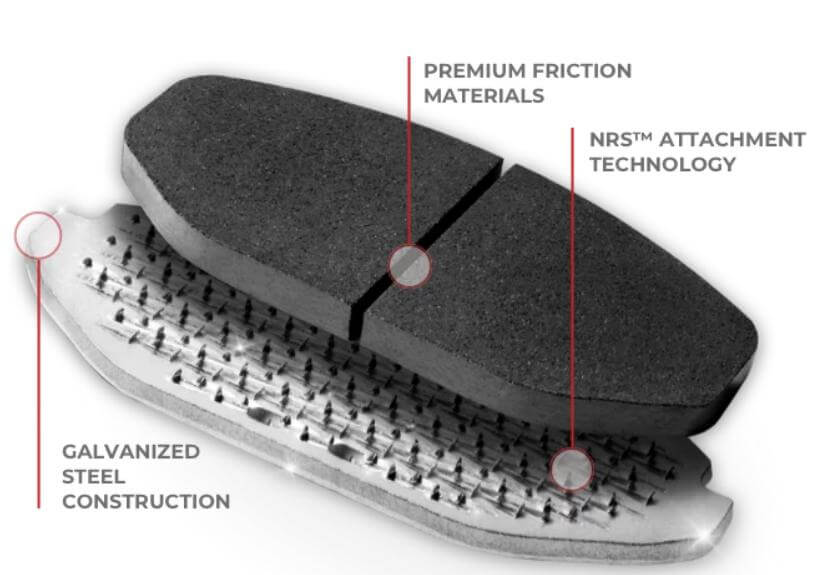
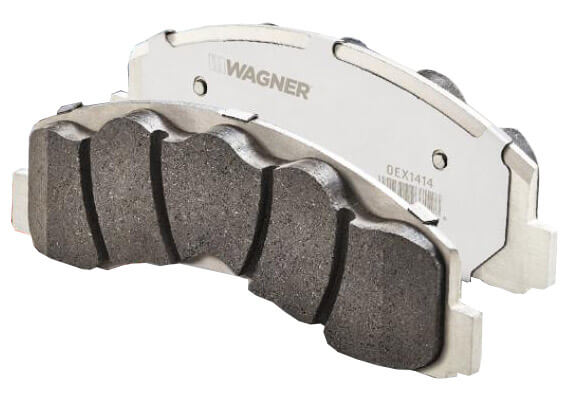
Wagner OEx brake pads use mechanical attachment technology and galvanized steel backing plates.
Don’t Forget Noise Reduction
Premium brake pads include multi-layer noise reduction shims and high-quality anti-rattle clips. These details matter. They prevent squeaks and rattles that cheap pads can’t avoid.

Multi-layer brake pad shim
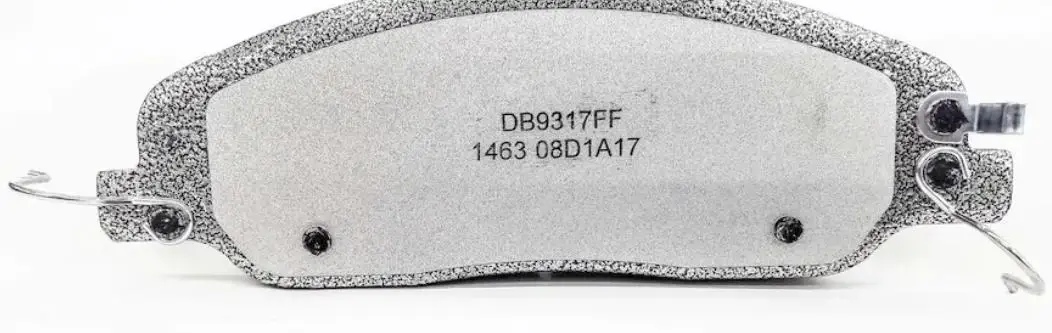
Match the coefficient of friction to the factory pads
The coefficient of friction is listed on the brake pad’s edge codes.
Brands I Trust
I generally stick with manufacturers that supply original equipment or premium aftermarket components. Some of the brands I consistently recommend include:
• Wagner
• Akebono
• Brembo
• Bosch
• ACDelco
These companies have earned solid reputations for engineering, quality control, and consistent braking performance.
I Usually Skip Store Brands
Many auto parts stores promote private-label brake pads with lifetime warranties. That sounds appealing until you realize you’ll be replacing them far more often than you would with a premium set.
A lifetime warranty doesn’t reimburse you for your time, labor, or the frustration of doing another brake job.
I’d rather install a quality set once than replace inexpensive pads every couple of years.
My Advice for Buying the Best Brake Pads
Whenever I buy brake pads, I use this simple checklist:
• Choose ceramic pads for most daily drivers.
• Choose semi-metallic pads for towing or heavy-duty use.
• Buy premium or OE-quality products.
• Look for galvanized backing plates.
• Choose pads with mechanical attachment systems.
• Replace the hardware.
• Match the factory friction rating.
• Don’t sacrifice quality to save a few dollars.
When it comes to brakes, you’re buying safety as much as you’re buying parts. Spending a little more on premium brake pads usually pays for itself through quieter operation, longer service life, and more confident stopping power.
Who are the major players in the brake pad business?
Akebono — Japanese company and Tier 1 supplier. See more below
ACDelco — owned by General Motors and a Tier 1 supplier to GM
Advics — See Aisin Seiki Co, Ltd below
Beck Arnley — see Dr1V division of Tenneco Automotive below
Bendix See — see MAT Holdings and TMD Friction
Brembo — A Tier 1 supplier of brake calipers for Porsche, Mercedes, Lancia, BMW, Nissan, and Chrysler. See more below
Bosch — No longer owned by Robert Bosch. It is now owned by Chassis Brakes International
Monroe — see Dr1V division of Tenneco Automotive
Pagid — See TMD Friction
Wagner — see Dr1V division of Tenneco Automotive
Who are the minor players in the brake pad business?
Dynamic Friction — A small supplier of brake parts. Located in California, the company has 18 employees with annual sales of around $3 million
EBC Brakes— A privately owned company with 400 employees and manufacturing in the U.K. and U.S. EBC products includes brake pads for cars, trucks and SUV, brake rotors (brake discs) for every rolling vehicle on the planet and even brake pads for wind farms, brake pads for military applications such as the Humvee, various armored cars and even tanks, railway brake products and all kinds of industrial vehicle brakes.
Hawk— A small specialty brake manufacturer catering to amateur racers
Power Stop — a smaller brake parts manufacturer and importer. Estimated sales of just $29.4 million/year (source Grojo.com) and 89 employees.
I’m not saying these minor players in the brake parts business make poor products. I’m not aware of any bad products from these companies. It’s just my preference to stick with well-known, nationally recognized brands.
More background on the major players in the brake pad business
Aisin Seiki Co, Ltd
Aisin Seiki Co., Ltd is a Japanese manufacturer of powertrains, chassis, vehicle safety systems, and automotive body parts. The Advics division manufactures brake friction and hydraulic components in 31 plants around the globe
Akebono
Akebono is a 90-year-old Japanese brake manufacturer headquartered in Hanyu, Saitama, and Nihonbashi. Akebono is a Tier 1 supplier of brake parts to Audi, Chrysler, Ford, General Motors, Honda, Isuzu, Mitsubishi, Nissan, Toyota, and Volkswagen.
Akebono has two R&D facilities in the U.S., Japan, and France. They manufacture brake parts in 30 company-owned and affiliate facilities worldwide, including two production facilities in Kentucky, one in Tennessee, and one in South Carolina.
Brembo
Started in 1961 in Italy by Emilio Bombassei and Italo Breda, the company began making brake discs. In 1972, Brembo began supplying Moto Guzzi. In 1975, Enzo Ferrari asked Brembo to equip the most prestigious Formula 1 racing cars. It was not long before Brembo was the leading name in the motorsports braking systems segment.
In the 1980s, Brembo developed an aluminum brake caliper, which was adopted for high-performance vehicles from Porsche, Mercedes, Lancia, BMW, Nissan, and Chrysler. Brembo later became a Tier 1 supplier to Iveco and Renault Industrial Vehicles.
In the 2000s, Brembo acquired Alfa Real Minas, a Brazilian manufacturer of brake discs and engine flywheels. Brembo also acquired the British company AP Racing Limited, manufacturer of brake and clutch systems for race cars, motorcycles, and high-performance sports cars. Brembo also acquired Marchesini, a manufacturer of magnesium racing motorcycle wheels.
Dr1V division of Tenneco Automotive
• Abex friction products
• Beck/Arnley
• Ferodo brake parts for European vehicles
• Jurid brake products for German vehicles
• Monroe brakes
• Wagner brake products
• Walker Exhaust products
Beck/Arnley — a direct importer of parts for foreign vehicles. Beck/Arnley purchases replacement parts directly from the Tier 1 suppliers to foreign vehicle manufacturers.
Champion Spark Plugs
Fel-Pro Gaskets
FP Diesel— replacement parts for diesel engines
Monroe shocks and struts
Moog steering and suspension parts
National Bearings and Oil Seals
Sealed Power — piston rings and replacement engine parts
Speed Pro — engine parts including pistons and valves
Mat Holdings Inc
Licensed the Bendix brand from Honeywell for distribution in the U.S.
MAT Holdings Inc. is a Tier 1 brake parts supplier to automakers: General Motors, Ford, Mercedes-Benz, BMW, Audi, Jaguar, Land Rover, Volkswagen, Nissan, TRW, Continental Teves, Bosch, WABCO, and Knorr-Bremse. MAT Holdings manufactures over 24 million sets of passenger brake pads per year under various names and private-label brands. They manufacture their own friction material, shoes, shims, backing plates, rotors, calipers, and carriers. MAT Auto Group supplies high-performance OEM products to auto racing companies AP Racing, Brembo, Hi Spec Motorsport, and Maxx Autosport.
TMD Friction, a Nisshinbo Group Company
Manufacturers brake parts under the Bendix (outside the U.S.) Textar, Mintex, Don, Pagid, Corbrecq and Nisshinbo brands
My favorite brand is Wagner, because they were one of the first brake pad manufacturers to offer galvanized steel backing plates with a mechanical attachment system. That’s pretty innovative because most brake pad manufacturers are still using common painted black steel backing plates and glue to attach the friction material.
© 2012 Rick Muscoplat
Posted on by Rick Muscoplat