
Can a Transmission Flush Fix Shifting Problems or Slipping?
Transmission Flush And Shifting/Slipping Problems: When It Works and When It Doesn’t
Quick Summary
A transmission flush might fix shifting or slipping problems, but only under very specific conditions. If the transmission fluid is simply old, or the friction modifiers have worn out, replacing nearly all the automatic transmission fluid (ATF) with a flush can sometimes restore proper hydraulic pressure and clutch engagement. However, if the transmission fluid is burned, with a black or dark brown appearance and a burned smell, that’s an indication of a worn-out transmission, and a flush won’t fix the underlying problems. In fact, performing a flush on a badly worn transmission can actually make the problem worse.
Article
What a Transmission Fluid Does
Transmission fluid serves several critical purposes:
• It lubricates internal components
• It cools the system, and, in automatic transmissions,
• It provides the hydraulic pressure needed to shift gears
• It contains friction modifier additives to help clutches and band engage and hold
• It contains detergents to remove varnish deposits from areas exposed to overheated and oxidized fluid.
What Causes Transmission Fluid to Degrade?
Overheating Degradation: Every time the transmission cycles through normal operation, fluid temperatures routinely climb above 175°F.
For every 20°F rise above the fluid’s optimal operating range, the rate of oxidative degradation roughly doubles — a well-established principle in lubrication chemistry that makes heat management central to any discussion of fluid longevity.
What causes overheating?
• Towing and hauling are among the most common causes of overheating in everyday use.
• Cooling failures: Some vehicles have free-standing transmission fluid coolers, while others incorporate a transmission cooling inside the radiator. In those cases, if the engine overheats due to radiator fan failure or a clogged radiator, the transmission also overheats.
• Sustained high-speed driving in desert conditions.
Fluid Temp VS. Transmission Life Expectancy
175°F = 100,000+ miles
190°F = 90,000 miles
210°F = 55,000 miles (Pressure Drops)
230°F = 25,000 miles (Valves Stick)
250°F = 17,000 miles (Varnish Forms)
270°F = 4000 miles (Seals & Clutches Burn)
300°F + = TRANSMISSION FAILURE
Shear Degradation: ATF, like motor oil, contains viscosity improver (VII) additives. VII additives are long-chain polymer molecules that “uncoil” as heat increases, resulting in increased viscosity. As the fluid cools, the molecules resume their coiled shape, lowering viscosity.
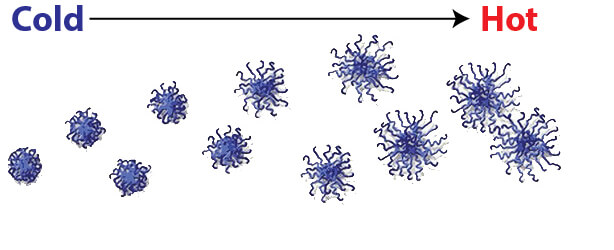
Viscosity improver polymers uncoil/expand as they heat
Shear occurs when the transmission is under heavy load or when bearings, bands, or clutches wear and slip. When a polymer chain is mechanically severed, it stays severed. Those shorter fragments can’t perform the same viscosity-regulating function the intact chain once did, and no amount of cooling or chemical intervention restores them. In other words, shear damage is permanent and cumulative. The result is a fluid that is thinner than it should be, particularly at operating temperature, and can no longer maintain the film thickness that the transmission’s engineers designed for. Over time, a highly sheared fluid behaves more like a lower-viscosity oil, leading to inadequate hydraulic pressure, reduced lubrication between moving components, and accelerated wear on the very parts the fluid is meant to protect.
Oxidation Degradation: As ATF molecules react with dissolved oxygen under elevated temperatures, they form acids, varnish, and sludge — byproducts that are corrosive to seals, clutch packs, and valve body components. The antioxidant additives blended into the fluid are designed to neutralize these reactions, but they are finite resources. This is why fluid that has been neglected beyond its service interval doesn’t simply continue degrading at a steady rate — it deteriorates rapidly once the additive package is exhausted.
What degraded transmission fluid does to a transmission
• It fails to lubricate properly, causing accelerated metal, clutch, and band wear. Clutch and band wear cause slip, which creates more heat and even more overheating.
• Deposit formation: Oxidized ATF forms varnish deposits inside the transmission.
• Seal degradation. The excessive heat causes seals to harden and crack, leading to pressure loss and more slip.
Can a Transmission Flush Fix Shifting Problems or Slipping? An Expert’s Real-World Explanation
As someone who has diagnosed and repaired transmissions for decades, I can tell you that one of the most common questions drivers ask is whether a transmission flush fixes shifting problems or slipping issues. Quick-lube shops often market transmission flushes as a miracle cure. The truth, however, is more complicated.
In some situations, a transmission flush fixes shifting problems almost immediately. In other cases, it does nothing—or worse, it pushes a worn transmission over the edge.
To understand why, you first have to understand what transmission fluid actually does and how automatic transmissions work.
When a Transmission Fluid Flush Might Actually Fix the Problem
• If the shifting issues are caused by dirty or contaminated fluid— If the transmission fluid is dirty or contaminated, it can affect the transmission’s performance. Flushing out the old fluid and replacing it with fresh fluid can improve shifting and overall operation.
• If the shifting issues are due to fluid breakdown— The friction modifiers in the transmission fluid can wear out, resulting in a loss of friction grip that causes the clutch discs and steel separators to slip. A transmission fluid flush can sometimes help restore the gripping action in the clutch packs, giving you better shifting.
• Debris and Deposits— Deposits and debris can accumulate in the transmission and affect its performance. A flush can help remove these contaminants and improve shifting.
Under those conditions, replacing the degraded fluid with fresh fluid can restore the correct friction properties.
I’ve seen vehicles come in with delayed shifts or mild slipping, where fresh fluid made the transmission feel completely normal again.
When a Transmission Flush Can’t Fix Slipping
• The seals have cracked due to heat and aging, resulting in pressure leaks in the clutch packs and band servos.
• The clutch discs are worn out.
• The bands are worn out
• There’s wear in the valve body
• The transmission pump is worn out and can’t produce enough pressure
If your transmission is already failing internally, a transmission fluid flush won’t save it. In fact, it could accelerate the failure. Let me explain.
Older fluid becomes contaminated with friction material from the clutch packs. That gunk can sometimes mask problems by increasing internal pressure and helping hold slipping clutches together. When you flush that out, you lose that “false support,” and what was a minor issue can turn into total failure within days.
Here are some warning signs that your transmission is already on its way out; performing a flush might do more harm than good:
• The fluid is black or smells like burned toast
• The transmission is slipping severely or won’t engage at all
I’ve seen it firsthand: customers who ignored fluid changes for 100,000 miles bring their car in for a flush because it started slipping, only for the transmission to fail completely a week later. By then, it’s too late.
In some cases, a transmission flush can make shifting problems even worse or cause total failure
If your transmission fluid is dark brown or black, 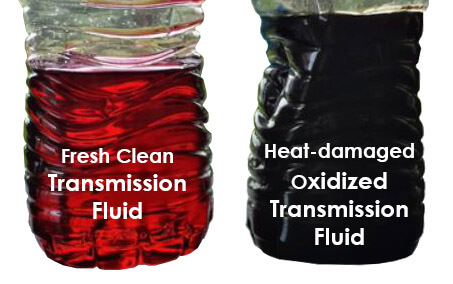 that’s a sign of severe fluid breakdown caused by overheating and clutch wear. Performing a fluid flush on a worn transmission with burnt fluid carries a big risk of total failure following the flush. There are several theories on why this happens:
• Overheating causes the transmission fluid to break down, leaving varnish deposits in high-friction areas. New fluid dissolves the varnish buildup, resulting in excessive clearances and pressure loss.
• Debris from fluid breakdown often settles in the cracks of seals. Fresh fluid cleans out the debris, causing pressure leakage and complete clutch pack failure.
• A fluid flush stirs up debris that has settled on the bottom of the transmission pan, causing it to spread throughout the transmission, clogging passages and accelerating wear on already worn parts.
How a transmission clutch pack works
Automatic transmissions use several clutch packs.
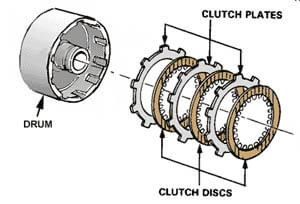
A transmission clutch pack includes a clutch drum, clutch friction discs, clutch plates (often called “steels:) and a piston and lip seal
Think of a clutch pack like a coffee can with a shaft running through the middle. The pack is loaded with alternating steel discs and clutch discs. The clutch discs have teeth on their inner diameter and engage with the shaft, while the teeth on the steel plates engage with the clutch drum. The entire disc pack fits into the clutch drum, and a piston and lip seal are added, along with a locking ring.
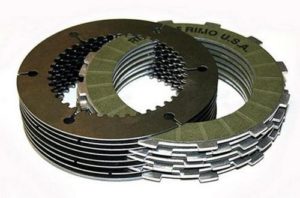
Alternating clutch discs and steel discs
When the clutch pack isn’t needed, a large band tightens around the clutch drum to prevent it from turning. There’s no fluid pressure inside the drum, so when the shaft spins, it turns the clutch discs freely. However, when the transmission requires that gear, it applies fluid pressure to the drum, causing the clutch discs to engage the steel discs. So the turning
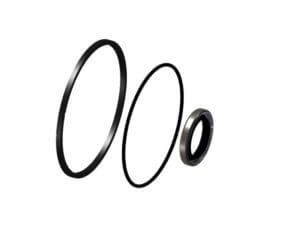
Clutch pack piston lip and shaft seals
shaft then rotates the clutch discs, which are held against the steel disc due to the high pressure. Since the steel discs are splined to the drum, the entire drum turns, and the gear mounted on the end of the drum provides a different gear ratio.
What goes wrong with a transmission clutch pack?
The piston lip seal is the most critical component of a clutch pack. Automatic transmission fluid can get very hot; over time, that hot fluid can cause rubber seals to harden and crack. If the clutch pack lip seal develops cracks, the discs inside will slip instead of being held solidly against one another. That slipping action causes the clutch discs to heat up and deteriorate. That extra heat further degrades the transmission fluid, and the wear particles can clog cracks in the clutch piston lip seal. The particles can help the lip seal create a better seal, but it’s not a lasting fix because the particles flush out, leaving the cracks open to pressure loss again.
Which transmission fluid additives help shifting issues?
Lots of companies make transmission fix additives. Most of these
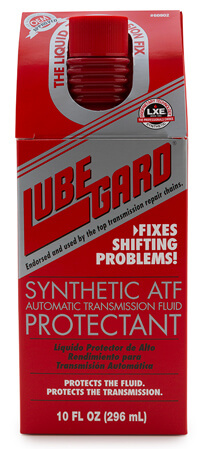
Lubeguard Automatic Transmission Protectant
“Miracle in a Bottle” products don’t work. They’re simply seal swellers that soften rubber seals, making them seal better. But the fix doesn’t last. I recommend only one product, and it’s the same product endorsed by most car makers: Lubeguard. Most transmission rebuilders add this additive after a transmission rebuild. I’ve used it, and I highly recommend it.
When added after a transmission fluid flush, LUBEGARD ATF Protectant reconditions seals, reduces “shudder” caused by frictionally depleted fluid. Shudder is often referred to as “stick slip.” The ingredients in Lubeguard ATF protectant help solve shudder problems. In addition, Lubeguard ATF protectant raises the transmission fluid’s thermal and oxidative stability and increases the fluid’s ability to transfer heat.
The other Lubeguard product that helps is Lubeguard Instant Shudder Fixx
Lubeguard Instant Shudder Fixx contains a specially formulated
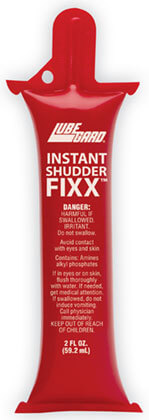
Lubeguard Instant Shudder Fixx stops the shudder when the transmission shifts into overdrive
friction modifier designed to instantly eliminate torque converter lock-up shudder. Lock-up shudder occurs during the “lock-up” phase when the torque converter provides 1:1 power to the transmission. In the process of locking up, the torque converter turbine locks to the clutch and rear housing. If slipping occurs during the pressure lockup, you get a momentary shudder. Lubeguard Instant Shudder Fixx eliminates the shudder when shifting into overdrive.
©, 2017 Rick Muscoplat
Posted on by Rick Muscoplat