
Car Won’t Start With a Jump? Here’s What to Check First
Car Won’t Start With a Jump? Here’s What to Check Before You Call a Tow Truck
Quick Summary
If your car won’t start with a jump, don’t assume you need a new starter or an expensive repair. In my experience, the problem is often much simpler, usually caused by:
• Cheap jumper cables that don’t carry enough current
• A battery that’s too deeply discharged to accept a charge
• Corroded battery terminals that create too much electrical resistance
• Poor cable connections account for most failed jump-start attempts.
Before you call for a tow truck, follow a systematic diagnostic process to determine what to check if a jump won’t start a car. In many cases, you’ll have the engine running in just a few minutes.
The Most Common Reasons Your Car Won’t Start With a Jump
1) Your Battery May Be Too Dead or Damaged to Accept a Jump — The most common mistake DIYers make is assuming that the donor vehicle powers your starter directly.
When you connect both batteries with jumper cables, you’re essentially wiring them in parallel. The good battery has a higher voltage (a healthy battery is ~12.6V, while a dead one might sag to 10V or lower), so current flows from the good battery to the dead one until the system tries to start the engine. Once you turn the key, the starter motor draws a large current (often 100-300+ amps), and that current is supplied mostly by the good battery, flowing through the cables, through the dead battery’s terminals, and on to the starter.
However, a battery that’s been deeply discharged for a long time, or one with a shorted/sulfated internal cell, can prevent the jumping power from reaching the starter. If it’s truly dead (not just discharged), no amount of jumper current will fix that.
2) You haven’t allowed enough time for the dead battery to recharge — Always allow some time to charge the dead battery before trying to start the engine. This lets some charge transfer in and raises the terminal voltage slightly. Cranking immediately on a severely dead battery sometimes just isn’t enough.
• Connect the cables correctly.
• Start the donor vehicle.
• Let it idle for 10 to 15 minutes.
• Increase engine speed to about 1,500 RPM for several minutes.
• Then try starting the disabled vehicle.
Many vehicles that initially refuse to crank will start after the battery receives enough surface charge.
3) Your battery terminals are corroded — Corroded battery terminals create high resistance, significantly reducing the power delivered to the dead vehicle. It takes just a few extra minutes to remove the terminals and clean the posts to ensure good contact.
My procedure is simple:
• Disconnect the negative cable.
• Remove the positive cable.
• Clean both battery posts.
• Clean the inside of each terminal.
• Reinstall securely.
• Attempt another jump.
4) You don’t have a good ground connection — Many people clamp the negative cable onto painted metal or rusty brackets. That dramatically increases resistance.
For maximum current flow:
• Clamp directly onto clean, bare metal.
• Avoid painted surfaces.
• Avoid greasy brackets.
• Wiggle the clamp slightly so the teeth bite into clean metal.
• Verify each clamp is tight.
I’ve seen dozens of vehicles start immediately after simply repositioning one cable.
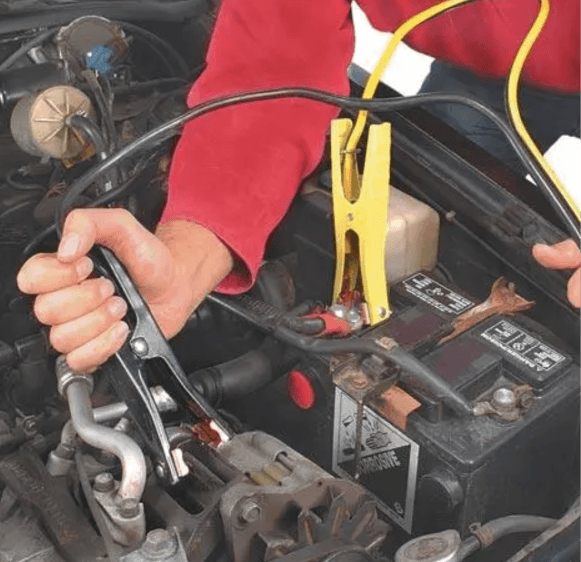
Connect the negative cable to a clean ground connection
A clean connection can easily make the difference between a crank and a no-crank condition.
5) You’re using cheap jumper cables — Cheap jumper cables are a common reason a car won’t start with a jump — This surprises many people, but inexpensive jumper cables are responsible for countless failed jump-starts. Thin cables can’t carry enough current
Most bargain jumper cables use 8-, 10-, or even 12-gauge wire. While they may look substantial because of thick insulation, the copper conductor inside is often much smaller than advertised.
A typical starter motor needs:
• 150 to 250 amps on many four-cylinder engines
• 250 to 400 amps on larger V6 and V8 engines
• Even more during cold weather
Small cables simply can’t deliver that much current.
Here’s a simple analogy: current flow is like water flow; if you use too small a pipe, you can’t flow much water. The same concept applies to cheap jumper cables; thin, undersized jumper cables create excessive voltage drop, leaving the starter with insufficient power.
I recommend using:
• 2-gauge cables for most passenger vehicles
• 1-gauge or 1/0-gauge cables for trucks and SUVs
• Copper cables rather than copper-clad aluminum
• Cable lengths under 20 feet whenever possible
See this post on jumper cable basics and how wire gauge and cable length determine how much power they can carry.
What to Do Next if Your Car Still Won’t Start With a Jump
If you’ve tried everything above and the car won’t jump start, here’s what I recommend checking next:
• Test the alternator – A failed alternator can drain a battery overnight.
• Check for parasitic drains – Something may be killing the battery when parked.
• Fully charge the battery with a charger – A jump cannot recover a severely depleted battery.
• If the battery fails a load test after charging, replace it.
How to clean battery terminals
Test your alternator
Find what’s draining your battery
Charge your battery
©, 2014 Rick Muscoplat
Posted on by Rick Muscoplat