
Causes of Turbocharger failure — Causes and Prevention Tips
Understanding the Causes of Turbo Failure
Quick Summary
A Lack of clean oil is the #1 cause of turbocharger failure. In addition, these other issues account for the rest of turbo failures.
• Oil starvation
• Oil contamination
• Overheating
• Foreign object damage
In fact, industry rebuilders report that more than 90% of failed turbochargers are damaged by lubrication issues rather than manufacturing defects.
Turbo failure is most often caused by oil contamination or oil starvation
In fact, according to btnturbo.com, a major rebuilder of replacement turbochargers, 95% of all turbocharger failures are due to oil or foreign object damage, not manufacturing defects.
The good news is that most turbo failures are preventable. Understanding the early warning signs of turbo failure, recognizing turbocharger oil starvation symptoms, and following proper maintenance practices can dramatically extend turbocharger life.
What Causes Turbocharger Failure?
I’ve diagnosed many failed turbochargers over the years, and one thing becomes clear very quickly: turbochargers rarely fail on their own.
Modern turbochargers are engineering marvels. Some spin at speeds approaching 300,000 RPM while enduring exhaust temperatures exceeding 1,800°F. Under those extreme conditions, even a small maintenance mistake can dramatically shorten turbo life.
When drivers ask me, “What causes turbocharger failure?” I tell them to think of a turbocharger as a high-speed machine that depends entirely on a constant supply of clean, cool oil. Remove that protection and failure isn’t a matter of if—it’s a matter of when.
Let’s look at the most common causes.
1) Oil Starvation: The Number One Turbo Killer — The leading cause of turbocharger failure is oil starvation. Turbocharger bearings ride on an extremely thin film of pressurized engine oil. If oil flow drops even briefly, metal-to-metal contact occurs, generating heat and rapid wear. Once bearing damage begins, failure can occur quickly.
Common Causes of Oil Starvation
• Running the engine low on oil
• Using the wrong oil viscosity
• Clogged turbo oil feed lines
• Restricted oil return lines
• Worn oil pump
• Sludge buildup inside the engine
• Poor-quality oil filters
• Turbocharger Oil Starvation Symptoms
Watch for these warning signs:
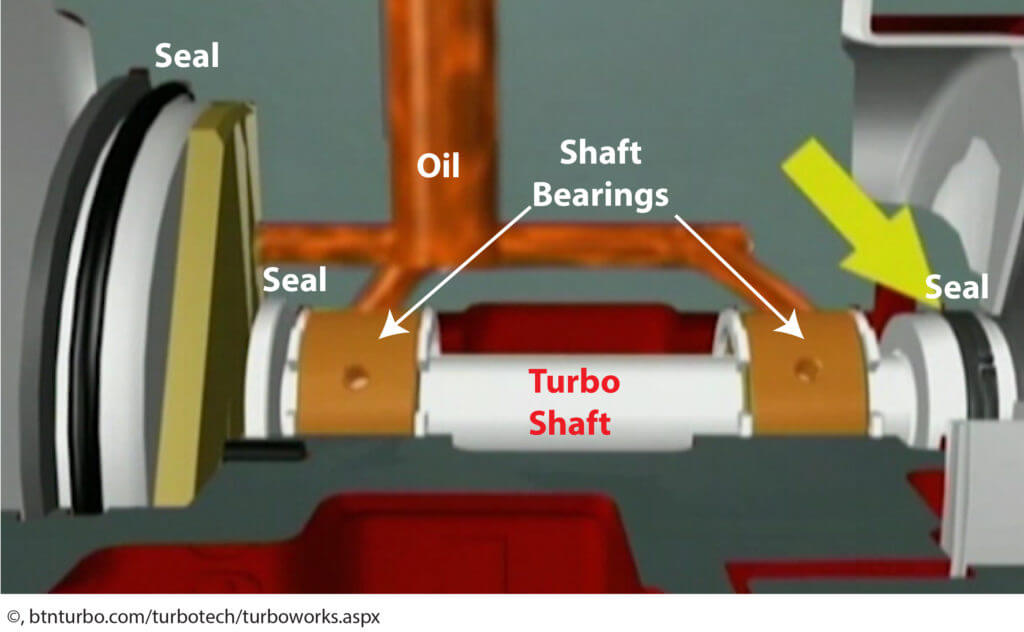
Lack of oil or contaminated oil are the primary causes of Turbocharger failure
• High-pitched whining noise
• Siren-like turbo sound
• Excessive shaft play
• Reduced boost pressure
• Blue exhaust smoke
• Loss of engine power
• Turbocharger overheating
Turbo bearings don’t use traditional ball bearings like wheel hubs. Most rely on floating journal bearings that require continuous oil pressure to keep metal surfaces separated.
When oil flow is interrupted:
• Bearings overheat.
• Bearing surfaces wear.
• Shaft clearances increase.
• Oil seals begin leaking.
• Compressor and turbine wheels contact the housing.
• Complete turbo failure follows.
I’ve seen many cases where a driver ignored a minor turbo whine for months, only to discover the turbo had destroyed itself internally. failure.
2) Oil Contamination Destroys Turbos from the Inside Out — Even when adequate oil pressure exists, contaminated oil can destroy a turbocharger.
Engine oil naturally collects:
• Carbon particles
• Soot
• Metal debris
• Dirt
• Fuel dilution
• Moisture
These contaminants act like liquid sandpaper inside the turbocharger. As abrasive particles circulate through the bearing housing, they wear away bearing surfaces and enlarge oil clearances. Eventually, oil pressure drops and turbo performance suffers.
What Causes Oil Contamination?
• Extended oil change intervals
• Frequent short trips
• Cheap oil filters
• Engine sludge buildup
• Internal engine wear
• Fuel contamination
This is one reason turbocharged engines are far less forgiving of neglected maintenance than naturally aspirated engines.
3) Foreign Object Damage Can Destroy a Turbo Instantly — The third major cause of turbocharger failure is foreign object damage. Because turbochargers move enormous volumes of air, anything entering the intake system can become a projectile.
Common culprits include:
• Dirt and sand
• Loose screws
• Broken air filter material
• Shop rags
• Intake duct fragments
• Pieces of damaged engine components
I’ve seen compressor wheels destroyed by a single loose hose clamp screw accidentally left inside an intake tube.
Signs of Foreign Object Damage
• Sudden loss of boost
• Loud rattling noises
• Whistling sounds
• Visible blade damage
• Check engine light
• Metal fragments in intake piping
4) Overheating and Heat Soak Damage Turbochargers — Turbochargers live in one of the hottest environments on the vehicle. Exhaust gases routinely exceed temperatures that would quickly destroy most engine components.
Common Causes of Turbo Overheating
• Heavy towing
• Extended high-speed driving
• Aggressive performance driving
• Cooling system problems
• Restricted oil flow
• Immediate engine shutdown after hard driving
One mistake I frequently see is shutting off a hot turbocharged engine immediately after towing or spirited driving. When the engine stops, oil circulation stops. The trapped oil can literally bake inside the turbo housing, creating carbon deposits that restrict future oil flow. This process, called “coking,” is a common contributor to premature turbo failure.
5) Turbo Overspeed Can Destroy the Compressor Wheel — Turbochargers are designed to operate within specific speed limits. When boost pressure exceeds design limits, the turbo can overspeed. When a turbo overspeeds, centrifugal forces
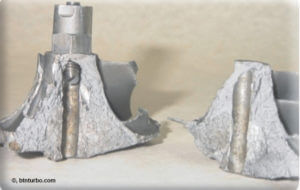
Turbine damage from overspeed
can cause turbine or compressor wheel failure. The results are often catastrophic.
Turbos are designed to handle a range of speeds. But if you exceed those speeds, the turbine blades can come apart, or the bearing may not be able to handle the load.
6) Turbo failure can also be caused by material fatigue and manufacturing defects
Turbochargers are subjected to extreme stresses, and over time, the materials can fatigue and fail. Additionally, manufacturing defects can lead to early failure.
Factors Contributing to Material Fatigue:
• Repeated thermal cycling— The constant heating and cooling cycles can cause thermal fatigue, leading to cracks and other failures.
• Vibration and shock loads— Engine vibrations and sudden shocks can stress the turbocharger components, particularly if the vehicle is driven aggressively.
Less than 1% of turbos fail because of manufacturing defects. Most failures are caused by the three ‘turbo killers’ of oil starvation, oil contamination and foreign object damage.
Overspeed conditions may result from:
• Faulty wastegates
• Sticking variable vane systems
• Incorrect aftermarket tuning
• Boost control solenoid failures
• Intake restrictions
Early Warning Signs of Turbo Failure
Catching problems early can save thousands in repair costs. Watch for these early warning signs of turbo failure:
Performance Symptoms
• Loss of acceleration
• Reduced boost pressure
• Poor fuel economy
• Sluggish throttle response
• Noise Symptoms
• Whining noise
• Siren sound
• Grinding sounds
• Metallic scraping
• Exhaust Symptoms
• Blue smoke
• Black smoke
• White smoke
• Excessive oil consumption
Diagnostic Symptoms
• Check engine light
• Boost pressure codes
• Overboost codes
• Underboost codes
The earlier these issues are addressed, the better your chances of avoiding complete turbocharger replacement.
How to Prevent Turbocharger Failure
Fortunately, learning how to prevent turbocharger failure is straightforward.
Follow These Turbo-Saving Habits
• Check oil level regularly
• Use only the manufacturer-specified oil viscosity and API rating
• Change oil on the right schedule. Most drivers follow the Normal service schedule when they actually drive according to the severe service schedule.
• Replace oil filters with quality parts
• Inspect intake plumbing for leaks
• Replace dirty air filters promptly
• Allow proper engine warm-up
• Let the engine idle briefly after heavy use
• Fix boost leaks immediately
A• ddress check engine lights promptly
These simple steps can help a turbocharger last well beyond 150,000 miles.
Final Thoughts on Turbocharger Failure Causes and Symptoms
When people ask me about the causes and symptoms of turbocharger failure,
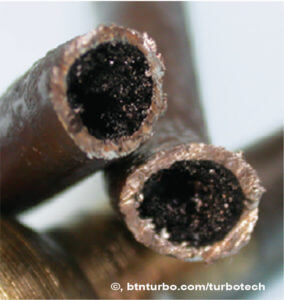
Clogged turbo oil lines are a major cause of Turbocharger failure
I always come back to one fundamental principle: oil is the turbocharger’s lifeblood.
Most failed turbochargers are victims of neglected maintenance, contaminated oil, oil starvation, overheating, or foreign object damage. Manufacturing defects are actually quite rare.
If you monitor oil condition, pay attention to unusual noises, and act quickly when you notice the early warning signs of turbo failure, there’s a very good chance your turbocharger will provide years of reliable service.
©, 2018 Rick Muscoplat
Posted on by Rick Muscoplat