
Common Kitchen Sink Leak Spots and How to Fix Them
Identifying Common Kitchen Sink Leak Spots
Quick Summary
The kitchen sink drain is a simple but carefully engineered plumbing assembly that moves wastewater from your sink to the home’s drainage system while preventing sewer gases from entering the kitchen. The system begins with the basket strainer, continues through the tailpiece and into a double basin tee or directly into the P-trap, and trap arm connected to the home’s drain line.
Most leaks occur at:
• The basket strainer putty seal
• The basket strainer rubber gasket located directly under the sink.
• The flanged gasket between the tailpiece and the basket strainer
• The beveled washers
• The P-trap connections.
When properly assembled, the kitchen sink drain relies on gravity, smooth pipe surfaces, and correctly compressed gaskets to move water efficiently and prevent leaks.
Understanding the Parts of a Kitchen Sink Drain and How It Works
The Basket Strainer: The Starting Point of the Kitchen Sink Drain
The first component of every kitchen sink drain is the basket strainer. This is the metal drain assembly installed through the hole in the bottom of the sink.
The basket strainer consists of several parts:
• Flange – the visible rim inside the sink
• Basket – the removable strainer that catches food particles
• Strainer body – the threaded section that passes through the sink
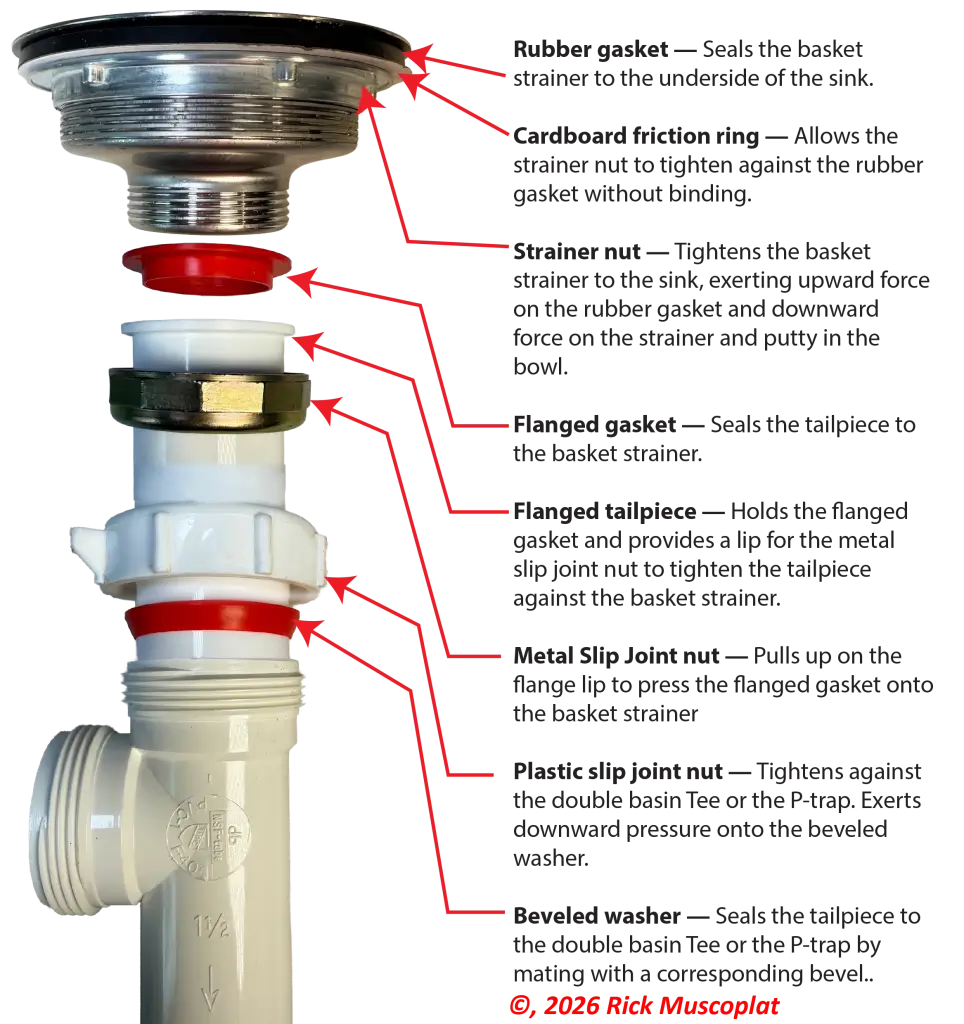
• Rubber gasket and fiber washer – seals the drain assembly to the bottom of the sink.
• Locknut – tightens the strainer to the sink
The basket strainer’s job is twofold. First, it allows water to enter the drain system. Second, it captures debris before it reaches the piping.
There are three common types of basket strainer designs: Cup, Strainer Nut, and Spin-on.
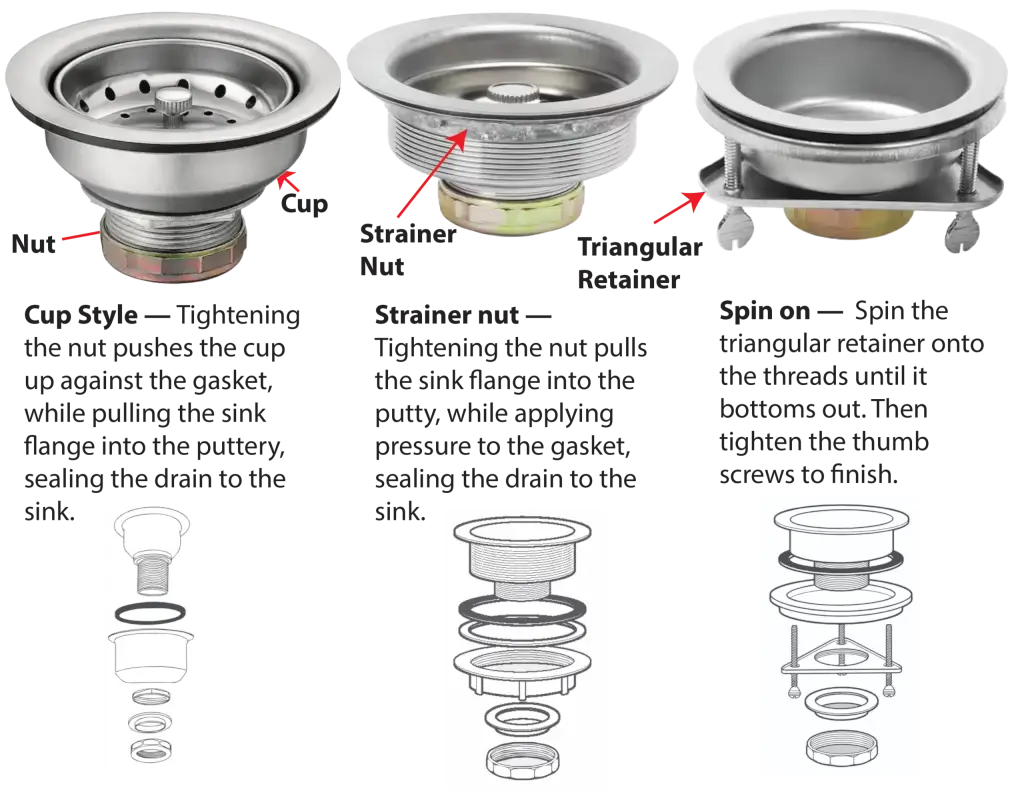
Pros and Cons of Each Type of Basket Strainer
Cup style — Pro: Faster and easier to install than the strainer nut style because the nut is much smaller. Press the sink flange into the putty. Install the rubber gasket and cup, and screw on the nut.
Con: 1) More prone to leaking than the other two styles, and the leak is less noticeable until the cup rusts out, and it becomes a large leak. 2) Very difficult to remove once rusted. The nut has to be cut off.
Strainer Nut — Pro: Least expensive.
Con: 1) The strainer body tends to rotate as you tighten the strainer nut, forcing you to hold the body with another tool while tightening. 2) The strainer nut corrodes to the body, making it impossible to unscrew later. You have to cut it off.
Spin-on — Pro: Easiest to install and easiest to remove.
Con: Most costly of the other two designs.
The strainer basket is a common source of leaks
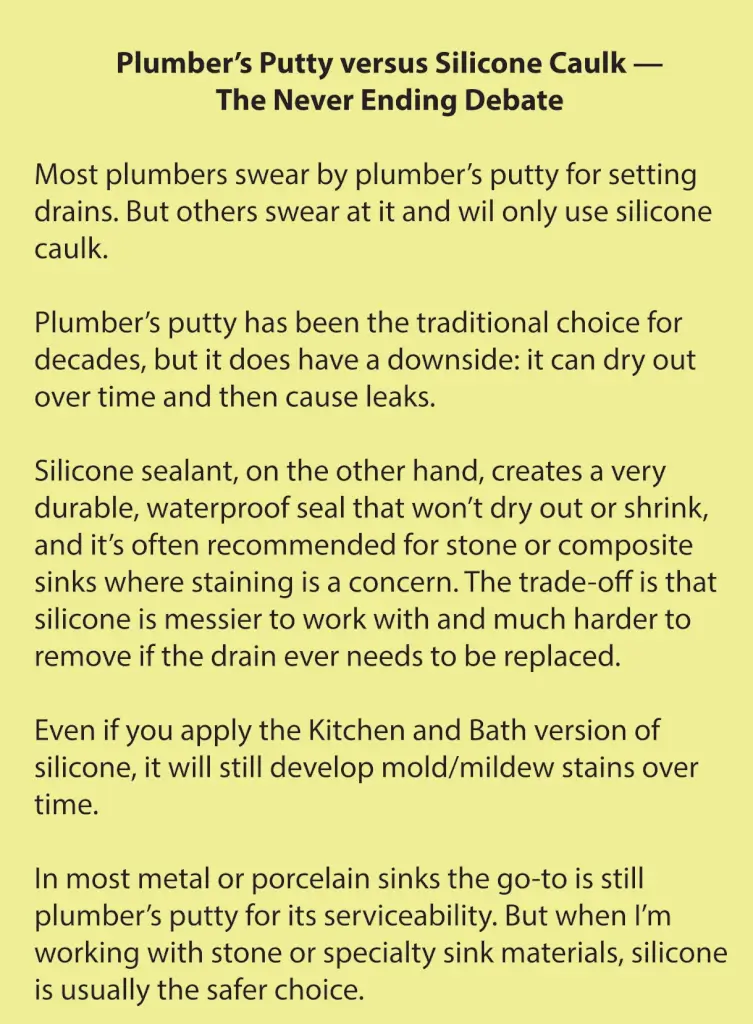 One of the most common spots for a kitchen sink leak is right here at the basket strainer.
Over time, the plumber’s putty dries out, cracks, and loses its seal. Or the rubber gasket ages and shrinks. Once that happens, water leaks past the drain, corroding the cup and nut, strainer nut, or the spin-on device.
Once the putty seal is breached, the only way to stop the leak is to remove the basket strainer, clean out all the old putty and replace it with new putty or silicone, and install a new basket strainer.
The Tailpiece Flange Gasket: If it’s misaligned, loose, or cracked, it’ll leak.
The tailpiece is usually made of PVC, ABS, brass, or chrome-plated brass and attaches using a special flanged gasket
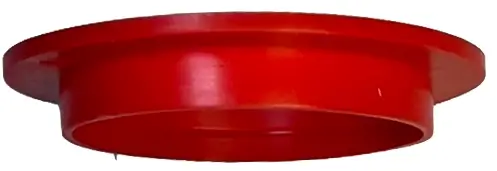
Flanged tailpiece gasket
and a slip-joint nut. The flanged gasket is what seals the tailpiece tube to the basket strainer, not the threads on the slip joint nut. The gasket can be made of a rubber-like material or a harder polythylene.
The flanged tailpiece gasket can cause leaks if the slip joint nut is loose, the gasket becomes misaligned after vigorous plunging, or if it is damaged by heat or drain-cleaning chemicals.
Beveled Washer: It’s what seals the tailpiece, continuous waste Tee, extensions, and P-trap
If your kitchen has two bowls, there 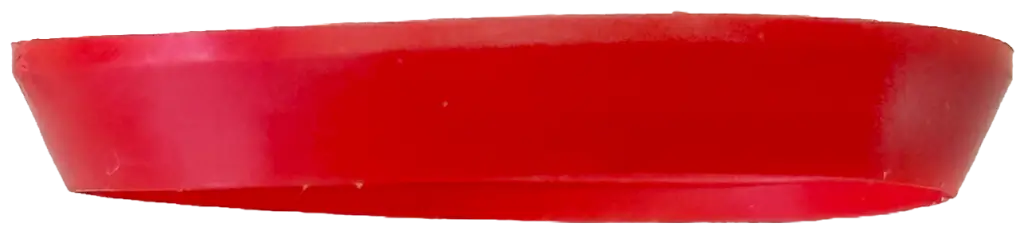 will be an additional component called the continuous waste pipe. This pipe connects the two sink drains together before the water reaches the trap. The assembly typically includes:
• Horizontal waste pipe
• Tee fitting
• Slip nuts and washers
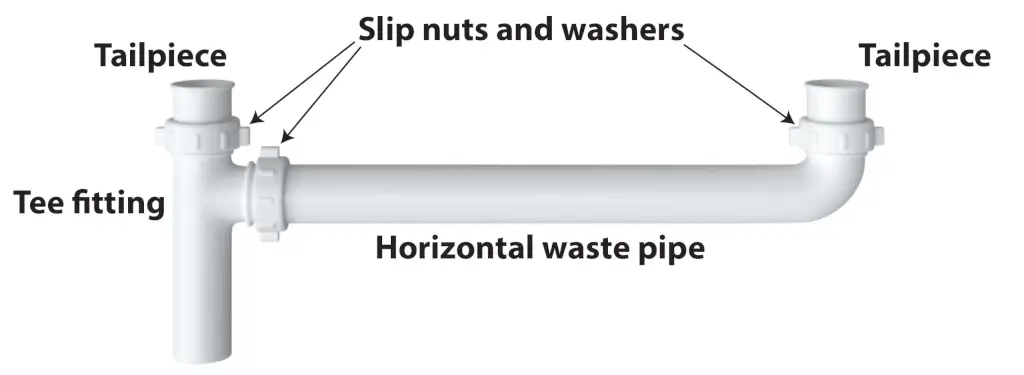
Water from one bowl flows through the waste arm and merges with the water from the other sink before entering the trap.
Many kitchen sink leak spots appear in this section because the assembly uses multiple slip joints with beveled washers that can loosen over time.
The P-Trap: A Common Leak Spot
The P-trap is the curved pipe section located beneath the sink. In my opinion, this is the most important component of the entire kitchen sink drain system.
The trap performs a critical function: it holds water, creating a seal that prevents sewer gases from traveling up the drain line and entering the home. The trap consists of two pieces:
• Trap bend – the curved section
• Trap arm – the horizontal pipe leading to the wall drain
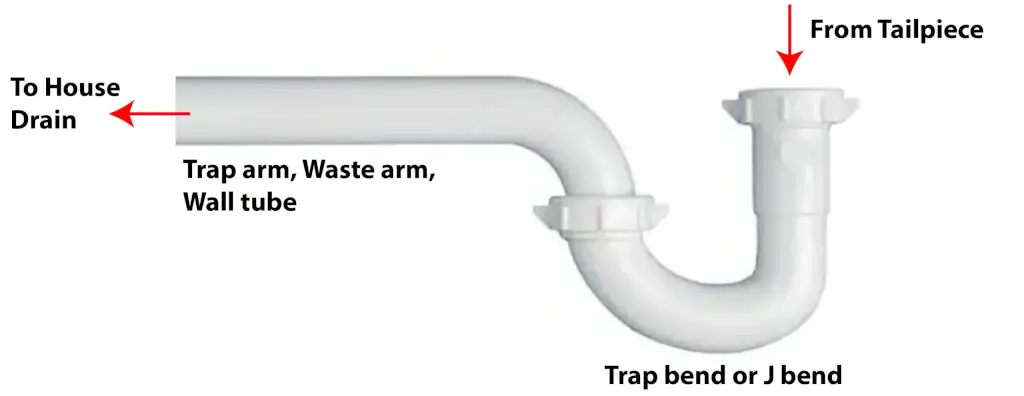
As wastewater flows down the drain, it fills the trap and spills over the bend into the trap arm. A small amount of water always remains behind. This water seal is why the trap is required by plumbing codes.
Another benefit of the P-trap is that it captures debris. Small items like rings or food particles often settle here rather than traveling further into the plumbing system.
The P-trap connects to the tailpiece on one end and the trap arm on the other. The connection to the trap arm is gasket-free; it seals by compressing the beveled end of the trap arm to a corresponding bevel in the J-bend.
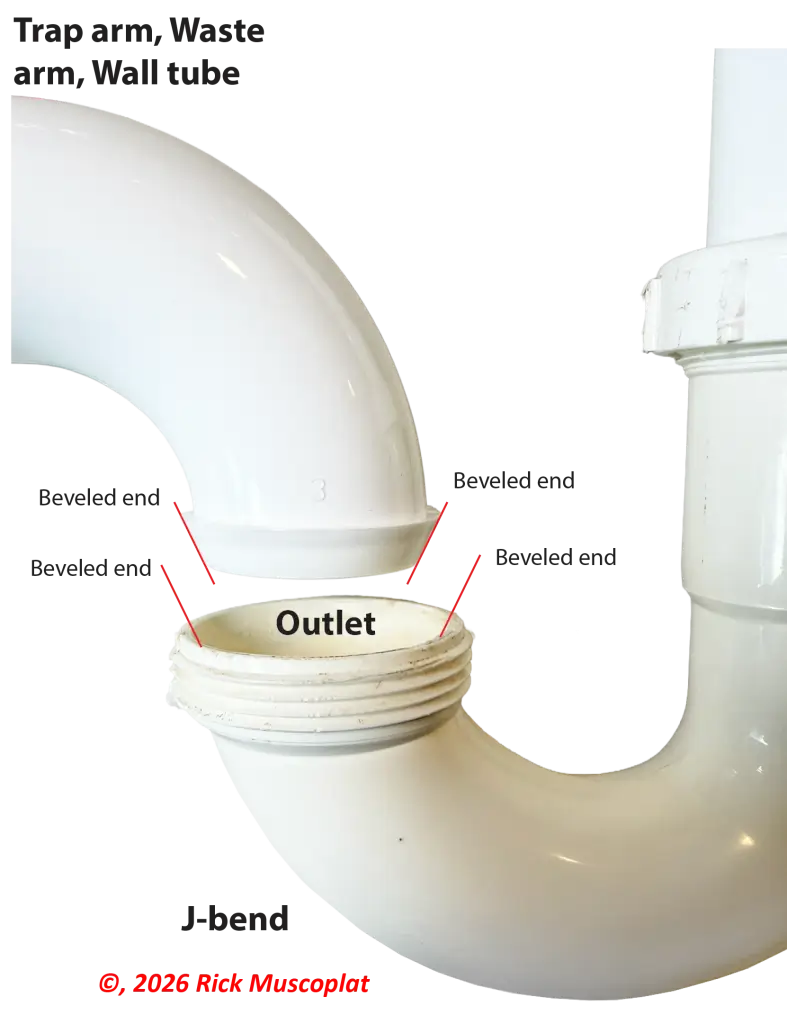
Trap connections are also common spots for kitchen sink leaks, especially if the slip-joint washers are cracked or improperly installed.
Sealing is all about the gaskets, not the threads
I’ve seen many DIYers coat the threads of the basket strainer and the drain parts with Teflon tape or pipe dope in the hope that it’ll stop the leak. That’s not how a drain works. The gaskets that perform the seal, not the threads! If the gaskets aren’t tight or are damaged, they’ll leak.
The threads only provide a way for the slip joint nuts to exert pressure on the gaskets; THEY DON’T SEAL WATER!
Here’s where each gasket is located:
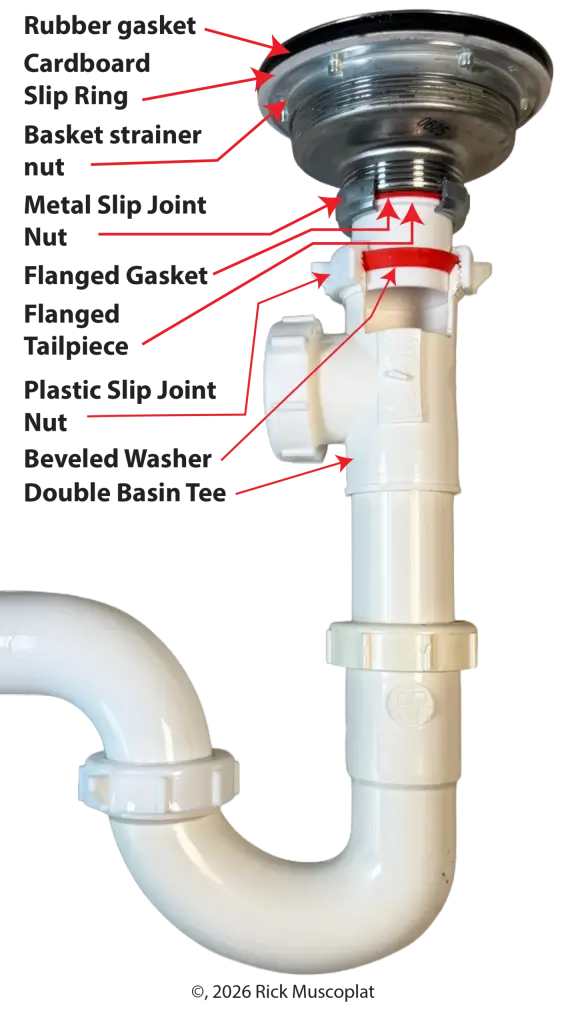
The Most Common Kitchen Sink Leak Spots And How To Fix Each One
After years of plumbing repairs, I can tell you the most frequent kitchen sink leak spots occur at the following locations:
• Basket strainer — Failed plumber’s putty or silicone. Remove the basket
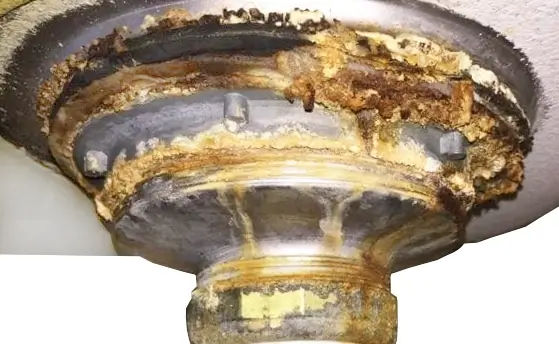
The plumber’s putty, silicone or the rubber gasket have failed, causing the basket strainer to leak.
strainer and clean off the old sealant. If the basket strainer and the rubber washer are in good condition, you can reuse them. Otherwise, replace it.
DIYer Mistake: Injecting household silicone under the sink is a temporary fix that never lasts. Don’t waste your time.
• Tailpiece slip joint — Try tightening the slip nut to compress the flanged gasket. Remember, the
Flanged tailpiece gasket
threads don’t perform the seal; only the gasket seals the tailpiece to the basket strainer. If tightening doesn’t work, examine the flanged tailpiece for cracks. If it’s good, install a new flanged gasket.
• Continuous waste connections — Try tightening the slip nut to compress the beveled gasket. Remember, the threads don’t perform the seal; only the beveled gasket seals the tailpiece to the continuous waste and P-trap. If tightening doesn’t work, examine the beveled washers for cracks. If they’re cracked, install new beveled washers.
• Trap arm compression fittings — The exit portion of the J-bend seals to the waste arm using the beveled edge of the waste arm and a corresponding bevel in the J-bend. There is no washer in this connection! Tighten the nut. If that doesn’t stop the leak, check for dents, chips, or cuts in the beveled edge of the waste arm or the J-bend.
Conclusion
The kitchen sink drain may seem simple, but it’s actually a carefully engineered assembly of parts that must work together to safely move wastewater out of the home.
From the basket strainer and tailpiece to the P-trap and trap arm, every component serves a specific purpose. When one part fails, leaks often develop at predictable spots, such as slip joints or gasket connections.
Once you understand how the system works, diagnosing and fixing problems becomes much easier.
© , 2026
Posted on by Rick Muscoplat