
EFB vs AGM Battery: What’s the Difference?
EFB vs AGM Battery: Key Differences Explained
Quick Summary
EFB vs AGM batteries are both significant upgrades over traditional flooded batteries, but they’re designed for different levels of electrical demand. \
• EFB (Enhanced Flooded Battery) technology was developed primarily for start-stop vehicles and offers better cycling capability, improved charge acceptance, and longer life than conventional batteries.
• AGM (Absorbent Glass Mat) batteries go a step further, providing even greater deep-cycle performance, vibration resistance, and power delivery for vehicles with heavy electrical loads. Choosing the right battery isn’t just about cost—it’s about matching the battery to your vehicle’s charging system and electrical requirements.
EFB vs AGM Battery: Understanding the Real Differences
As someone who’s spent decades working with automotive electrical systems, I’ve watched battery technology evolve dramatically. Years ago, most vehicles used simple flooded lead-acid batteries. Today, modern cars equipped with start-stop systems, regenerative braking, and dozens of electronic accessories require far more advanced battery technology.
One of the most common questions I hear is: “What’s the difference between an EFB and AGM battery?”
It’s a great question because choosing the wrong battery can shorten battery life, reduce fuel economy, and even cause charging system problems.
Let’s break down the differences in plain English.
What Is an EFB Battery?
EFB stands for Enhanced Flooded Battery. Think of it as a heavily upgraded version of a traditional flooded lead-acid battery.
Automakers developed EFB technology specifically to meet the demands of start-stop systems, in which the engine may restart dozens of times during a single commute.
Compared to a conventional battery, an EFB battery features:
• Thicker lead plates
• Improved active material retention
• Enhanced charge acceptance
• Better resistance to deep discharge
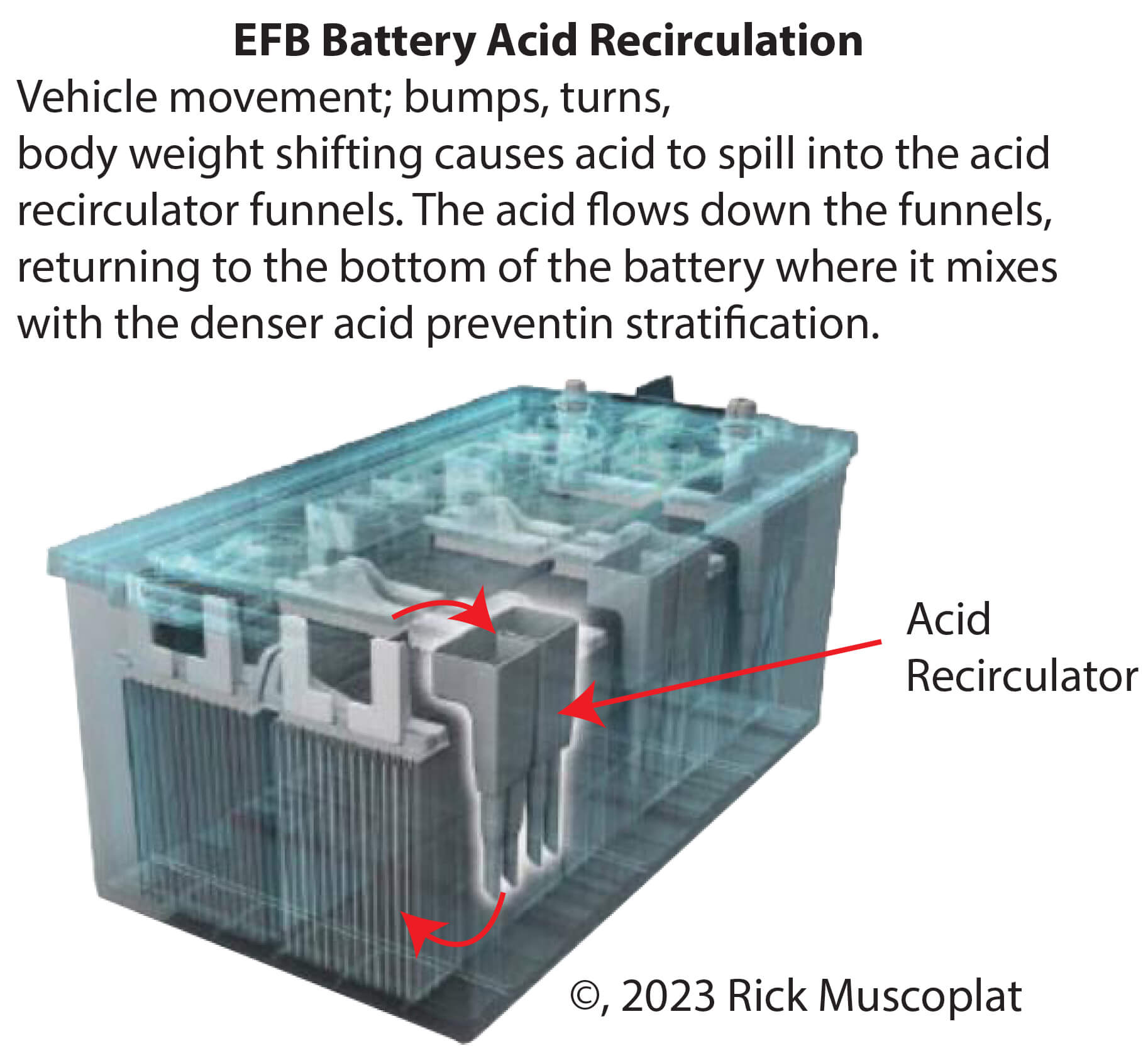
• Acid circulation technology that reduces stratification
The result is a battery that can withstand far more charging and discharging cycles than a standard flooded battery.
In many cases, an EFB battery can survive nearly three times as many engine starts as a traditional flooded battery.
Here’s what separates an EFB battery (RFB battery) from a conventional flooded design:
1. Acid Recirculation to Prevent Stratification— One of the biggest killers of standard batteries is acid stratification—when the heavier sulfuric acid settles at the bottom, corroding the lower plates and reducing capacity.
EFB batteries include acid recirculation funnels that use vehicle motion to stir the electrolyte, maintaining even acid density throughout the cells. This uniform mixture ensures consistent power output and longer plate life.
2. Polyfleece Scrim Layer— Inside every RFB battery, a polyfleece scrim lines each vertical plate. This material stabilizes the active material on the plates and helps retain newly generated charge. The result? More consistent voltage delivery and longer life—especially in vehicles with high electrical loads.
3. Thicker Plates for Deeper Discharge— The plates in an EFB battery are physically thicker than those in a conventional flooded unit. That allows deeper discharges without damage—important in stop/start cars that constantly draw power for lights, HVAC, and infotainment systems while the engine is off.
4. Improved Dynamic Charge Acceptance— Tests show that an EFB battery’s Dynamic Charge Acceptance (DCA) is close to that of an AGM battery. That means it can absorb charge quickly after a start/stop cycle or while decelerating, helping the alternator recover energy efficiently.
5. Better Heat Resistance— In hot climates or underhood installations, EFB batteries last longer than AGM units. Laboratory tests have shown that RFB batteries outperform AGMs by as much as 52% in high-temperature endurance tests—a major benefit for drivers in warm regions.
What Is an AGM Battery?
AGM stands for Absorbent Glass Mat. Instead of using a free-flowing liquid electrolyte like an EFB battery, AGM batteries use fiberglass mats that absorb and hold the electrolyte between the battery plates.
This design provides several advantages:
• Spill-proof construction
• Superior vibration resistance
• Faster charging
• Greater reserve capacity
• Better deep-cycle performance
• Higher power output
Because AGM batteries can repeatedly discharge and recharge without significant damage, they’re commonly found in luxury vehicles, vehicles with regenerative braking systems, and vehicles loaded with electronic accessories.
EFB vs AGM Battery: Key Differences
1. Deep-Cycle Performance — When comparing EFB vs AGM battery technology, AGM clearly wins in deep-cycle capability. AGM batteries tolerate repeated deep discharges much better than EFB batteries.
This makes AGM batteries ideal for:
• Vehicles with extensive electronics
• Heavy accessory loads
• Regenerative braking systems
• Premium luxury vehicles
2. Cost — EFB batteries typically cost less than AGM. If your vehicle doesn’t require AGM technology, spending extra money may provide little benefit.
Average replacement costs:
• EFB battery: Moderate price range
• AGM battery: 25% to 60% higher
3. Heat Resistance — This surprises many people. Although AGM batteries outperform EFB batteries in many categories, EFB batteries often perform better in extreme heat. The flooded design allows heat to dissipate more effectively, which can contribute to longer life in hot climates.
4. Charging Requirements — This is where many DIY battery replacements go wrong. AGM batteries require different charging strategies than EFB batteries. Modern vehicles monitor battery state of charge and regulate charging voltage accordingly. Installing an AGM battery in a vehicle calibrated for an EFB battery can cause:
• Overcharging
• Undercharging
• Reduced battery life
• Battery monitoring system errors
Can You Replace an EFB Battery With an AGM Battery?
Technically, yes—but only under the right circumstances. Many vehicle manufacturers allow AGM upgrades if:
• The battery management system can be programmed for AGM operation
• The charging system supports AGM charging profiles
• The replacement battery meets OEM specifications
However, blindly swapping an EFB battery for an AGM battery isn’t always a smart move.
Before upgrading, verify:
• OEM battery specifications
• Charging system compatibility
• Battery registration requirements — Many European vehicles require battery registration after installation.
Can You Replace an AGM Battery With an EFB Battery?
In most cases, NO. This is one of the most expensive battery mistakes I see. Vehicles designed for AGM batteries often rely on the battery’s superior deep-cycle performance and charging characteristics. Installing an EFB battery in an AGM-equipped vehicle can lead to:
• Premature battery failure
• Start-stop system shutdown
• Charging system faults
• Reduced battery life
Always follow the vehicle manufacturer’s battery recommendations.
Which Battery Lasts Longer?
The answer depends on how the vehicle is used.
AGM Batteries Generally Last Longer In:
• High electrical demand vehicles
• Frequent short-trip driving
• Regenerative braking applications
• Extreme vibration environments
EFB Batteries Often Last Longer In:
• Moderate start-stop applications
• Hot climates
• Vehicles designed specifically for EFB technology
A properly matched EFB battery can easily outlast a poorly matched AGM battery.
Which Battery Is Best for Start-Stop Vehicles?
For most start-stop vehicles originally equipped with EFB batteries, the best replacement is another EFB battery.
Benefits include:
• Lower cost
• OEM compatibility
• Excellent cycling capability
• Improved charge acceptance
• Proven durability
If the vehicle was originally equipped with an AGM battery, replace it with an AGM battery unless the manufacturer specifically approves another option.
Why carmakers install start-stop systems in cars
Final Thoughts
When comparing EFB vs AGM battery technology, neither is universally better. The right choice depends entirely on your vehicle’s electrical system and charging strategy.
EFB batteries bridge the gap between conventional flooded batteries and AGM batteries, offering excellent cycling performance, strong heat resistance, and lower cost. AGM batteries deliver ultimate performance for vehicles with demanding electrical systems, deep discharge cycles, and advanced energy management systems.
My advice is simple: always replace your battery with the type recommended by the vehicle manufacturer. The few dollars saved by choosing the wrong battery can easily turn into hundreds of dollars in battery and charging system problems later.
For more information on EFB batteries, click on this link to Exide’s page
©, 2023 Rick Muscoplat
Posted on by Rick Muscoplat