
Ford’s Variable Cam Timing System: Benefits, Failures, and Fixes
The Complete Guide to Ford VCT and Variable Cam Timing Technology
Quick Summary
Ford’s Variable cam timing (often called Ford VCT) adjusts camshaft position while the engine is running to improve power, fuel economy, and emissions. The Ford VCT system relies heavily on clean engine oil; dirty oil is one of the most common causes of failure.
Sensors such as the camshaft and crankshaft position sensors provide feedback to the PCM, enabling precise control of variable cam timing.
Common symptoms of Ford VCT problems include rough idle, misfires, poor acceleration, and a check engine light.
Diagnosing Ford VCT issues can be tricky because electrical, hydraulic, or mechanical problems can cause similar symptoms.
Proper oil maintenance is the single most important step in preventing variable cam timing failures.
Article
Variable Cam Timing in Ford Engines: How Ford VCT Works and What Goes Wrong
Over the years, I’ve worked on many Ford engines, and one technology that consistently confuses both DIYers and even some technicians is variable cam timing. Ford refers to this system as Ford VCT, and it plays a huge role in how modern Ford engines achieve better performance, improved fuel economy, and lower emissions.
When it works correctly, variable cam timing is almost invisible to the driver. But when it fails, the symptoms can mimic a dozen different engine problems. That’s why understanding how Ford VCT works is critical to diagnosing drivability problems correctly.
For detailed information on how to diagnose a Ford VCT problem, see this article.
How Variable Cam Timing Works in Ford Engines
In older engines, the camshaft timing was fixed. Once the timing chain or belt was installed, the valve timing never changed. That meant the engine had to compromise between low-speed torque and high-speed power.
Ford solved that compromise by introducing Ford VCT, which allows the camshaft timing to advance or retard depending on engine conditions.
Here’s the simplified version of how it works
The powertrain control module (PCM) constantly monitors engine operation using the crankshaft position sensor and camshaft position sensor. These sensors provide feedback to the PCM, allowing it to know the exact relationship between the camshaft and crankshaft.
Using that information, the PCM commands an oil-controlled actuator to rotate the camshaft slightly forward or backward. That small change alters valve timing.
The system relies on pressurized engine oil flowing through a VCT solenoid into a cam phaser mounted on the camshaft. The cam phaser then rotates the camshaft relative to the timing chain sprocket. This ability to adjust timing on the fly is the essence of variable cam timing.

What Variable Cam Timing Actually Does
At low engine speeds, Ford’s VCT may retard cam timing slightly to improve idle quality and reduce emissions. When the driver accelerates, the PCM advances the camshaft timing to improve cylinder filling and produce more torque. At highway speeds, variable cam timing can adjust again to improve fuel efficiency. Because of these adjustments, Ford VCT helps deliver three major benefits:
• Improved engine performance
• Better fuel economy
• Lower emissions
This closed-loop system constantly monitors and adjusts camshaft position, which allows variable cam timing to respond instantly to throttle input, load, and engine speed.
Why Engine Oil Is Critical to Ford VCT
The important point to stress here is that variable
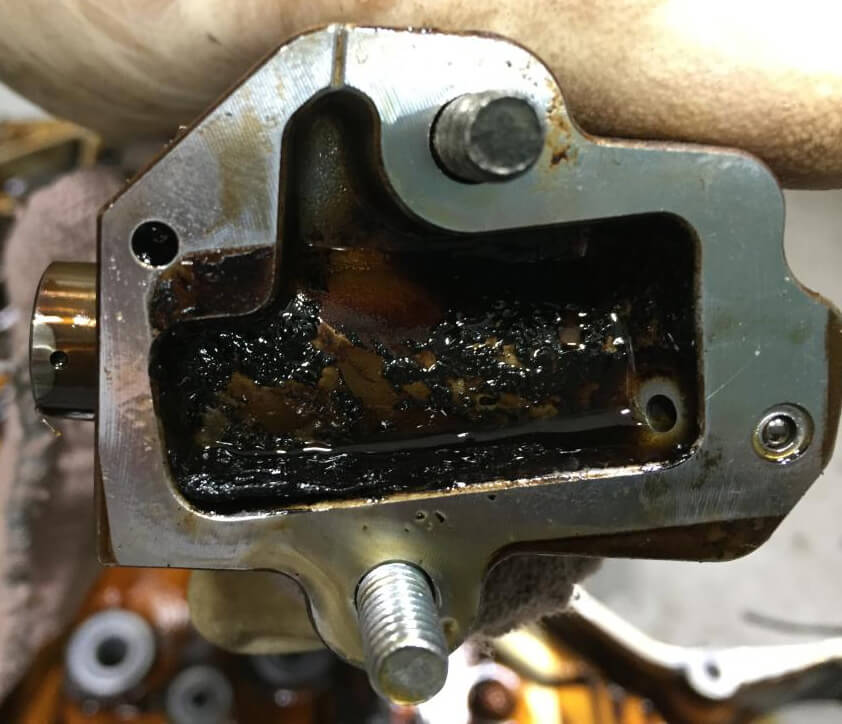
Sludge in VCT oil control solenoid screen
cam timing lives and dies by the quality of the engine oil. That’s because Ford VCT is fundamentally a hydraulic system. Oil pressure drives the cam phaser. If the oil becomes dirty, sludged, or thick from neglect, it can clog the tiny passages inside the VCT solenoid or cam phaser. When that happens, variable cam timing may respond slowly or stop working entirely.
In fact, one of the first diagnostic steps when dealing with Ford VCT problems is simply checking the oil level and condition. Contaminated oil alone can cause drivability issues or trigger diagnostic trouble codes related to variable cam timing.
Common Symptoms of Ford VCT Problems
In the shop, I often see Ford VCT failures that get misdiagnosed as ignition or fuel problems. That’s because variable cam timing failures can produce symptoms that mimic other engine issues.
Some of the most common symptoms include:
• Rough idle
• Engine misfires
• Check engine light
• Poor acceleration
• Engine rattling or knocking noise
• Stalling or hesitation
Sometimes the PCM will set specific diagnostic trouble codes related to variable cam timing, but not always. That’s what makes the Ford VCT diagnosis tricky. For example, a customer might complain about a rough idle or a misfire, and the technician may start replacing ignition coils when the real problem is the variable cam timing system.
Common Failures in the Ford VCT System
Over the years, I’ve seen several common problems with Ford VCT systems.
One of the most common failures is the VCT solenoid. These solenoids control oil flow into the cam phaser. If they stick or clog, variable cam timing stops responding correctly.
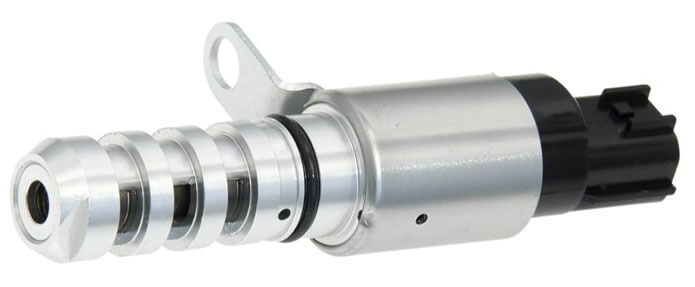
Oil control solenoid
Another common issue is the cam phaser itself. Cam phasers can wear internally, especially on high-mileage engines or engines with poor oil maintenance. When a cam phaser fails, it may cause a rattling noise at startup or allow the camshaft timing to drift out of position.
Timing chain stretch can also affect Ford VCT operation. If the timing chain becomes loose, the PCM may detect that the camshaft is not in the expected position. A loose timing chain can be caused by extended oil changes or by chain guide wear.
Finally, electrical issues such as wiring problems or faulty sensors can also trigger variable cam timing codes.
Because so many systems interact with Ford VCT, diagnosing the root cause requires a systematic approach.
Diagnosing Variable Cam Timing Issues
When I diagnose Ford VCT problems, I always follow the same order.
1) Check the oil level and condition. Dirty or incorrect oil is responsible for a surprising number of variable cam timing issues.
2) Scan the PCM for codes and examine live data to see whether the commanded camshaft position matches the actual camshaft position. If the system is not responding correctly, I test the VCT solenoids and inspect the wiring circuits.
3) If everything else checks out, I consider mechanical issues such as worn cam phasers or timing chain problems.
Because variable cam timing relies on electrical inputs, hydraulic pressure, and mechanical components, a failure in any of those areas can cause the same symptoms.
©, 2026 Rick Muscoplat
Posted on by Rick Muscoplat