
How do you know if your car alternator is bad?
Learn how to check if your alternator is bad
The alternator is a crucial component in your vehicle’s electrical system, responsible for charging the battery and powering electrical systems when the engine is running. When the alternator fails, it can lead to various problems, from a dead battery to electrical malfunctions. Identifying a bad alternator early can save you from being stranded and prevent further damage to your vehicle. Here’s a comprehensive guide on how to check if your alternator is bad.
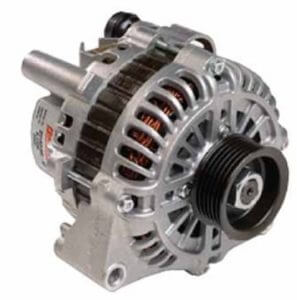 Understand the Symptoms of a Bad Alternator
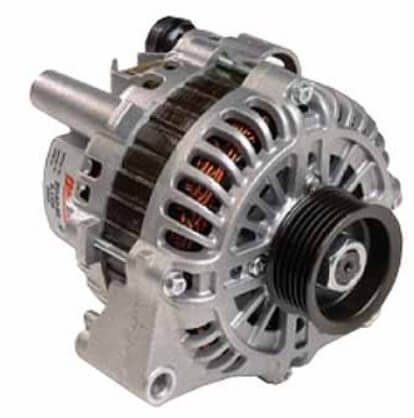
Before diving into diagnostic procedures, it’s important to recognize the common symptoms of a failing alternator:
• Dim or Flickering Lights— One of the first signs of a bad alternator is dimming or flickering headlights and interior lights.
• Electrical Issues— Malfunctions in electrical components such as power windows, radio, or air conditioning can indicate alternator problems.
• Warning Lights— The dashboard may display a battery warning light or an ALT (alternator) light.
• Strange Noises— A failing alternator may produce a grinding or whining noise.
• Battery Problems— If your battery keeps dying despite being relatively new, the alternator may not be charging it properly.
• Engine Stalling— The engine may stall or have difficulty starting because the alternator isn’t providing enough power.
Start With A Visual Inspection
Start with a visual inspection of the alternator and its surrounding components:
• Check the Belt— Inspect the serpentine belt that drives the alternator. It should be tight and in good condition. A loose or worn-out belt can affect the alternator’s performance.
• Inspect the alternator connections— Ensure that the electrical connections to the alternator are secure and free of corrosion. Loose or corroded connections can lead to charging problems.
• Look for Physical Damage— Check the alternator for any visible signs of damage, such as cracks or worn-out bearings.
Test battery and charging voltages with a meter
1) Set the meter to read 20 volts DC or less. Attach the red positive lead to the positive terminal on the battery and the black negative lead to the negative terminal. You need at least 12.4 volts to continue testing the alternator.
2) Start the engine and read the voltage on the meter. The old rule was that you should instantly see at least 13 volts. However, late-model vehicles incorporate energy-saving software that monitors battery voltage and stops the alternator from producing power if the battery is full. So don’t condemn an alternator immediately if you don’t see above 13 volts at startup.
3) Turn on loads. Start by turning on your headlights. The meter may dip slightly but should return to a reading above 13 volts. Then, turn the blower on full blast and increase idle speed to about 1,500 RPM. The meter should read above 13 volts. Continue adding loads like rear defogger and seat heaters while increasing RPM to 2,000. Hold the RPMs at that speed for a few minutes and watch the meter (yeah, you’ll need a helper to do that). A good car alternator will maintain at least 13 volts—usually above 13.5. A bad alternator will begin to drop below 13 volts as you add electrical loads and increase engine RPM.
You’ve just completed the first phase of alternator testing. You’ve confirmed the alternator is working and can maintain minimum voltage. However, you still don’t know if it’s causing your battery to drain.
Check the car alternator for diode ripple
Car alternators produce AC power, but cars require DC power. So the  alternator flows the power through one-way “valves” known as diodes or “rectifiers.” Diodes can fail in three ways; they produce an AC ripple that injects AC voltage or “noise” into the car’s electrical system, the diode shorts-to-ground creating a dead short inside the alternator than can drain your battery in about an hour, or they fail in an “open” position that prevents the alternator from producing full output.
The easiest way to check for diode ripple is with the diode ripple test. Connect the positive lead from your meter to the BAT terminal on your car alternator. Connect the negative terminal to the alternator mounting bracket. Set the reading to the lowest AC voltage setting. Then start the engine and rev it to about 1,500 RPM. You should see less than 0.5 volts on your meter. The reading may go as high as 0.8 or 1.0 volts in a heavy-duty charging system (like on a truck). A reading higher reading indicates a bad alternator.
Check for a diode short to ground condition
Since a short-to-ground diode drains the battery, you’ll want to check the current flow with the engine off. To do that you’ll have to use either an inductive current clamp or install your meter in series with the negative battery cable. If you choose the latter method, follow this procedure:
Remove the negative battery terminal. Then, remove the wire connected to the alternator BAT terminal. Install your meter in series between the BAT terminal and the wire you just disconnected from that terminal. Move the positive lead at the meter to the mA port while leaving the negative lead in the COM port. Then, switch your meter to mA.
If you have a push button start vehicle, take your fob into the house so it doesn’t keep the electronics running. With the engine off, all electrical accessories off, keys out of the ignition, and doors closed, you should see a reading of fewer than 0.5 milliamps. If you see a higher reading, leave the connections in place and check again in 30 minutes when all the computers have entered sleep mode. If the reading is still above 0.5 milliamps, chances are you have a bad diode, and the alternator is bad and causing the battery drain.
How does a car alternator work?
Older generators operate by rotating a coil of wire around a magnet to produce electricity. As car makers began installing more electrical accessories, they found that a generator couldn’t produce enough power to keep the accessories running while also recharging the battery. That’s when they switched to an alternator.
An alternator rotates an electro-magnet inside a coil of wire to generate electricity. 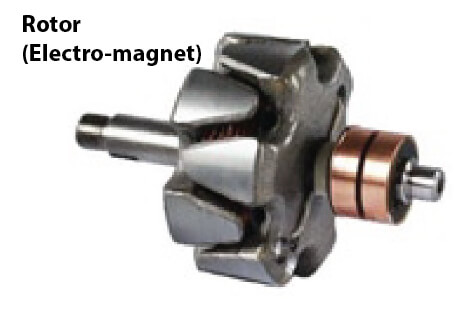 To vary the amount of electricity an alternator generates, the voltage regulator varies the amount of power it feeds to the spinning electromagnet. If you learn nothing else from this article, remember this: an alternator uses an electro-magnet—it can’t make power without first having power to run the electro-magnet. That’s why an alternator can’t charge a dead battery—there’s not enough power to run the electromagnet.
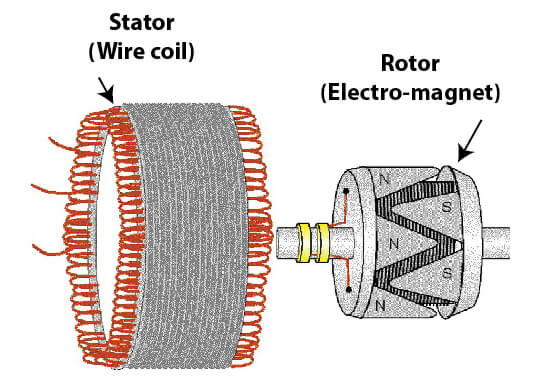
All alternators have a stator and a rotor. The rotor is the electromagnet
©, 2016 Rick Muscoplat
Posted on by Rick Muscoplat