
How to Bleed Air Out of Power Steering
Manufacturer-Approved Power Steering Bleeding Methods
Quick Summary
Anytime you open a power steering system—whether replacing a hose, pump, or steering rack—you must bleed power steering correctly. If you don’t bleed air out of the power steering, trapped air will foam the fluid, reduce cooling, cause noise, and can permanently damage the pump through cavitation. The safest and most effective method on modern vehicles is vacuum bleeding, not the old lock-to-lock method.
Bleed Power Steering the Right Way: Why Old Methods Can Destroy Your Pump
I’ve seen more power steering pumps ruined by improper bleeding than by outright part failure. The mistake usually happens right after a repair, when someone refills the reservoir, starts the engine, cranks the wheel from lock to lock, and assumes the job is done. On older vehicles, that sometimes worked. On modern steering systems, it’s a recipe for noise, foaming fluid, and expensive comebacks.
If you want to protect the pump and restore proper assist, you need to bleed the power steering correctly and completely remove air from the system before the system ever sees real load.
Why You Must Bleed Power Steering After Repairs
Power steering systems are hydraulic systems, and hydraulics absolutely hate air. When air gets trapped in the pump, hoses, or steering gear, it mixes with the fluid, turning it into foam. Foamed fluid doesn’t lubricate, doesn’t cool, and can’t transmit pressure effectively.
Even worse, air inside the pump causes cavitation. Cavitation creates microscopic shock waves that erode pump vanes and housing surfaces. Once that damage starts, no amount of bleeding will save the pump. That’s why it’s critical to bleed air out of the power steering immediately after any component replacement.
The Two Common Ways People Try to Bleed Power Steering
There are two methods you’ll see discussed online. One still works. The other belongs in the past.
The first is the old “lock-to-lock” method, where the engine is running, and the steering wheel is turned fully left and fully right multiple times. This approach is outdated and risky on modern vehicles.
The second—and correct—method is to use a handheld vacuum pump to bleed power steering by pulling air from the entire system under controlled conditions. This method safely removes trapped air without loading the pump.
Why Lock-to-Lock Bleeding Is Dangerous on Modern Vehicles
With the engine running, a power steering system can generate close to 2,000 psi when the wheel is held against the steering stop. Holding the wheel at full lock for more than a second or two overheats the fluid, stresses the hoses, damages the pump vanes, and can blow internal seals in the steering rack.
In hybrid hydraulic-electric steering systems—where the pump is driven by an electric motor rather than a belt—the risk is even higher. Lock-to-lock steering can overheat the motor, trigger warning lights, and shut down power assist entirely. You’re left with manual steering that feels like the car weighs five tons.
That’s why, on late-model vehicles, I avoid lock-to-lock bleeding entirely and rely on vacuum methods to safely bleed air out of the power steering.
The Best Way to Bleed Power Steering Using a Vacuum Pump
Once the repair is complete and the reservoir is filled with the correct fluid, I start by removing large air pockets with the engine off. With the front wheels off the ground, I slowly turn the steering wheel from full left to full right. You’ll see air bubbles rise in the reservoir, which confirms the steering gear is pushing trapped air out of the piston chambers. This step alone does not fully bleed power stee
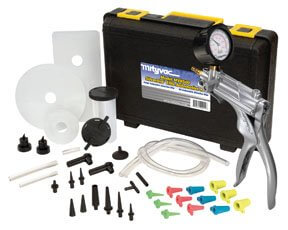
Mityvac MITMV8500 Silverline Elite Automotive Vacuum Pump Kit. Click on image to purchase from Amazon
ring, but it prepares the system for vacuum bleeding.
Next comes the critical step.
Using a reservoir adapter, I connect a handheld vacuum pump to the power steering reservoir. I apply approximately 20–25 inches of vacuum and hold it there for at least five minutes. During this time, the vacuum expands trapped air bubbles and pulls them out of hoses, the pump, and the rack.
Once bubbling stops, I slowly release the vacuum, reinstall the factory reservoir cap, and start the engine. If there’s any whining noise while turning the wheel, I shut the engine off and repeat the process. Fully bleeding air out of the power steering sometimes takes more than one cycle, especially after rack replacement.
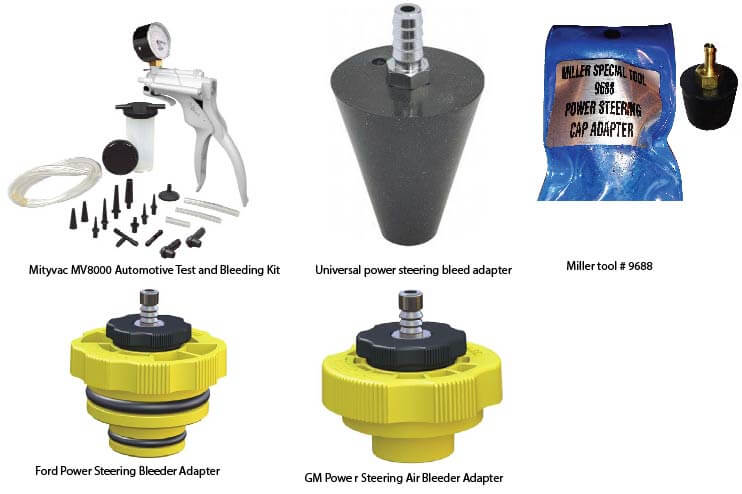
Power steering vacuum bleed adapters
When to Use Limited Steering Movement After Vacuum Bleeding
If a small amount of air remains, I’ll run the engine and gently turn the wheel left and right—but never holding it against the stops. After that, I shut the engine off and perform one final vacuum bleed. This ensures the system is completely purged without risking pump damage.
Why Manufacturers Warn Against Lock-to-Lock Bleeding
Some automakers explicitly warn against traditional bleeding methods. Chrysler, for example, issued a technical service bulletin instructing technicians to bleed the power steering using only vacuum. The bulletin states that failing to properly bleed air out of the power steering can result in pump damage.
Their procedure involves filling the reservoir, installing a cap adapter, pulling 20–25 inches of vacuum, holding it for several minutes, and repeating the process until fluid levels stabilize. They specifically warn technicians not to turn the steering wheel stop-to-stop as was once common practice.
That guidance mirrors what I’ve seen in the field—vacuum bleeding works, and lock-to-lock bleeding breaks parts.
Signs You Didn’t Bleed Power Steering Completely
If air remains in the system, the symptoms are hard to miss. You’ll hear whining or groaning noises when turning the wheel, feel inconsistent assist, or see fluid foaming in the reservoir. These are clear signs you still need to bleed air out of the power steering.
Ignoring these warnings can turn a simple hose replacement into a full pump replacement.
Final Thoughts: Do It Once, Do It Right
The best way to bleed power steering hasn’t changed in years—it’s controlled, methodical, and uses vacuum, not brute force. Taking a few extra minutes to properly bleed air out of the power steering protects the pump, restores smooth steering, and prevents expensive repeat repairs.
If you’ve already invested time and money into steering repairs, don’t gamble at the last step. Bleed it correctly, and you’ll only have to do it once.
© 2012 Rick Muscoplat
Posted on by Rick Muscoplat