
Is Premium Gas Better for Your Engine? Facts vs. Myths
Is Premium Gas Worth It? What Every Driver Should Know Before Paying More at the Pump
Quick Summary
Is premium gas worth it? In most cases, the answer is no—unless your vehicle’s manufacturer specifically requires or recommends it. Despite what many drivers believe, premium gasoline doesn’t contain more energy, doesn’t clean your engine better, doesn’t improve fuel economy in vehicles designed for regular gas, and won’t magically add horsepower. Its primary advantage is its higher octane rating, which helps prevent engine knock in high-compression and turbocharged engines.
In this article, I’ll explain the facts behind premium fuel, separate myths from reality, and help you decide whether paying extra at the pump is money well spent.
Is Premium Gas Worth It? Here’s the Truth
As an ASE Master Technician and someone who’s spent decades diagnosing engine performance problems, I’m asked this question almost every week: “Is premium gas worth it?”
I understand why drivers ask. Premium gasoline costs considerably more than regular unleaded, and fuel companies often market it as the “better” gasoline. It’s easy to assume that paying more must mean you’re getting more.
But that’s rarely true.
Over the years, I’ve seen thousands of drivers spend hundreds of extra dollars on premium fuel that provides absolutely no benefit to their vehicles. I’ve also seen the opposite—drivers trying to save money by filling a premium-required engine with regular gas, only to pay thousands for engine repairs.
The key isn’t whether premium gas is “better.” The real question is whether your engine actually needs it.
Once you understand what octane does—and just as importantly, what it doesn’t do—the answer becomes surprisingly simple.
What Makes Premium Gas Different?
Many people think premium gasoline contains more power or higher-quality ingredients. It doesn’t. The single biggest difference between regular and premium gasoline is octane rating.
Typical octane ratings are:
Regular: 87 octane
Mid-grade: 89 octane
Premium: 91–94 octane
Octane is simply a measure of a fuel’s resistance to detonation, commonly called engine knock or spark knock. Higher-octane fuels resist uncontrolled combustion due to the high heat produced by high-compression engines. That characteristic is essential for engines that operate under very high cylinder pressures.
1) Premium gas doesn’t contain any appreciable amount of additional energy over regular gas.
2) Premium gas doesn’t contain any more detergent than regular gas. In other words, it doesn’t clean your fuel system any better than regular gas.
3) It simply resists knock better.
To prevent detonation in early engines, refiners used to add tetraethyl lead as an antiknock additive. That’s now illegal. So they use other detonation reduction products like:
• Benzene, xylene, and toluene
• Alcohols: ethanol, methanol, tertiary butyl alcohol (TBA)
• Propane and butane. The increased volatility from added propane and butane often leads to hot-weather driveability problems.
When blended into gasoline, these chemicals create a final product with stronger carbon-carbon bonds, which reduces the fuel’s tendency to spontaneously ignite in an uncontrolled manner when under compression.
Premium Gas Myths That Refuse to Die
Let’s clear up several myths I hear almost every day.
Myth #1: Premium Gas Produces More Power — If your engine was designed to run on regular gasoline, premium fuel won’t make it faster or more powerful.
Modern engine computers already optimize ignition timing for the recommended fuel. Unless the engine was specifically engineered to take advantage of higher octane, adding premium won’t unlock hidden horsepower.
For the overwhelming majority of vehicles designed for 87-octane fuel, acceleration feels exactly the same.
Myth #2: Premium Gas Contains More Energy — This surprises many people. Premium gasoline contains virtually the same amount of chemical energy as regular gasoline. In fact, the energy difference is generally less than one percent—far too small for any driver to notice.
That’s why simply paying more doesn’t automatically translate into more miles or more power.
Myth #3: Premium Gas Cleans Your Engine Better Than Regular Gas
No, it doesn’t. The cleaning ability of gasoline comes from its detergent package—not its octane rating. Detergent levels may vary by brand, but generally speaking, premium gas has the same detergent additives as regular gas.
Every gasoline sold in the United States must contain detergent additives required by federal regulations.
Even better are Top Tier™ fuels, which contain higher concentrations of detergents than the minimum federal standard.
Here’s the important point:
• A Top Tier regular gasoline often contains the same detergent package as that brand’s premium gasoline. In other words, you’re paying for higher octane—not additional cleaning chemicals. If keeping your engine clean is your goal, buying Top Tier gasoline is usually far more important than buying premium.
Myth #4: Premium Gas Improves Fuel Economy
For vehicles designed for regular fuel, the answer is almost always no. Because premium contains virtually the same amount of energy, your engine doesn’t suddenly become more efficient. In my experience, any mileage differences people notice usually come from:
• Seasonal gasoline blends
• Different driving habits
• Tire pressure changes
• Weather
• Different fuel brands
Not from the fuel’s octane rating.
However, there is one important exception.
If your owner’s manual recommends or requires premium fuel, using the correct octane allows the engine computer to maintain its intended ignition timing and boost pressure.
In those engines, premium fuel can help maintain the fuel economy the manufacturer originally designed into the vehicle.
So while premium usually doesn’t improve fuel economy, it can prevent a loss of fuel economy in engines engineered to use it.
Myth #5: Premium Gas Increases Horsepower
Again, it depends entirely on the engine. If your vehicle was designed for regular gasoline, premium won’t suddenly create additional horsepower. There’s simply no mechanism for that to happen. However, performance engines tell a different story.
Many turbocharged and high-compression engines continually adjust ignition timing using sophisticated knock sensors. When those engines receive premium fuel, the computer can safely advance ignition timing and maintain higher boost pressures. That allows the engine to produce its advertised horsepower.
Conversely, filling one of these engines with regular gasoline often causes the computer to retard ignition timing to protect the engine, reducing:
• Horsepower
• Throttle response
• Acceleration
• Fuel economy
That’s why premium fuel can absolutely increase horsepower—but only in engines designed to take advantage of it.
Myth #5: Premium Fuel Lasts Longer Than Regular Gas
This myth is based on the false assumption that all premium gas is ethanol-free so it has a longer shelf life. Some premium gas is ethanol-free, but not all. If the pump label doesn’t say “Contains no ethanol,” or “Ethanol Free,” you shouldn’t assume that it is ethanol-free.
Aside from the ethanol issue, premium gasoline oxidizes and degrades at essentially the same rate as regular gasoline.
If you’re storing gasoline for seasonal equipment, the best way to keep it fresh longer is to use a tightly sealed metal container and add a fuel stabilizer at the pump.
The Bottom Line So Far
After decades of diagnosing engines, here’s the advice I give every customer:
• Use the fuel grade listed in your owner’s manual.
• Don’t pay extra for a premium if your vehicle was designed for regular.
• Never downgrade to regular if premium is required.
• Buy quality Top Tier gasoline whenever possible.
• Remember that octane prevents knock—it doesn’t create power.
Why Some Engines Require Premium Gas
I’ve heard plenty of drivers say, “My luxury car runs fine on regular gas, so why should I spend the extra money on premium?” The answer is that “running” isn’t the same as “running correctly.”
Today’s engines are remarkably intelligent. They can compensate for many things—including the wrong octane fuel—but every adjustment comes with a tradeoff.
To understand why, you first need to know what causes engine knock.
What Is Engine Knock?
Inside every gasoline engine, the air-fuel mixture is supposed to ignite only when the spark plug fires. The flame front then travels smoothly across the combustion chamber, pushing the piston downward in a controlled combustion.
When the fuel-air mixture ignites prematurely or burns uncontrollably, the pressure inside the cylinder spikes dramatically. Instead of one smooth flame front, multiple flame fronts collide, creating powerful shock waves. That’s engine knock.
If you’ve ever heard a metallic pinging noise while accelerating, you’ve heard knock.
Occasional light knocks usually aren’t catastrophic, but repeated knocks can destroy an engine surprisingly quickly. That’s exactly what premium gasoline is designed to prevent.
Detonation vs. Pre-Ignition: They’re Not the Same Thing
Many people—including experienced mechanics—use these terms interchangeably. They’re actually two different problems.
Detonation happens after the spark plug fires, and the piston is Moving Down During the Power Stroke
Here’s the detonation sequence:
1) The spark plug ignites the mixture at the right time
2) Combustion begins, causing a rapid pressure increase in the cylinder
3) The rapid pressure and heat increase cause pockets of fuel to spontaneously ignite in an uncontrolled manner
4) This results in multiple flame fronts colliding.
5) Instead of a controlled burn, multiple pressure waves slam into each other at extremely high speeds.
Those shock waves can damage:
• Pistons
• Connecting rod bearings
• Cylinder heads
• Spark plugs
• Piston rings
• Head gaskets
Over time, repeated detonation pounds internal engine components like a tiny hammer striking them thousands of times every minute.

This image shows the piston caused by detonation when you fill your engine with regular gas instead of premium gas in your engine
Pre-Ignition Happens Before the Spark
Pre-ignition is even more destructive. Instead of waiting for the spark plug, the air-fuel mixture ignites early due to excessive heat in the combustion chamber.
The high heat can be caused by:
• Overheated spark plug electrodes
• Glowing carbon deposits
• Hot exhaust valves
• Extremely high cylinder temperatures
• High heat caused by high-compression engines
When ignition starts from a heat source rather than a spark and the piston is still traveling upward, the pre-mature combustion attempts to force the piston downward. The result is enormous cylinder pressure.
I’ve seen pistons with melted crowns, broken ring lands, cracked rings, and damaged cylinder heads caused by severe pre-ignition.
That’s why manufacturers specify premium fuel for certain engines.
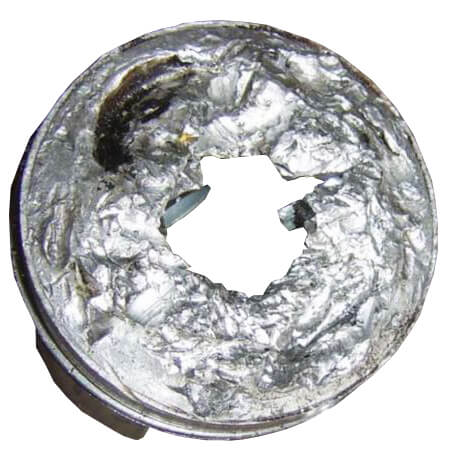
This image shows piston damage caused by the high heat of pre-ignition
Why High-Compression Engines Need Premium Gas
Engine compression ratio has increased dramatically over the last two decades.
Higher compression improves:
• Fuel efficiency
• Power output
• Thermal efficiency
• Emissions
But it also increases combustion temperatures and pressures. The higher the compression ratio, the greater the chance the fuel will ignite before the spark plug fires.
Premium gasoline’s higher octane rating allows these engines to operate safely without uncontrolled combustion. That’s why many sports cars, luxury vehicles, and performance sedans specify premium fuel.
Many Turbocharged Engines Depend on Higher Octane Fuel
Turbochargers compress incoming air before it enters the engine to boost cylinder pressures. By packing more air and fuel into the cylinder, the engine produces substantially more horsepower from a smaller engine. The downside?
• Boost pressure dramatically increases cylinder pressure.
• Without sufficient octane, knock becomes much more likely.
This is one reason so many modern turbocharged four-cylinder engines recommend or require premium gasoline.
How Knock Sensors Protect Your Engine
Fortunately, today’s engines have an impressive safety net. Most modern vehicles use knock sensors mounted directly to the engine block. These sensors “listen” for the unique vibration frequencies produced by detonation.
When they detect a knock, the engine computer immediately responds by:
• Retarding ignition timing
• Reducing turbo boost (if equipped)
• Altering fuel delivery
• Limiting engine torque
These adjustments usually stop the knock before engine damage occurs. It’s an impressive system. But it’s also why some drivers mistakenly believe regular gas works just fine in a premium-required engine.
However, reducing ignition timing due to knock events means the engine isn’t running normally. It’s actually operating in a protective mode.
What Happens If You Use Regular Gas in a Premium-Required Engine?
Modern engine computers can compensate for lower octane fuel—but only up to a point. As mentioned above, when knock occurs, the computer retards ignition timing to protect the engine. That protection comes at a cost.
When you retard ignition timing, you get:
• Reduced horsepower
• Slower acceleration
• Poorer throttle response
• Lower fuel economy
• Less responsive passing power
• Increased engine temperatures under heavy loads
In severe situations, especially during hot weather, mountain driving, or towing, the engine may still experience damaging knock if the computer reaches the limits of its adjustment range.
Repeated exposure to detonation can eventually damage pistons, piston rings, valves, bearings, and cylinder heads.
Knock detection is reactive, not proactive
A knock sensor only detects knock after it has occurred. So, you can run into a situation where the ECM has retarded ignition timing to its maximum of 25% retard based on previous knock sensor reports. Yet, due to current driving conditions, the engine is still producing knock, and the ECM can’t retard timing any further. That’s when you get piston damage, even though you thought you were protected.
Saving a few dollars at the pump simply isn’t worth risking thousands in engine repairs.
What If the Owner’s Manual Says “Premium Recommended?”
The word “recommended” can be a bit confusing. In the U.S., under the Magnuson-Moss Warranty Act, the term “recommended” should be interpreted as “required.”
When Is Premium Gas Actually Worth the Extra Cost?
Premium gasoline is worth every penny if:
• Your owner’s manual says “Premium Recommended.”
• You own a high-compression engine.
• Your vehicle has a high-output turbocharged engine.
• You’re towing heavy loads in hot weather with a premium-recommended engine.
• You’re driving aggressively enough to push the engine near its limits.
For everyone else, premium fuel is usually an unnecessary expense.
If your vehicle was designed for 87-octane gasoline, you’ll almost always receive the best value by using quality regular unleaded from a reputable Top Tier fuel supplier.
Remember, premium gasoline isn’t “better” gasoline. It’s simply gasoline that’s engineered to resist knock under demanding engine conditions.
Knowing the difference can save you hundreds of dollars every year—without sacrificing reliability or performance.
Final Verdict: Is Premium Gas Worth It?
After spending decades diagnosing engine problems and explaining fuel systems to customers, my advice has never changed.
Premium gasoline isn’t better because it’s more expensive.
It’s better only when your engine needs a higher octane rating.
If your owner’s manual says Premium Required, don’t try to save a few dollars by using regular gasoline. The short-term savings simply aren’t worth sacrificing performance—or risking expensive engine repairs.
On the other hand, if your vehicle was engineered for regular gasoline, you’ll almost certainly gain nothing by paying extra for premium.
Instead, spend your money where it actually makes a difference:
Buy gasoline from reputable Top Tier brands.
Keep up with scheduled maintenance.
Replace dirty air filters.
Maintain proper tire pressure.
Change the oil on schedule.
Fix check engine lights promptly.
Those steps will do far more for your engine’s performance, fuel economy, and longevity than buying premium gasoline your vehicle doesn’t need.
The next time you’re standing at the pump wondering whether premium fuel is worth the extra cost, remember one simple rule:
Use the octane rating your vehicle was designed to run on—no more and no less.
Doing so gives you the best balance of performance, fuel economy, engine protection, and value.
Want to learn more about gasoline? Download this article
Want to know what happens when you add 87-octane gas to an engine that requires 93-octane? Read this article
©, 2013 Rick Muscoplat
Posted on by Rick Muscoplat