
Learn what the VIN code means and how to decode it
How to decode your VIN number
The Vehicle Identification Number (VIN) is a unique code assigned to every motor vehicle when it’s manufactured. Serving as the automotive equivalent of a fingerprint, the VIN is a 17-character string of letters and numbers that uniquely identifies a specific vehicle. This code provides crucial information about the vehicle, such as its manufacturer, model, year of production, and more. Understanding the VIN is essential for car owners, buyers, and enthusiasts, as it can reveal a lot about the vehicle’s history and specifications.
Where were VIN numbers started?
The current VIN numbering system was established in 1981. The standardization allowed a mix of numbers and letters except for the letters O, I, and Q to prevent confusion with 0, 1, and 9. The new system was mandated by the National Highway Traffic Safety Administration (NHTSA) to eliminate the confusion in identifying information about vehicles. Prior to 1981, the U.S. federal government required the American Manufacturers Association to develop a system that categorizes and classifies all motor vehicles in a standardized manner. Unfortunately, each automaker had its own classification system, which caused confusion.
Where is the VIN located?
The VIN must be shown on the driver’s side of the dash to be viewed from outside. You’ll also find it on the vehicle’s title, its registration, and many carmakers stamp the VIN into inconspicuous places– or sometimes hidden altogether
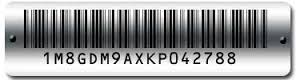
VIN plate
Deciphering the VIN characters 1-3
The first three digits are the World Manufacturer Identifier (WMI). The first character represents the country of origin. For instance, vehicles made in the United States start with 1, 4, or 5, while those from Japan begin with J.
Country Codes:
1, 4, 5 = U.S.
2 = Canada
3 = Mexico
6 = Australia
7 = New Zealand
8, 9, 0 = South America
A-H = Africa
J-R = Asia
S-Z = Europe
Some assignments are straightforward when identifying specific countries within Africa, Asia, and Europe, like “J” for Japan. However, because the alphabet is divided regionally and certain letters (O, I, and Q) are prohibited from the VIN, some country codes might seem arbitrary. For example, the letter combinations ZA-ZR represent Italy.
The remaining characters of the WMI are used to identify the manufacturer. There are numerous manufacturer codes, and companies often have separate codes for different countries of operation. Individual codes can be found in vehicle repair manuals, but some of the more common codes include:
The third character, when combined with the first two, may indicate the vehicle type or the manufacturing division. For example, in a VIN starting with 1HG, “1” stands for the U.S., “H” stands for Honda, and “G” might represent the vehicle type.
Here are some of the most common manufacturer codes:
T = Toyota
N = Nissan
H = Honda
AU = Audi
BA, BS = BMW
US = BMW U.S.A.
DB = Mercedes-Benz
FA, FB, FC, FD, FM = Ford Motor Company U.S.A.
L = Lincoln
M, ME = Mercury
G = General Motors
G1 = Chevrolet
VW = Volkswagen
VIN Vehicle Descriptor Section (VDS) Characters 4-9
Characters 4 to 8 provide information about the vehicle’s model, body type, engine type, and transmission. These characters are defined by the manufacturer and vary significantly between different brands. However, the 8th digit is standard and is the code identifying the engine. The 9th character is a check digit used to detect invalid VINs. It’s calculated using a specific mathematical formula that includes the other characters of the VIN.

An illustration of how the vehicle descriptor code works
The 8th digit engine identifier
The engine identifier is specific to the carmaker. The image below is just a portion of the 8th digit descriptor from a Ford 2019 VIN code chart.

Ford’s 8th digit engine identifier
Characters 10-17 — Vehicle Identifier Section
The last string of digits in the VIN – characters 10-17 – are known as the “vehicle identifier section” or VIS for short. The last eight digits are essentially your vehicle’s serial number. A dealer can identify all the components used in your vehicle, including the model year and the last 8 digits of your VIN.
The 10th digit is the vehicle model year. The current VIN system is set to last up until 2039, after which it will most likely repeat itself for another cycle, returning to “A” for 2040 model year vehicles.

Use this chart to determine the model year of the vehicle using the eighth digit of the VIN code
Many websites offer VIN deciphering simply by entering your VIN number. But beware! Most of those sites use your sell your information or try to sell you additional services such as your vehicle’s repair history.
How to use your VIN information
• Get your car’s current value— Sites like kbb.com, edmunds.com, NADA.com will provide you with your cars current value as a trade-in or to sell as a private party. You can enter the year, make, and model manually on those sites or enter your VIN code for an exact match.
• Find service bulletins or recalls—Enter your VIN into the National Highway Traffic and Safety Administration site NHTSA.gov to get a list of your vehicle’s current investigations, service bulletins, or recalls.
• Vehicle History Reports— Fee-based services like Carfax and AutoCheck use the VIN to provide detailed reports on a vehicle’s history, including accidents, ownership changes, and maintenance records. This information is invaluable when buying a used car.
• Registration and Insurance— The VIN is required for vehicle registration and insurance purposes. It helps authorities and insurance companies track the vehicle and verify its authenticity.
• Theft Recovery— In the event of a theft, the VIN can help law enforcement agencies track and recover stolen vehicles. The unique identifier makes it difficult for thieves to disguise a stolen vehicle.
• Parts and Repairs— Use the 8th and 10th digits when buying parts from auto parts stores like AutoZone, OReillys, or Advance Auto Parts. However, if you’re buying parts from the dealer parts department, they’ll want the 8th and 10th digits and the last eight digits.
You can see how much information is in your VIN code
The VIN is more than just a random string of characters; it is a comprehensive identifier that provides critical information about a vehicle. From its manufacturing details to its history and specifications, the VIN is a powerful tool for owners, buyers, manufacturers, and regulators. Understanding how to decode and use the VIN can help you make informed decisions about vehicle purchases, maintenance, and safety. Knowing your VIN can provide valuable insights and peace of mind, whether you’re a car enthusiast, a potential buyer, or a vehicle owner.
© 2015, Rick Muscoplat
Posted on by Rick Muscoplat