
Manifold Catalytic Converter: The Pros and Cons
Understanding a Manifold Catalytic Converter
Not all catalytic converters are created equal, and their placement in the exhaust system can affect their function and design. Two common types of catalytic converters are the manifold catalytic converter and the post-catalytic converter. Understanding the differences between these two can help vehicle owners make informed decisions about maintenance, repairs, and upgrades.
What is a Manifold Catalytic Converter?
A manifold catalytic converter, also known as an integrated or close-coupled catalytic converter, is positioned directly after the exhaust manifold. In some modern vehicles, particularly those with inline engines or V-shaped engines, the catalytic converter is often built into the exhaust manifold itself. This proximity to the engine allows the converter to heat up quickly, which is crucial for reducing emissions, especially during cold starts.
The Pros and Cons of a manifold catalytic converter
Pros:
• Quick Warm-Up Time: The close proximity to the engine allows the converter to reach its optimal operating temperature more quickly, reducing the amount of pollutants emitted during the cold start phase.
• Efficient Emission Control— Because it heats up quickly, the manifold catalytic converter can start reducing harmful emissions almost immediately after the engine is started.
• Compact Design— The integration of the converter into the exhaust manifold can save space and reduce the overall weight of the exhaust system, which can be beneficial for vehicle performance and fuel efficiency.
Cons:
•Replacement Cost— Manifold catalytic converters are often more expensive to replace due to their integration with the exhaust manifold. In many cases, if the converter fails, the entire manifold may need to be replaced.
• Potential for Heat Damage— Being close to the engine, these converters are exposed to high temperatures, which can lead to quicker wear and tear compared to converters located further down the exhaust system.
This design is particularly common in vehicles designed to meet stringent emissions standards, as it helps ensure that the catalytic converter is working as effectively as possible as soon as the engine is started.
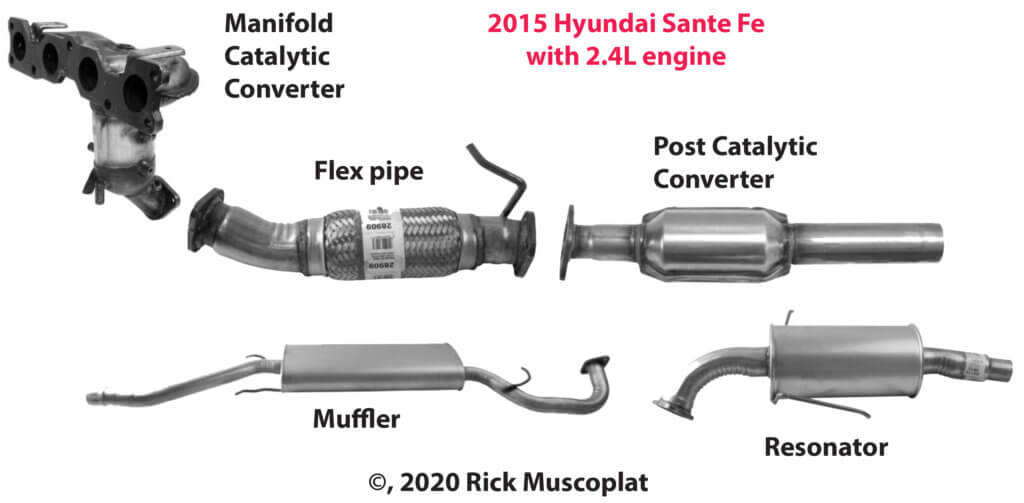
Exhaust setup for a 2015 Hyundai Sante Fe Sport with 4-cylinder engine
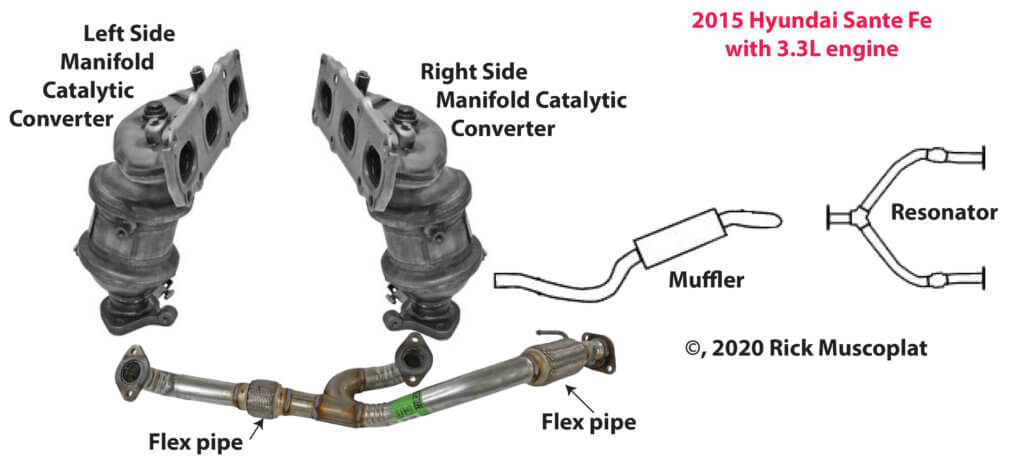
Exhaust setup for the 2015 Hyundai Sante Fe with a 3.3L V-6 engine
In addition to the manifold converters, the vehicle/engine configuration may or may not have one or more post-catalytic converters.
Why carmakers use a manifold catalytic converter
A catalytic converter must reach a minimum temperature in the ~600°F range to effectively start treating exhaust gases.
By placing a catalytic converter right at the exhaust ports, the manifold catalytic converter can “light off” (reach operating temperature) more quickly since the hot exhaust gas immediately heats up the catalytic converter core.
A quick light-off is especially important on cold starts, when the engine is fed a rich fuel mixture that needs to be treated more aggressively in the catalytic converter.
Since the catalytic conversion process generates heat the exhaust gas leaves the manifold converter hotter than it came in. If the carmaker includes a secondary post catalytic converter, the hotter exhaust gas helps that unit light off faster.
Why didn’t the old system work?
The problem with the older system, where the catalytic converter sits under the vehicle, is that the exhaust would cool too much in cold weather, taking much longer for the underside converter to light off. That caused increased emissions on cold starts in cold weather.
If it has a Manifold Catalytic Converter, why does it need another one downstream?
Some carmakers use one or more manifold catalytic converters along with another one farther down in the exhaust. It all depends on the emissions standards the car was built for (CA or federal). A second one is needed in some cases because the manifold converter is so small that it can’t handle all the exhaust clean-up.
Do thieves steal manifold catalytic converters?
Generally not. They’re easier to access since they’re often out in the open under the hood. But cutting through the thick manifold is far more difficult. Plus, in many cases, the manifold catalytic converter contains less precious metal, making it less valuable at the recycling center. In other words, it’s too much work for too little reward.
©, 2020 Rick Muscoplat
Posted on by Rick Muscoplat