
P0420 or P0430 No Other Codes? Here’s What I Check First
P0420 or P0430 With No Other Codes: How I Diagnose It Without Wasting Money
Quick Summary
If you have a P0420 or P0430 with no other codes, don’t automatically assume the catalytic converter is bad without additional testing. In my experience, the converter is often the culprit, but it’s not the only possibility. I always begin by confirming there are truly no additional engine, fuel trim, misfire, or oxygen sensor codes, then inspect for exhaust leaks and analyze live scan data before recommending an expensive converter replacement. Following a logical diagnostic process can save hundreds—even thousands—of dollars while preventing a repeat failure.
I’ve diagnosed hundreds of emission-related problems over the years, and few trouble codes lead to more unnecessary parts replacements than P0420 or P0430 with no other codes. The first thing many DIYers do is replace oxygen sensors. The second thing they do is replace the catalytic converter. Unfortunately, they often spend money without actually diagnosing the problem.
When I see P0420 or P0430 with no other codes, I don’t reach for parts—I reach for my scan tool.
What Does P0420 or P0430 With No Other Codes Really Mean?
Modern engine computers constantly compare the signals from two oxygen sensors:
• Upstream (Sensor 1): Measures the oxygen content leaving the engine.
• Downstream (Sensor 2): Monitors how well the catalytic converter cleans the exhaust.
A healthy catalytic converter smooths out the rich/lean fluctuations created by the engine. The downstream oxygen sensor should produce a relatively stable signal.
When the downstream sensor starts switching almost as rapidly as the upstream sensor, the PCM concludes the converter isn’t storing oxygen effectively and eventually sets P0420 or P0430 after multiple failed drive cycles.
Common Causes of P0420 or P0430 With No Other Codes
In my shop, these are the most common causes:
• Aging catalytic converter
• Small exhaust leak ahead of Sensor 2
• Contaminated catalytic converter from past oil or coolant consumption
• Downstream oxygen sensor reporting inaccurate data
• Previous engine problems that permanently damaged the converter
Why Having No Other Codes Matters
The phrase “with no other codes” is important.
If there are no:
• Misfire codes (P0300-P0308)
• Fuel trim codes (P0171, P0172, P0174, P0175)
• Oxygen sensor circuit codes
• Air-fuel ratio sensor codes
then you’ve already eliminated many of the most common causes of catalytic converter damage.
However, no other codes doesn’t guarantee the converter is bad. Some exhaust leaks and aging converters never trigger additional diagnostic trouble codes.
My Step-by-Step Diagnostic Process
1. Verify There Really Are No Other Codes — Many inexpensive code readers only display active codes and generic P powertrain codes, but no enhanced manufacturer-specific codes or U, C, or B codes. Pending misfire codes often appear before a catalyst efficiency code becomes active.
I always perform a complete scan for:
• Pending codes
• History codes
• Permanent codes
• Manufacturer-specific codes
2. Review Freeze Frame Data — Freeze frame information tells me:
• Engine RPM
• Vehicle speed
• Coolant temperature
• Engine load
• Fuel trims
• Closed-loop operation
If the code set during cold operation or before the converter reached operating temperature, that points me in a different direction than a code that sets during steady highway cruising.
3. Check Long-Term Fuel Trim Anyway — Even if there isn’t a fuel trim code, I always examine live data. Ideally:
• LTFT should remain within about ±10%
• Short-term fuel trim should fluctuate normally
Fuel trims consistently above 15-20% indicate the engine is compensating for another problem that could shorten catalytic converter life.
4. Inspect for Exhaust Leaks — This is one of the most overlooked causes.
A small exhaust leak can pull fresh air into the exhaust stream. That extra oxygen fools the downstream sensor into reporting poor catalyst efficiency. I’ve seen tiny pinhole leaks set P0420 codes repeatedly.
• At the manifold
• At the flex pipe
• Around a flange
• Ahead of the downstream oxygen sensor
5. Evaluate Oxygen Sensor Performance — Many people replace oxygen sensors simply because they see a catalyst code. I don’t. Instead, I examine live graphing. On a healthy system:
• Upstream sensor switches rapidly
• Downstream sensor remains relatively steady
If the downstream sensor is slow, stuck, or electrically erratic, I test its wiring and operation before replacing anything.
A failed oxygen sensor usually sets its own diagnostic code, but not always.
6. Compare Sensor Waveforms — This is where professional diagnosis separates itself from guesswork. If both sensors produce nearly identical waveforms, the converter is no longer storing oxygen efficiently.
If the downstream waveform remains relatively stable while the upstream switches normally, the converter is generally doing its job.
7. Inspect the Catalytic Converter — If all previous tests pass, I inspect for signs of converter failure:
• Rattling ceramic substrate
• Overheated shell
• Impact damage
• Melted internal brick
• Restricted exhaust flow
An infrared thermometer or exhaust backpressure test can help identify a partially plugged converter.
A melted/shattered catalytic converter due to overheating or impact damage
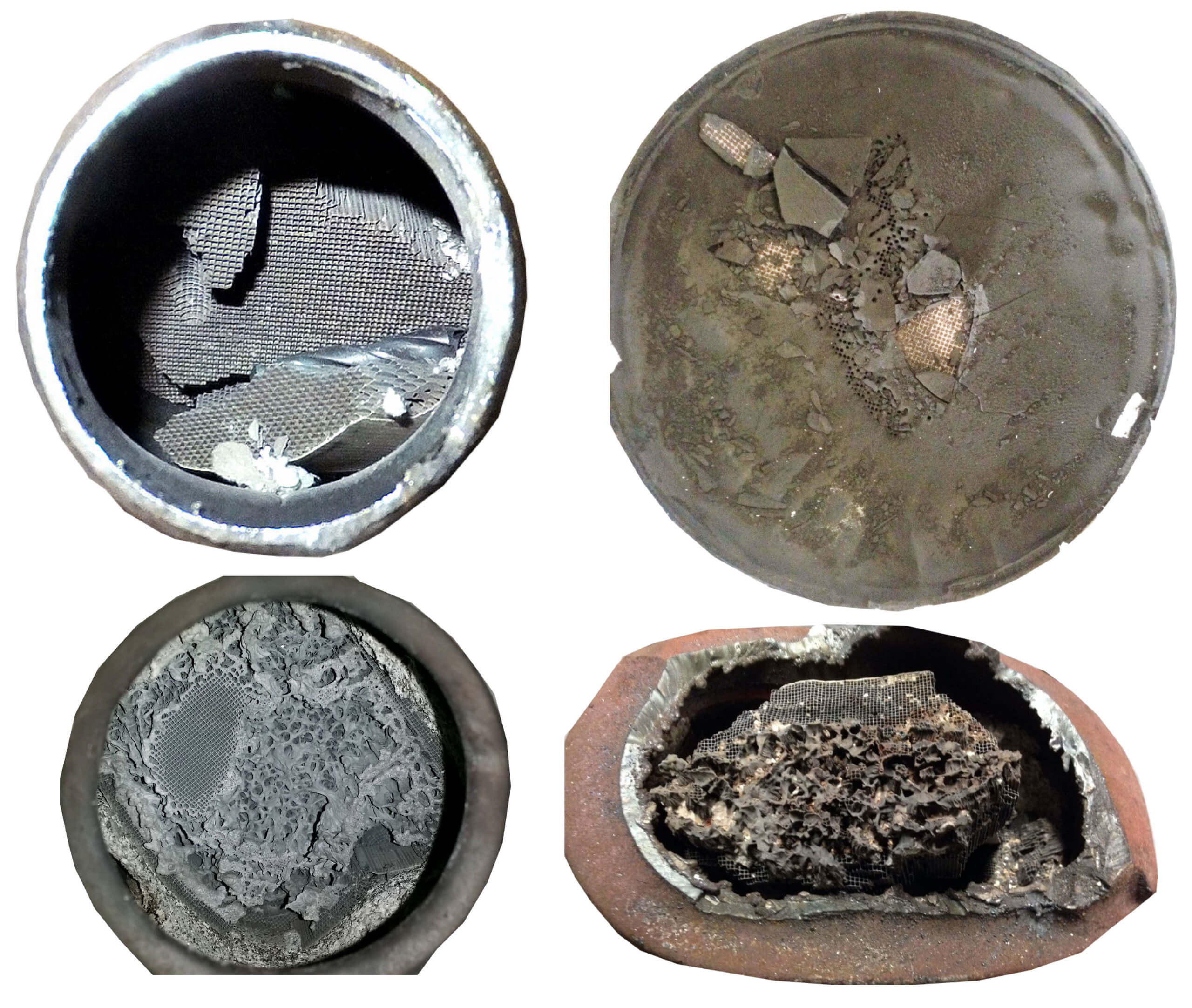
Inside view of a catalytic converter with a melted ceramic structure
How the Catalytic Converter Is Monitored
To understand why the P0420 code appears, you need to understand how the system works. The upstream oxygen sensor rapidly switches between rich and lean as the engine runs. A healthy catalytic converter smooths out those fluctuations.
The downstream oxygen sensor should show a relatively steady signal. When the downstream sensor begins to mimic the upstream sensor, the PCM interprets this as reduced catalyst efficiency. After a sufficient number of failed tests across multiple drive cycles, the P0420 code is stored, and the check engine light illuminates.
How to Fix a P0420 Code (Without Wasting Money)
Repair Engine Problems First — If the engine isn’t running correctly, any new catalytic converter will fail again. Fix misfires, oil consumption, vacuum leaks, or rich fuel conditions before clearing the P0420 code.
Fix Exhaust Leaks — Repairing an exhaust leak is often the cheapest and fastest fix for a P0420 code, and it’s frequently overlooked.
Replace Faulty Oxygen Sensors — If testing confirms a bad downstream oxygen sensor, replacement can restore correct readings and eliminate the P0420 code.
Replace the Catalytic Converter (When Proven Bad) — When replacement is necessary, use a quality OEM or CARB-compliant converter. Low-cost units often don’t meet efficiency thresholds and can trigger the P0420 code.
What Not to Do
I regularly see these expensive mistakes:
• Replace oxygen sensors without testing
• Replace the catalytic converter before diagnosis
• Ignore small exhaust leaks
• Clear the code repeatedly hoping it disappears
• Install a low-quality aftermarket converter
Cheap catalytic converters often fail to meet OEM efficiency standards and may trigger the same code shortly after installation.
Can You Drive With P0420 or P0430?
Usually yes.
Most vehicles drive normally because catalyst efficiency doesn’t significantly affect engine performance.
However, I don’t recommend ignoring it because:
• Emissions increase
• Fuel economy may decline
The underlying cause could continue damaging the converter
• You may fail an emissions inspection
My Bottom Line
Whenever I diagnose P0420 or P0430 with no other codes, I never assume the catalytic converter is automatically bad. I verify there are truly no additional codes, inspect for exhaust leaks, analyze fuel trims, compare oxygen sensor waveforms, and only condemn the converter after every other possibility has been eliminated.
That extra hour of diagnosis often saves hundreds of dollars—and prevents replacing a catalytic converter that wasn’t actually the problem in the first place.
© 2012 Rick Muscoplat
Posted on by Rick Muscoplat