
Rack and pinon steering: How it works
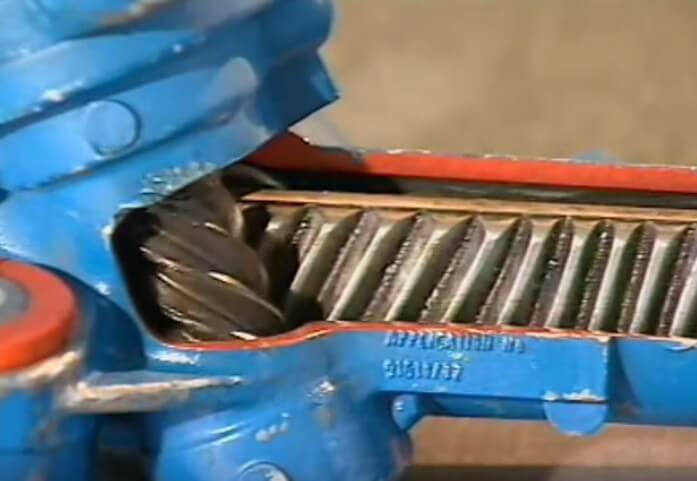
Understanding Rack and Pinion Steering: How It Works and How It Differs from Other Steering Systems
Rack and pinion steering is a popular and widely used steering mechanism in modern vehicles. Its simplicity, precision, and effectiveness make it a preferred choice for many automobile manufacturers. This article delves into the workings of rack and pinion steering, its advantages, and how it compares to other steering systems.
How Rack and Pinion Steering Works
Rack and pinion steering converts the rotational motion of the steering wheel into the linear motion required to turn the wheels. This system consists of two main components: the pinion gear and the rack.
Components and Operation
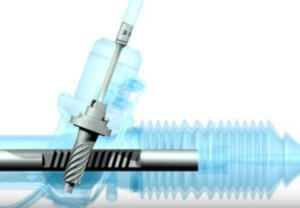
• Steering Wheel and Steering Shaft— The driver turns the steering wheel, which is connected to the steering shaft.
The steering shaft, in turn, is connected to the pinion gear.
• Pinion Gear— The pinion gear is a round gear at the end of the steering shaft. As the steering wheel rotates, the pinion gear turns.
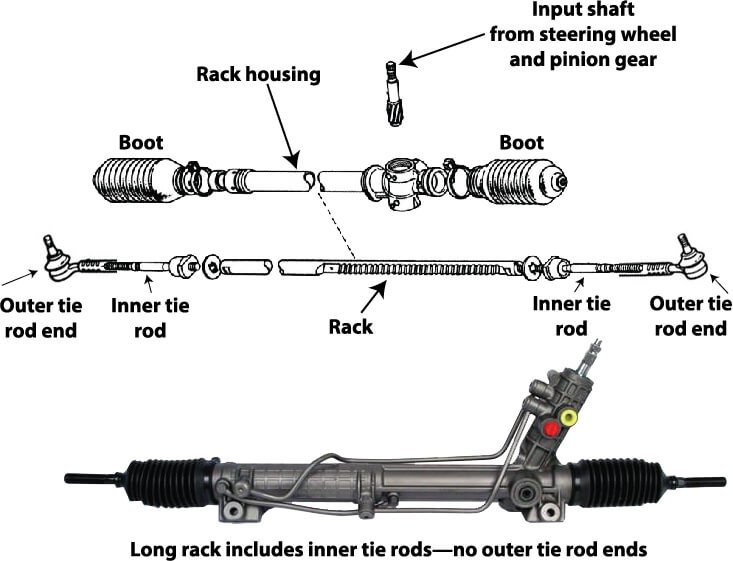
• Rack— The rack is a flat, toothed bar that meshes with the pinion gear. The rotation of the pinion gear moves the rack left or right.
• Tie Rods— Attached to each end of the rack are tie rods.
The tie rods connect to the steering knuckles, which are attached to the front wheels.
Movement of the rack pushes or pulls the tie rods, turning the wheels.
• Power Steering— Many modern vehicles feature power-assisted rack and pinion steering.
Hydraulic or electric systems reduce the effort needed to turn the steering wheel, providing smoother and easier steering.
The Advantages of Rack and Pinion Steering versus a Recirculating Ball Steering Gear
A Rack and pinion steering gear offers several benefits over other steering systems:
• Precision and Responsiveness— The direct connection between the steering wheel and the wheels provides precise control and quick response. This enhances the driving experience, especially in high-performance and sports cars.
• Simplicity and Compact Design— The system’s simplicity results in fewer components and lower weight. The compact design makes it easier to fit into tight spaces, contributing to better overall vehicle design.
• Improved Feedback— Rack and pinion steering provides better feedback to the driver, allowing for a more intuitive understanding of road conditions. This improves safety and driving confidence.
• Reduced Maintenance— With fewer moving parts, rack and pinion systems generally require less maintenance and are more durable. The reduced complexity also leads to lower manufacturing and repair costs.
How Rack and Piniont Steering Differs from Other Steering Systems
To understand the unique benefits of rack and pinion steering, it’s helpful to compare it with other common steering systems, such as recirculating ball worm and roller steering.
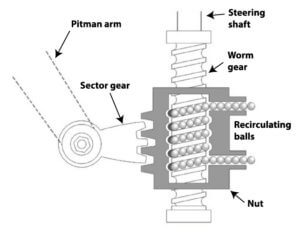
• Recirculating Ball Steering— Recirculating ball steering uses a series of ball bearings to reduce friction between the steering gear and the worm drive. The system involves a worm gear mounted on the end of the steering shaft, which meshes with a sector gear attached to the pitman arm.
This system is commonly used in larger vehicles, such as trucks and SUVs, because it can handle heavier loads.
It provides greater mechanical advantage making it easier to steer heavy vehicles. The design can absorb and dampen shocks from rough road conditions.
Disadvantages of a recirculating ball steering gear:
It is less precise and responsive compared to rack and pinion steering. The complexity of the system results in more components that can wear out and require maintenance.
How a recirculating ball steering system works
Traditional pitman arm or recirculating ball steering gears use a worm gear and “nut” steering gear mechanism and parallelogram-style steering linkage. In this system, turning the steering wheel rotates the worm gear, moving the nut up and down, which then rotates the pitman arm in an arc. The pitman arm connects to a center linking rod, an idler arm, and two tie rods connected to the wheels. The pitman arm translates an arc motion into linear left and right movement. There are many more moving parts in a recirculating ball steering mechanism and far more components and movable joints in the steering linkage in a parallelogram steering system. Here’s a deeper explanation o
Recirculating ball steering gear and parallelogram steering linkage
This image shows the inside of a recirculating ball steering gear. Manufacturers design the grooves on the worm gear to accept ball bearings and include a recirculating tube as a return path for the balls. Rotating ball bearings against the threads of the worm gear result in far less friction than the same setup without the ball bearings. The main advantage of a recirculating ball style steering gear is the increased mechanical advantage. It takes less mechanical effort to steer with a recirculating ball steering gear than a rack and pinion system.
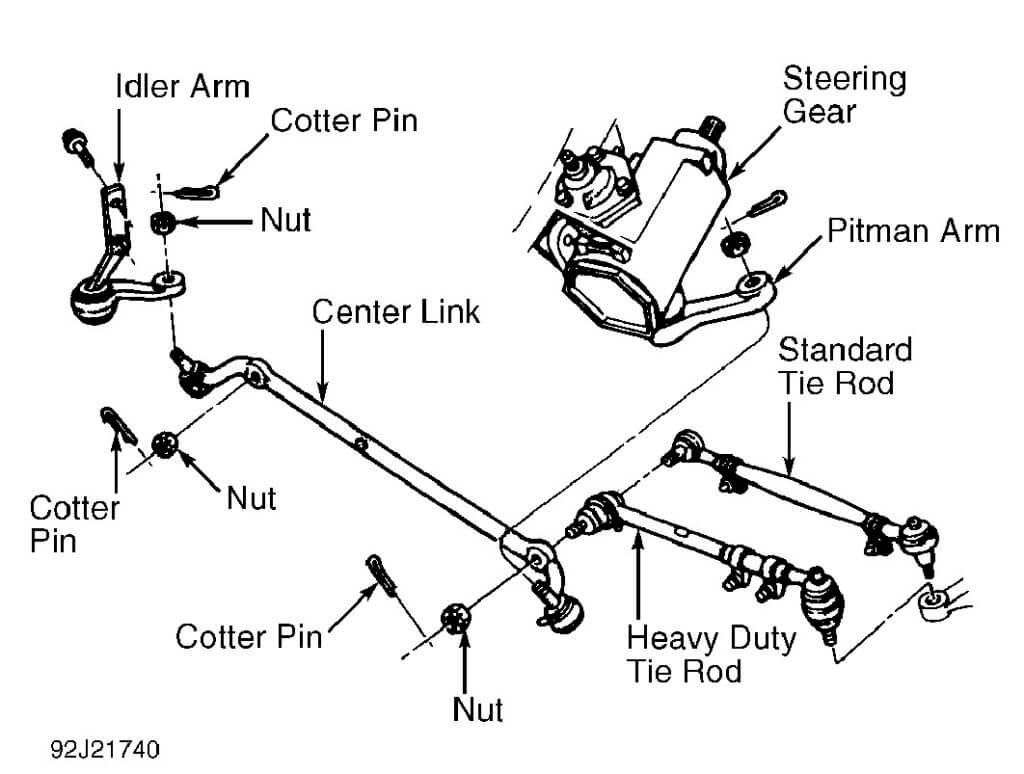
On the downside, recirculating ball steering gears weigh more than a rack and pinion steering system, cost more to manufacture and install and repair. Plus, the additional movable joints in a parallelogram steering system reduce road feel and delay driver input slightly.
Rack and pinion steering systems
As you can see in the diagrams, rack, and pinion steering systems, have fewer moving parts inside the gear compared to recirculating ball steering systems. Plus, they have fewer joints in the steering linkage. Steering motion is transferred directly to the rack and then to the wheels, so the steering is more precise and far more responsive. The direct linkage to the wheels provides more road feel and driver feedback, so driver response time is decreased when encountering slippery patches. The system costs less to manufacture and install and weighs less, which improves gas mileage.
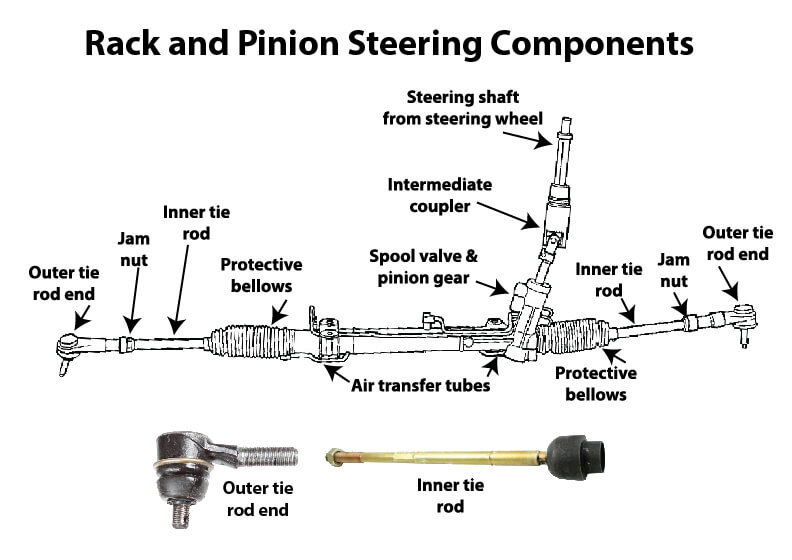
Where the inner tie rod and outer tie rod ends are located on a rack and pinion steering gear
However, rack and pinion steering mechanisms do have some disadvantages. Since the rack must move left and right, the length of the rack is limited based on vehicle width and engine compartment space. These systems are also more susceptible to bump steer which is caused by backward liner input to the gear when the wheel hits and rebounds from road bumps. This is due to the fact that the tie rod must move up and down to accommodate wheel movement, and that movement is usually in an arc. Since the length of the tie rod is fixed, wheel movement up from dead center forces the tie rod into or out of the steering housing assembly causing the steering wheel to move.
What goes wrong with rack and pinion steering gears?
The first generation R&P gears from the early ‘80’s suffered from “morning sickness” where the driver had no power steering assist when starting off first thing in the morning. Power assist returned as the power steering fluid heated up and the metal components expanded, preventing high pressure fluid seepage between ports. That problem has been corrected.
Leaking rack and pinion steering gear
These days, the most common R&P failure is leaking end seals. You can spot this failure by examining each bellows for signs of leaking fluid or tears. If a bellows tears, road dirt can get inside and grind away at the end seals, causing them to fail. However, the seals can also be worn from normal use. Most shops won’t install new seals because the labor involved is greater than the time it takes to install a complete rebuilt unit. Don’t bother trying a stop-leak product—it won’t work because the rack is constantly moving in and out of the seal. Stop leak products don’t work when there’s movement in the seal. Here’s what rack leaks look like.
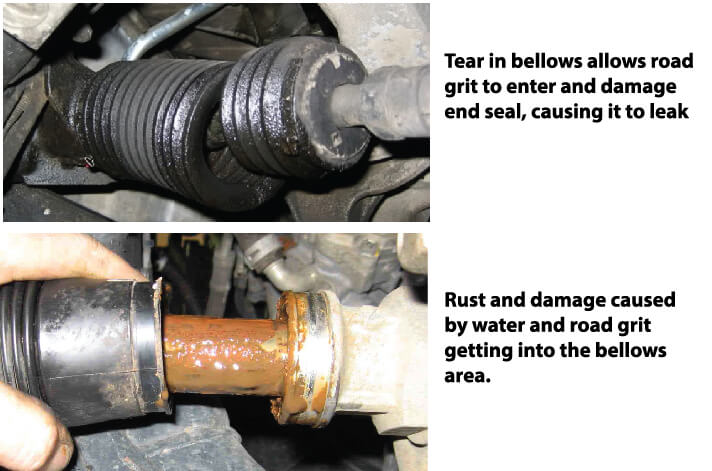
R&P gears can also develop fluid leaks in the spool valve area near the steering shaft input. These leaks are usually caused by dirty, contaminated or improper power steering fluid.
For more information on power steering fluid, read this post
For more information on tie rods, read this post
For more information on tie rod replacement cost, read this post
For more information on rack and pinion replacement cost, read this post
©, 2017 Rick Muscoplat
Posted on by Rick Muscoplat