
Remove a Car Door Trim Panel in Under 15 Minutes
How to Safely Remove a Car Door Trim Panel
Quick Summary
The key to removing a car door trim panel is understanding how the panel is assembled at the factory, locating the hidden fasteners, and lifting the panel off correctly rather than forcing it. I’ll walk you through how I do it in the shop—step by step—so you can confidently access window regulators, latches, speakers, or switches without guesswork.
Article
How I Remove a Car Door Trim Panel Without Breaking Anything
The first thing I tell people is this: removing a door panel isn’t hard—it’s just unfamiliar. Car manufacturers intentionally hide fasteners to keep interiors clean and reduce assembly time. Once you understand the design logic, removing a car door trim panel becomes straightforward and predictable.
Door trim panels are typically secured with a combination of snap fasteners—commonly called “Christmas tree” fasteners—and a few strategically placed screws. During assembly, the factory first hangs the top of the panel over the window ledge, then slams it into place to seat the fasteners. Your job is simply to reverse that process carefully.
Understanding Door Panel Fasteners Before You Start
Most trim panels use plastic snap fasteners that press into holes in the metal door shell. These fasteners expand as they enter the hole, gripping tightly. They’re strong enough to hold the panel in place but flexible enough to release when pried correctly.
However, manufacturers know those fasteners can’t handle the daily stress of pulling the door shut. That’s why screws are always added in high-load areas, such as the armrest and door pull. Those screws are hidden behind small plastic “vanity caps,” reflectors, or trim covers. To remove a car door trim panel, you must locate all the screws—missing even one will cause cracked plastic or broken clips.
 The snap fasteners are known as “Christmas Tree” fasteners. The head locks into a keyhole slot on the door trim panel, and the barbed “limb ends” are designed to push into a pre-punched hole in the metal door. During installation, the assembler hooks the top of the door trim panel on the window ledge and presses the panel against the door frame. They smack the door panel with a rubber mallet to force the Christmas Tree fasteners into the holes. As the fasteners enter the holes, their “limbs” expand and hold the panel.
Step #1: Remove the window crank (manual windows)
If you have manual windows, start by removing the window crank. Some window 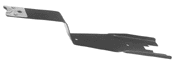 cranks are screwed in place. The screw is either in plain sight or hidden under a vanity cap in the center of the large circular part of the crank. If your vehicle doesn’t have a screw or hex-head fastener, it is held in place with a clip. There’s a way to remove the retaining clip with just a rag. But it doesn’t always work. The proper removal tool is cheap (less than $8 at any auto parts store) and will get you off to the right start on this project.
The removal tool works by expanding the ears on a clip in a slot on 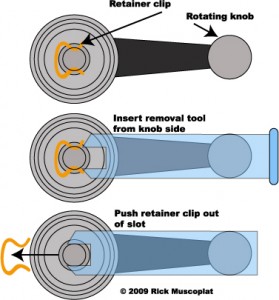 the window crank. Most DIYers get frustrated at this point because they don’t know which way to insert the tool. The factory always installs the open end of the clip so it faces the rotating knob. If this is the first time the crank is being removed, insert the tool between the crank handle hub and the protective plastic disk. The protective disk prevents the crank arm from wearing a groove into the door trim panel. If you try to insert the removal tool between the protective disk and the door panel, it will not engage the spring clip. If you cannot disengage the clip, the window crank may have been removed by someone else, and the clip may be installed backwards. In that case, insert the tool so it pushes the clip towards the rotating knob.
Hold a rag on the ejection side of the window crank to catch the clip. Trust us, it will go flying across the room if you don’t cover the edge with a rag. Then push the tool towards the center hub. You will feel the clip pop off. Then pull the window crank towards you. When you reassemble the crank handle, remember to install the clip so the open end faces the rotating knob. With the clip installed in the groove, simply press the crank assembly onto the splined shaft until the clip snaps into the shaft groove.
Step #2 Finding and Removing Hidden Screws
Now comes the detective work. I methodically inspect the armrest, door pull pocket, latch area, and lower edge of the panel. Any decorative plastic piece usually hides a screw. Reflectors often pop out to reveal fasteners behind them. On carpeted panels, screws are frequently buried along the bottom edge—you have to feel for them with your fingers.
This is where patience pays off. Every screw must be removed before you attempt to release the panel fasteners. When people break door panels, it’s almost always because they skipped this step while removing a car door trim panel too aggressively.
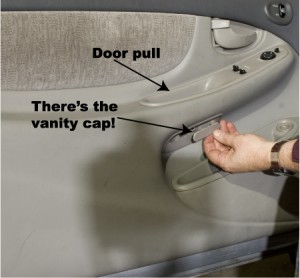
Vanity caps come in all shapes and sizes
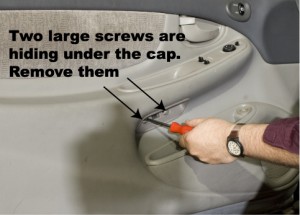
Here’s one under the door pull area.
Don’t forget to check under reflectors and along the latch side of the door panel.
If your door panel has carpet, feel for screws hidden along the bottom edge of the carpet.
Clearing Anything That Blocks Panel Removal
Modern vehicles often have trim pieces near the side mirror or door latch that must come off first. Some snap in place, others use hidden screws. I use a trim removal tool—not a screwdriver—to avoid marring the plastic.
If there’s a tweeter or courtesy light in the trim, disconnect the wiring as soon as it’s accessible. Never let the panel hang by electrical connectors. That’s a guaranteed way to create more work when you’re trying to remove a car door trim panel safely.
Dealing With Door Latch Handles (Especially on Asian Vehicles)
Many Asian vehicles require partial removal of the interior door handle before the panel can come off. Sometimes there’s a visible screw. Other times, the trim bezel snaps over the release mechanism.
Once loose, slide the latch assembly forward to disengage
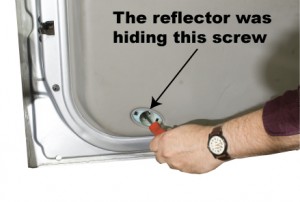
Don’t forget to check under reflectors and along the latch side of the door panel.
the plastic hooks, then disconnect the latch rod by rotating the retaining clip. Don’t lose that clip—it’s critical for reassembly. I’ve seen people waste an hour because they didn’t understand this step when removing a car door trim panel.
Some Asian vehicles look like the latch in the illustration, but do not have a screw. The trim bezel on these latches hides the release mechanism. Use a small flat-blade screwdriver to gently pry the bezel up from the edge of the latch. Then, pry down on the bottom edge of the bezel. Once it’s off, you’ll see either hidden screws or spring-release latches. Remove those, and the door handle will come out.
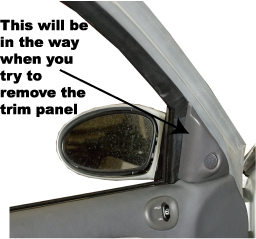
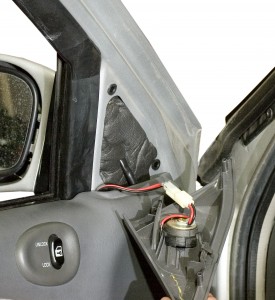
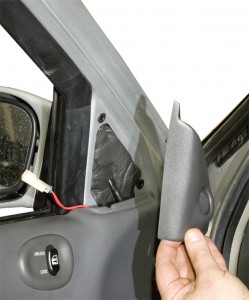
Disconnect the electrical connector
Releasing the Panel Fasteners Properly
I always start at the bottom of the door. Using a door panel removal tool, I pry against the metal door shell—not the trim panel—until I feel each fastener pop free. I work my way around the panel, keeping outward tension so released clips don’t snap back in.
Once the lower and side fasteners are loose, the panel will feel free, but still won’t come off. That’s by design.
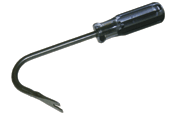
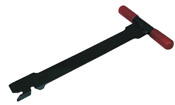
Start at the bottom of the trim panel and insert the door panel removal tool. Pry 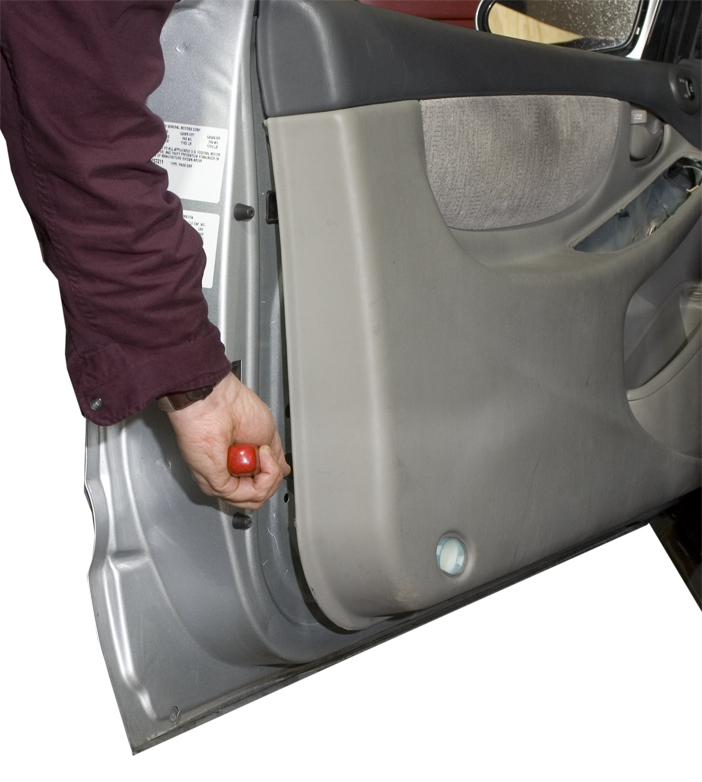 against the metal portion of the door until you feel the fasteners pop. Move the tool toward the hinge area, then repeat while keeping the loose portion away from the door. Once the bottom fasteners are released, you can usually pull the door panel out, and the remaining fasteners will pop out. If they don’t, you’ll need a long-handled tool like the one shown below.
Lifting the Panel Up and Disconnecting Wiring
Here’s the part most people get wrong. The top of the panel hooks over the window sill, so you must lift it straight up—not pull it out. Once it clears the sill, stop and disconnect all electrical connectors for switches, speakers, and courtesy lights.
Only after everything is unplugged should you fully remove the panel. If your goal is to remove a car door trim panel without damage, this step is non-negotiable.
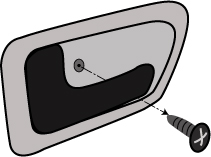
Remove the screw from the door latch
Step #7: Account for all Christmas Tree Fasteners and re-install where necessary
It’s not uncommon for Christmas Tree fasteners to slide out of their keyhole slots in the trim panel. Locate any fasteners still in the door frame and remove them with the slotted removal tool. Then reinstall them in the keyhole slots in the trim panel. Straighten any bent fasteners now or buy new ones at the auto parts store.
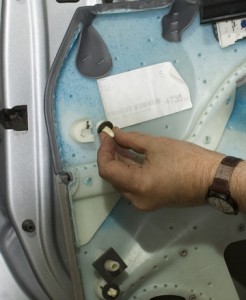
© 2012 Rick Muscoplat
Posted on by Rick Muscoplat