
Understanding Detonation Piston Damage
Avoiding Piston Damage: The Truth About Detonation
Many people confuse the terms detonation and pre-ignition. Both can cause engine damage, but the root cause is different. Preignition, as the name implies, is a combustion event that occurs before the ignition system provides a spark. The combustion can start from a hot spot within the combustion chamber or from the high heat created in a high-compression engine using low-octane fuel. Detonation, on the other hand, happens AFTER the spark has fired, combustion has started, and the piston is about 2/3 of the way through its power stroke. Pre-ignition and detonation happen for different reasons and the piston damage caused by each is different. Detonation piston damage happens more quickly because it’s caused by a more violent explosion.
Detonation: The Definition
Detonation, also known as engine knocking, occurs when pockets of low-octane fuel ignite spontaneously from the rapid heat and pressure buildup created by the spark-initiated controlled combustion. The spontaneous combustion of multiple pockets of low-octane fuel collides with the main combustion front, creating a violent and uncontrolled explosion and a knocking sound. The extremely high heat and pressure waves cause detonation piston damage that can show up as burn-through or cracked piston lands.
Low octane fuel causes detonation
The number one cause of detonation is using low-octane fuel in an engine that requires a higher-octane fuel. If an engine is designed for 91 or 93-octane fuel and you fill it with 87-octane, the engine will experience detonation. Think of normal combustion as a single controlled explosion. The ignition starts the combustion event, and the flame front expands, spreading outward. However, in a detonation event, the multple flame fronts collide in an uncontrolled explosive manner, causing piston damage.
How an engine handles detonation
Modern engines monitor the combustion process with a knock sensor. When detonation or pre-ignition occurs, the knock sensor detects the sound of the uncontrolled explosions. If the ECM receives a knock sensor signal before it initiates the spark for that particular cylinder, it knows its pre-ignition event. It then alters spark timing, the air-fuel mixture, or both. However, If the ECM detects knock sensor operation AFTER it initiates the spark, it knows that it’s dealing with detonation.
In both cases, the ECM will retard spark timing. If your engine was designed to burn premium fuel, but you fill it with 87 octane, the ECM will retard spark but as much as 25%. If detonation still occurs after retarding spark timing by that much, the ECM will set a check engine light and store a trouble code.
What pre-ignition does to your engine
Pre-ignition causes super-heated temperatures inside the combustion chamber along with pounding opposing forces that:
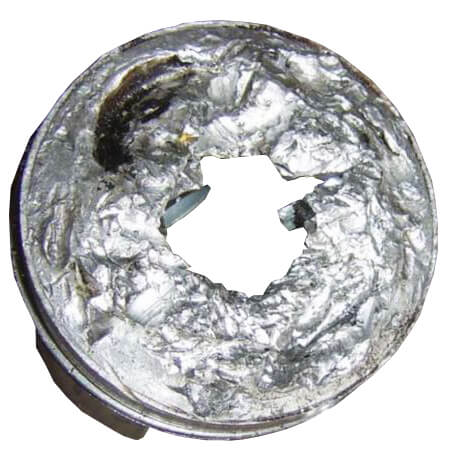
Piston damage caused by the high heat of pre-ignition
• Burns the center dome of the piston
• Damages rod and crankshaft bearings
What detonation does to an engine?
While pre-ignition tends to melt the center of the piston, detonation damages the edges of the piston rings and lands.

This image shows examples of detonation piston damage cause by the violent uncontrolled combustion event
Detonation and octane myths
MYTH: High-octane fuel requires a higher ignition temperature.
High-octane and low-octane fuel ignites at the same temperature. Octane has nothing to do with flash point. The spark temperature is the same for an engine burning regular fuel versus high-octane fuel. Yet regular and premium fuels both start ignition with the same spark.
MYTH: High octane fuel takes longer to burn. The burn time is the same for regular and premium fuels.
MYTH: High octane fuel contains more cleaning additives. Oil companies may add more fuel injector cleaners to their premium fuels by choice. But it’s not universally true that all premium fuels contain more cleaning additives. Aside from having a higher octane rating, the additive package in premium fuel is usually the same as regular fuel.
MYTH: All premium fuel is ethanol-free. Many premium fuels don’t contain ethanol. But fuel is a mixture of almost 150 different chemicals and every refiner has their own recipe. The fuel has to meet RON and MON octane ratings and it’s up to each company to formulate their gasoline to meet those rating. Since ethanol has a higher resistance to detonation, refiners can use it to boost the fuel’s octane level. You can’t make the claim that all premium gas is ethanol free.
Premium gas provides more power. This is misleading. Premium gas, by itself, has nearly the same energy content as regular fuel (although some premium fuel may have slightly higher BTU content simply because of the components they add to reach the octane rating). If an engine calls for premium gas and you fill it with premium fuel, you will get the maximum power out of that fuel. If you fill it instead with regular gas, the ECM will retard spark timing to eliminate detonation and THAT will result in less power.
On the other hand, if you fill you tank with premium fuel and your engine was designed to run on regular gas, you will NOT get any more power from your engine. Premium gas doesn’t provide more power. Period.
©, 2019 Rick Muscoplat