
Understanding the Importance of the Brake Pad Backing Plate
Brake pad backing plate quality is critical to brake pad life
The brake pad backing plate is just as important as the friction material! The friction material on your brake pads may stop your car, but the brake pad backing plate is what transfers the clamping force from the caliper piston(s) to the friction material. It has to be strong, flat, and rust, and flex-resistant. Based on recent surveys, most backing plates don’t measure up. In fact, the surveys show that 51.1% of used brake pads failed due to rusted backing plates, and that rust occurred long before the friction material was used up. For more information on how brake pads fail, see these test results from the Global Brake Safety Council
Why backing plates rust and fail
Backing plate steel is hot rolled at the mill at 900°C to 1100°C. Iron oxide forms on the surface as it exits the rolling machinery and is exposed to the air. The iron oxide must be removed and the steel preserved against corrosion before before being stamped to size, and painted or zinc plated.
“Pickling” is one method to remove the oxide and preserve the steel.

The brake pad backing plate has rusted. “Rust jacking” (expanding rust) causes the friction material to debond from the backing plate. The friction material cracks, causing uneven friction material to the rotor application, which causes a grinding noise
The pickling process starts by immersing the steel in an acid bath to dissolve the oxide layer. Then, the steel is dipped in oil to prevent further oxidation. Pickling is the preferred method for most brake pad manufacturers because it’s cheap and provides some corrosion protection prior to stamping. But some brake pad companies skip the pickling step and simply leave the iron oxide in place until they’re ready to fabricate. Then they shot blast the steel.
Shot blasting removes some of the oxide, but leaves some corrosion embedded in the outer layer. Later, when the steel is stamped into backing plates, that oxide is further embedded into the lugs and holes. That remaining oxide is what causes the final paint coating to fail, which allows water to reach and corrode the steel.
How a rusted backing plate damages your brake pads
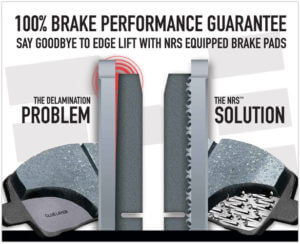
As rust forms, it grows in size, which pushes the friction

Total friction material separation from backing plate caused by low quality steel
material away from the backing plate. This “rust jacking” causes the adhesive bond to fail between the friction material and the backing plate. Once the friction material de-laminates, it can no longer transfer heat to the backing plate. The result? The friction material cracks and breaks of, leaving you with reduced braking ability.
Nucap NRS™ backing plates eliminate the glue
Brake pad manufacturers typically attach the friction material to the backing plate using an adhesive. Some manufacturers take it a step further by using adhesive along with an in-mold technique where the friction material is forced into holes in the backing plate during the molding process. This is referred to as in-mold bonding. For more information on friction material attachment methods and in-mold backing plates, see this post.
Adhesive bonding is the least reliable over the long term. Disc brake pads live in an environment where the heat can fluctuate between -20°F to over 500°F in seconds and then cool down rapidly, a process that repeats itself every time you apply the brakes.
Brake pads also encounter severe vibration. The rapid temperature changes, along with rapid expansion and contraction and vibration can eventually even the best backing plate paint (even power coated paint) to fail. Once the paint cracks, moisture enters and rust begins. That’s the beginning of the end for brake pads!
Nucap’s NRS backing plates eliminate the glue bond
Rather than rely on adhesive, Nucap incorporates hundreds of metal hooks that engage the friction material during the molding process. So the friction block is retained mechanically and the entire backing plate is protected against corrosion by its galvanized coating. Since Nucap NRS backing plates are stiffer than traditional backing plates, they also reduce backing plate flex.
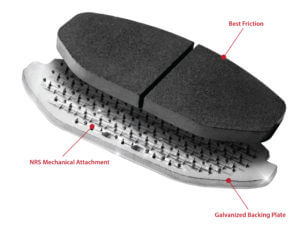
Nucap NRS backing plates mechanically bond the friction material to the backing plate with hooks
Top name brake pad manufacturers use Nucap’s NRS backing plates

These top brands use Nucap’s backing plates
You’ll also find Nucap’s galvanized backing plates in OEM brake pads for these major brands
AUDI
BUGATTI
CADILLAC
CHEVROLET
CHRYSLER
DODGE
FERRARI
FORD
GMC
HINO
HUMMER
INTERNATIONAL
ISUZU COMMERCIAL
JEEP
KENWORTH
LINCOLN
MCLAREN
MERCEDES
MITSUBISHI
MITSUBISHI FUSO
PAGANI
PETERBILT TRUCK
PEUGEOT
RAM
SAAB
SEAT
TOYOTA
VOLKSWAGEN
VOLVO
DISCLAIMER: In accordance with Federal Trade Commission (FTC) rules regarding endorsements, I have not received any financial remuneration from NUCAP or any other company in return for posting this press release on my site.
©, 2019 Rick Muscoplat