
Understanding the P0299 Code on a 2.0L VW or Audi
P0299 Code on a 2.0L VW or Audi: Causes and Solutions
The P0299 code is a common code that can appear on a 2.0L VW or Audi engine. This code specifically refers to a “Turbocharger/Supercharger Underboost” condition. If you’re experiencing this code, it’s crucial to understand what it means, how it affects your vehicle, and what steps you can take to address the issue. This article will delve into the details of the P0299 code on a 2.0L VW or Audi vehicle, including its causes, symptoms, and potential solutions.
What is the P0299 Code?
The P0299 code is triggered when the engine control module (ECM) detects that the turbocharger or supercharger is not producing the expected boost pressure. In essence, the ECM is monitoring the turbocharger’s performance and has found that the actual boost pressure is lower than the desired level.
Common Causes of the P0299 Code according to VW service bulletin TT 21-10-02
VW has issued a service bulletin to address a P0299, P0234 or P0236 trouble code on all 2008-2015 vehicles with the 2.0L TSI engine.
VW has determined that a roll pin located in the turbocharger exhaust housing might possibly back out. That allows the wastegate valve and lever to drop into the housing. The wastegate lever can then become seized in the open or closed position, causing either an under-boost or over-boost condition. The over-/under-boost condition can be intermittent, making it hard to duplicate the fault.
Check the wastegate lever for approx. 3mm of clearance between the bottom of the lever and the turbocharger housing. If there is no gap then the turbo must be replaced.
Other causes of a P0299 code
• Boost Leak— One of the most frequent causes is a leak in the boost system. This can occur in various places, including the intercooler, boost hoses, or connections. Leaks reduce the amount of boost pressure delivered to the engine.
• Faulty Turbocharger— The turbocharger itself might be malfunctioning. Issues can range from mechanical failure to problems with the turbocharger’s wastegate or actuator.
• Failing Wastegate Actuator— The wastegate controls the flow of exhaust gases to the turbocharger. If the actuator fails, it can lead to incorrect boost levels.
• Clogged or Dirty Air Filter— A restricted air filter can limit the amount of air entering the turbocharger, causing a drop in boost pressure.
• Faulty Boost Pressure Sensor— The boost pressure sensor measures the amount of boost the turbocharger is producing. If this sensor fails, it can provide incorrect readings to the ECM.
• Turbocharger Control Valve Issues— The turbocharger control valve regulates the flow of air into the turbocharger. A malfunction here can also lead to boost pressure problems.
• Exhaust Leaks— Leaks in the exhaust system can affect the turbocharger’s efficiency, leading to reduced boost pressure.
• Engine Control Module (ECM) Issues— Though less common, a malfunctioning ECM could also cause incorrect boost readings.
Symptoms caused by a P0299 Code on a 2.oL VW or Audi Vehicles
When the P0299 code is triggered, you might notice several symptoms indicating a problem with your turbocharger or supercharger:
Reduced Engine Power: You may experience a noticeable decrease in engine performance and acceleration. The vehicle may feel sluggish and less responsive.
Poor Fuel Economy: A drop in boost pressure can lead to reduced fuel efficiency, causing your vehicle to consume more fuel.
Check Engine Light: The most immediate indication of the P0299 code is the illumination of the check engine light on your dashboard.
Turbocharger Whining or Noise: If you hear unusual noises coming from the turbocharger, it might indicate a mechanical issue.
Acceleration Problems: You might notice a lack of power during acceleration, making it harder for the vehicle to pick up speed.
Check for power at the charge air pressure sensor for P0299 trouble code
Disconnect the charge air pressure sensor connector. Connect your meter as shown. Turn the key to ON and check for voltages shown. If you don’t see those readings, check for opens and shorts in harness by testing the harness at the ECM.
Next, check for pressure readings. Reconnect connector and backprobe terminal #4 and ground. With the key in the ON position but engine OFF, you should see about 2-volts. The voltage will increase as you add boost pressure.
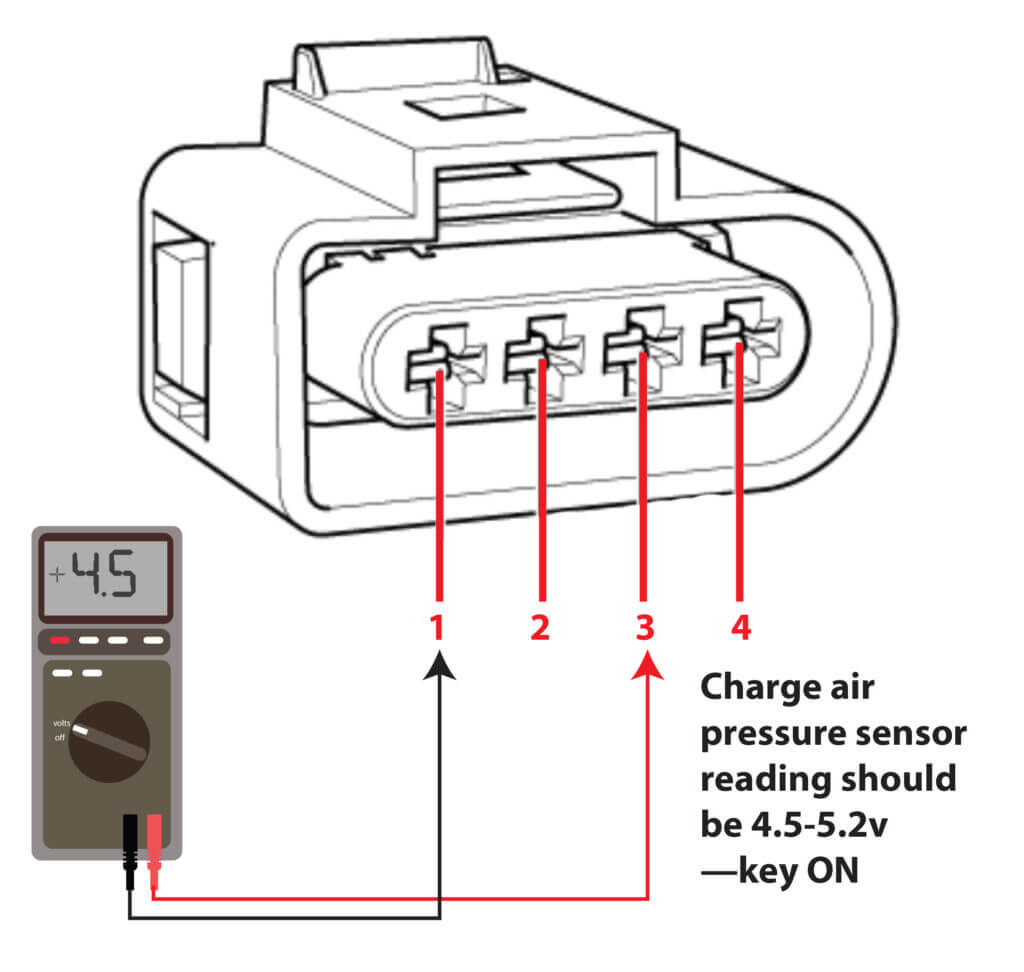
Test the Charge Air Pressure Sensor
Check the turbocharger recirculation valve
The turbocharger recirculation valve is a solenoid valve that meters vacuum to the turbo wastegate to open and close it in varying degrees depending on the amount of boost required. The valve is operated by the ECM with a pulsed voltage. Battery power comes to the valve from the fuel pump relay and the ECM controls the ground to the valve. There are only two terminals on the turbocharger recirculation valve. To test, connect your multimeter and check resistance. You should see 14-20Ω. If not, replace the turbocharger recirculation valve.
Test turbocharger bypass valve
The turbocharger bypass valve diverts boost pressure into the incoming air to the turbo to prevent turbo slowdown. Check for battery power on terminal #1. Check resistance. Should be 27-30Ω.
Test the turbocharger control shutoff valve and wastegate regulating valve
Check the wastegate to ensure it is not leaking at idle. Apply vacuum to the turbocharger control shutoff valve to ensure it’s not leaking.
©, 2019 Rick Muscoplat
Posted on by Rick Muscoplat