
Understanding Traction Control and Stability Control
Learn how traction control and stability control systems work
Many drivers don’t understand the difference between the traction control and stability control system in their cars. I’ll cover what each system does and how each works, along with an explanation of how they work together to keep you safe on slippery roads.
What traction control does
Traction Control Systems (TCS) are designed to prevent the wheels from spinning excessively during acceleration, particularly on slippery surfaces. By preventing wheel spin, TCS enhances vehicle stability and ensures optimal traction.
How TCS Works
The traction control system monitors the wheel speed sensors to detect wheel slip during acceleration. The sensors report wheel rotation speed to the ABS module, which shares the data with the TCS and stability control modules. Once the TCS detects that one or more wheels are spinning faster than the others, indicating a loss of traction, the TCS chooses from one of the following options to increase traction:
• Apply the brake on the spinning wheel—The TCS commands the ABS hydraulic unit to momentarily apply the brake on the spinning wheel(s) to reduce their speed and restore traction.
• Reduce engine power— The TCS can also communicate with the ECM to reduce engine power by adjusting the throttle position, retarding ignition timing, or limiting fuel injection.
What is stability control?
Electronic Stability Control (ESC) is a computerized technology that improves a vehicle’s stability by detecting and reducing the loss of traction, loss of control (skidding) or both. When ESC detects that the driver is losing control, it automatically applies brakes to individual wheels to help steer the vehicle where the driver intends to go. Some ESC systems also reduce engine power until control is regained.
How stability control systems work
The ESC system relies on several sensors to monitor the vehicle’s performance:
• Yaw Rate Sensor— The yaw sensor measures the rotation rate of the vehicle around its vertical axis.
• Lateral Accelerometer— The lateral accelerometer detects lateral movement and the rate of movement associated with a skid
• Longitudinal accelerometer—The longitudinal accelerometer detects the vehicle’s longitudinal rate of speed, especially during a skid event when the wheel speed sensors may produce inaccurate readings.
• Steering Angle Sensor— Tracks the direction the driver intends to go.
• Wheel Speed Sensors— Monitors the speed of each wheel.
The ESC system monitors the vehicle’s direction of travel and compares it to the
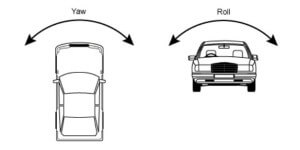
Yaw versus roll
driver’s intended direction of travel from the steering angle sensor. If the system detects an oncoming loss of stability, it uses the ABS unit’s hydraulic module to brake the wheels and commands the ECM to reduce engine power until stability is regained.
Integration of ESC and TCS
The ESC and TCS are often integrated into a single system, as they share several components and work towards a common goal: maintaining vehicle stability. While TCS primarily addresses issues during acceleration, ESC is active during all driving conditions, constantly monitoring and correcting the vehicle’s trajectory.
Regulatory and Industry Impact
Due to their significant safety benefits, ESC and TCS have become standard features in many vehicles. In fact, regulatory bodies in various countries have mandated the inclusion of ESC in new vehicles. For instance, the European Union has required ESC in all new cars since 2014, and the United States followed suit with a similar mandate in 2012.
©, 2014 Rick Muscoplat
Posted on by Rick Muscoplat