
What Causes Car Battery Terminal Corrosion?
What Causes Car Battery Corrosion? The Real Causes, Warning Signs, and How to Stop It
Quick Summary:
White, blue, or green powdery crust around your battery terminals can come from a discharge condition or a leak. 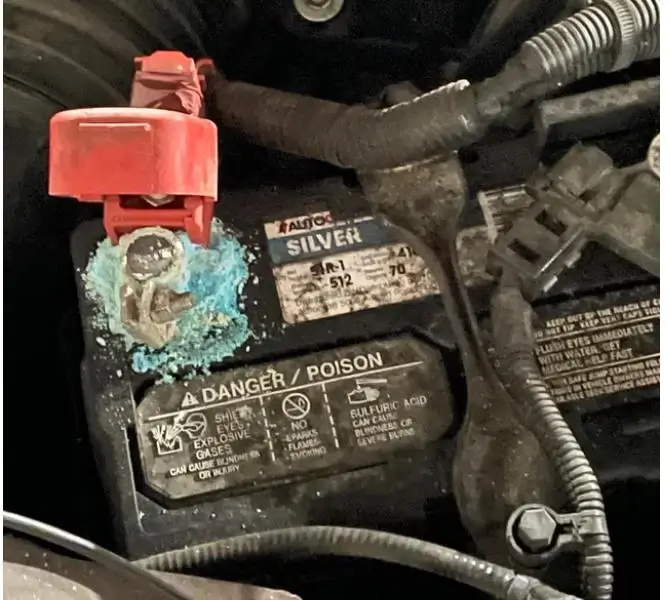 While cleaning it may solve an immediate poor connection, removing the buildup doesn’t necessarily address why it formed.
• Car battery corrosion is a chemical reaction, not ordinary dirt or rust.
•Battery age, acid vapor, electrolyte leakage, heat, charging problems, and poor terminal connections can all contribute.
•Corroded battery terminals increase electrical resistance and can contribute to slow cranking, charging problems, intermittent electrical symptoms, and eventually a no-start condition.
• A battery that repeatedly corrodes after cleaning deserves further diagnosis.
•A cracked, swollen, leaking, or unusually hot battery should be treated as a battery problem—not simply a dirty-terminal problem.
•Keeping the battery secure, the connections clean and tight, and the charging system operating correctly can help prevent corrosion from returning.
The most important lesson I can give you is this: don’t just clean battery corrosion. Find out why it’s there.
What Is Car Battery Corrosion?
Many people assume it’s rust. It isn’t.
Car battery corrosion results from chemical reactions around the battery terminals, posts, cable ends, electrolyte, gases, moisture, and surrounding metals.
On a conventional lead-acid automotive battery, sulfuric acid is part of the electrolyte. Acid mist, electrolyte leakage, and gases escaping around a deteriorating post seal can react with the metals in and around the battery connections.
That reaction can produce the crusty material you see around the terminals.
The color sometimes provides useful clues:
• White or gray buildup can include lead-related corrosion products.
• Blue or blue-green corrosion commonly involves copper compounds from the battery cable or terminal.
• Greenish corrosion may indicate corrosion products involving copper-containing components.
But I don’t diagnose the underlying problem by color alone. The color tells me corrosion is occurring. My next question is much more important: Why is it happening?
What Causes Car Battery Terminal/Post Corrosion?
There isn’t one universal cause of battery terminal corrosion. When I diagnose recurring corrosion, I look at the battery itself, the charging system, cable connections, operating conditions, battery age, and signs of leakage.
Here are some of the most important causes.
1. An Aging Battery and Deteriorating Post Seals — Battery age is one of the first things I consider when corrosion keeps returning.
Battery posts pass through the battery case, and the area around those posts must stay properly sealed. As a battery ages, deterioration or movement around a post seal can allow electrolyte or acid mist to reach the outside of the battery. Once that material reaches the terminal and cable connection, corrosion can develop.
This is why repeatedly cleaning an old battery isn’t always the answer.
Signs the battery itself may be the problem
I pay particular attention when I find:
• Corrosion returning soon after cleaning
• Moisture or residue around a battery post
• Wetness on top of the battery
• A damaged battery case
• A loose or damaged terminal post
• A swollen or distorted battery case
• Evidence of electrolyte leakage
If the battery is physically damaged or leaking, I don’t consider cleaning it a permanent repair. You need to address the underlying battery condition.
2. Battery Overcharging and Excessive Gassing — A charging-system problem can also contribute to car battery corrosion.
When a conventional lead-acid battery is charged excessively, it can experience increased gassing and heat. That can accelerate deterioration and create conditions that encourage corrosion around the battery.
Possible causes of excessive charging voltage include:
• Charging-system faults
• Voltage-regulation problems
• Incorrect external battery-charger settings
• A charger that is inappropriate for the battery type
Warning signs I take seriously
• A battery that becomes unusually hot
• Excessive gassing
• A swollen battery case
• A strong sulfur or “rotten egg” odor
• Rapid loss of electrolyte in serviceable batteries
• Repeated terminal corrosion
I wouldn’t diagnose overcharging based only on which terminal has corrosion. I verify the charging system with proper testing and compare the results with the vehicle manufacturer’s specifications.
Modern charging systems can intentionally vary alternator output, so no single charging-voltage number applies to every vehicle under every operating condition.
3. Undercharging and a Chronically Low Battery State of Charge — Undercharging can create a different set of battery problems.
I see this often on vehicles that make short trips, sit for extended periods, or run many electrical accessories without enough driving time to replenish the battery.
Common causes include:
• Frequent short-distance driving
• Extended periods of vehicle inactivity
• Excessive parasitic electrical draw
• Charging-system problems
• Heavy accessory use
• A deteriorating battery that no longer accepts or retains charge properly
A battery that spends too much time partially discharged can deteriorate prematurely.
That’s why you should consider recurring corrosion alongside the battery’s state of charge and overall health, rather than treating it as an isolated cosmetic issue.
4. Heat Can Accelerate Battery Deterioration — If there’s one environmental condition batteries dislike, it’s excessive heat.
Under-hood temperatures can get severe, particularly in hot weather, during extended idling, towing, and other demanding driving conditions.
Heat accelerates chemical activity inside a lead-acid battery and can contribute to:
• Increased water loss in applicable battery designs
• Increased gassing
• Faster internal deterioration
• Accelerated aging
• Shorter battery service life
This helps explain why a battery can look fine one season and develop noticeable terminal corrosion later.
Heat may not be the only cause, but it can accelerate any existing weakness.
5. Battery Acid or Electrolyte Leakage — This is where I become much more cautious.
There’s a big difference between some dry corrosion around a terminal and evidence that the car battery is leaking.
A battery case may be damaged by:
• Physical impact
• Improper installation
• Excessive vibration
• Freezing after the battery becomes severely discharged
• Excessive internal pressure
• Damage around a terminal post
• Improper battery restraint or hold-down problems
If I see wetness, a cracked case, swelling, or obvious electrolyte leakage, I don’t treat the problem as routine terminal cleaning.
A leaking or physically damaged battery may require replacement and careful inspection of the surrounding battery tray, cables, wiring, and metal components.
6. Loose or Poor Battery Terminal Connections — Here’s another problem that deserves more attention: the connection itself.
A battery terminal should provide a clean, secure, low-resistance electrical connection.
A loose, damaged, or poorly fitted connection can cause:
• Excessive resistance
• Voltage drop
• Starting problems
• Localized heating
• Intermittent electrical faults
• Poor charging performance
If corrosion has worked its way between the battery post and cable terminal, cleaning only the outside isn’t enough.
When appropriate, I remove the cable ends and inspect the actual contact surfaces. That’s where the electrical connection is made.
Why Car Battery Corrosion Is More Serious Than It Looks
One of the most common mistakes I see is ignoring corrosion because the engine still starts.
The starter motor demands a large amount of current. Even modest resistance at a battery connection can produce a meaningful voltage drop when the starter is operating.
That can lead to symptoms such as:
• Slow engine cranking
• Clicking when attempting to start
• Intermittent no-start conditions
• Dim or unstable lighting
• Charging complaints
• Electrical accessories behaving unpredictably
Another concern with modern vehicles is their complexity.
Today’s cars can contain dozens of electronic control modules. These systems depend on stable electrical power. A poor battery connection can therefore create symptoms that seem unrelated to the battery.
Before chasing complicated electronic faults, I always want to know that the battery, cables, grounds, and charging system are healthy.
Why Does My Battery Corrosion Keep Coming Back?
This is one of the questions I hear most often.
If you clean the terminals and the corrosion returns, something is still creating the conditions that caused it.
I start looking for:
• An aging battery
• Leakage around a terminal post
• Electrolyte residue
• A damaged battery case
• Loose cable terminals
• Charging-system problems
• Excessive heat
• A battery that isn’t being maintained at an adequate state of charge
• Corrosion that has traveled inside the battery cable
Recurring battery terminal corrosion is a clue—not the diagnosis.
Cleaning removes the visible symptom. Diagnosis determines why it returned.
Does Car Battery Corrosion Mean I Need a New Battery?
Not necessarily.
A relatively healthy battery can develop terminal corrosion, and cleaning the connections may be all that’s required if the battery tests properly and there’s no evidence of leakage or physical damage.
However, replacement becomes much more likely when I find corrosion along with:
• A cracked battery case
• Swelling
• Persistent leakage
• Damaged or loose posts
• Poor battery-test results
• Repeated corrosion around a leaking post seal
• Failure to maintain an adequate charge
• Advanced battery age combined with other symptoms
Battery age alone doesn’t prove that a battery is bad. I prefer testing over guessing.
How to Clean Car Battery Corrosion Safely
Before cleaning corroded battery terminals, remember what you’re working around.
Lead-acid batteries contain corrosive electrolyte and can produce flammable gases. Eye protection and sensible precautions matter.
If the battery is cracked, severely swollen, actively leaking, extremely hot, or otherwise physically damaged, I would not treat it as a routine DIY cleaning job.
What I Use to Clean Battery Terminals
For a typical serviceable situation, useful supplies include:
• Safety glasses or chemical-resistant eye protection
• Suitable protective gloves
• Battery terminal cleaning brush
• Baking soda
• Water
• Clean rags
• Basic hand tools appropriate for the terminal fasteners
• Battery terminal protectant, if appropriate
Keep sparks, cigarettes, flames, and other ignition sources away from the battery.
How I Clean Corroded Battery Terminals
Before disconnecting a battery,
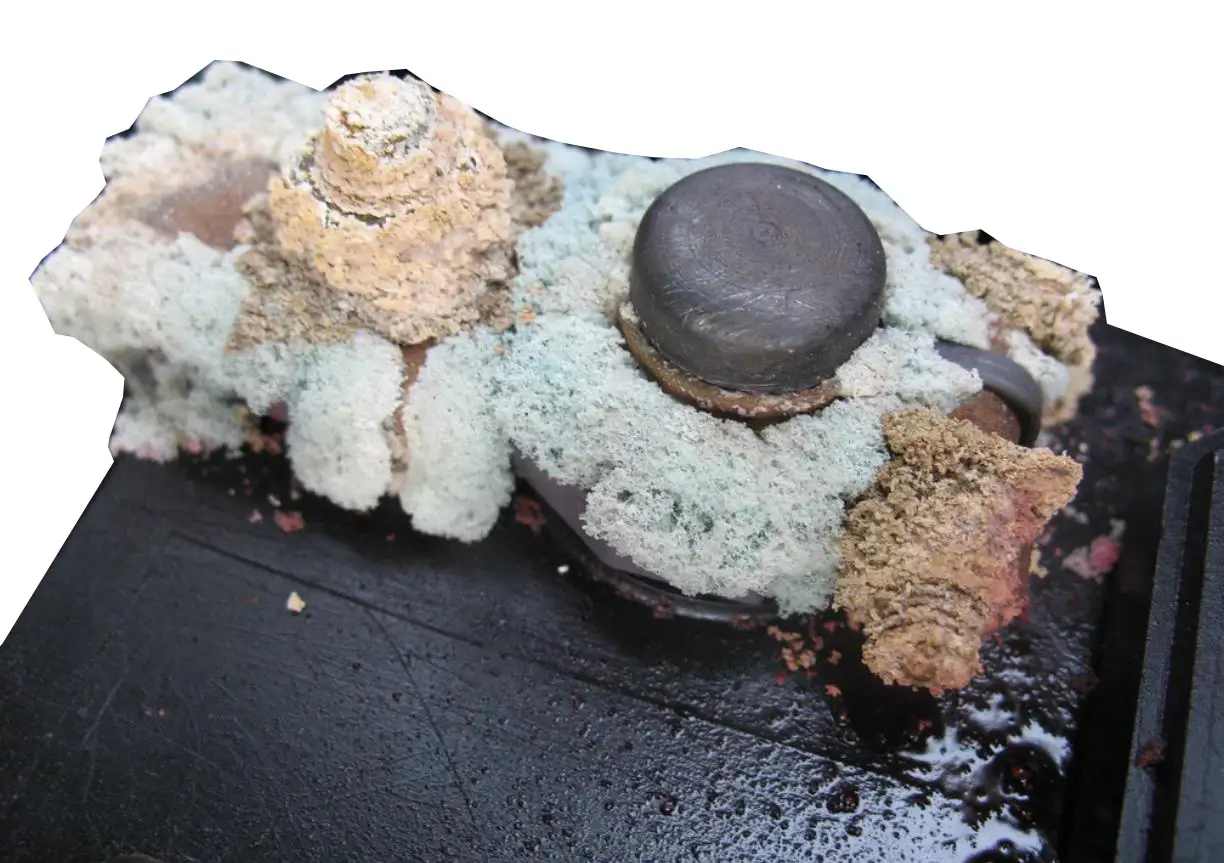
Notice the corrosion and the wetness on the top of the battery. This car battery is leaking between the case and the post
I check the vehicle manufacturer’s procedures. Some vehicles may lose learned settings, require initialization procedures, or have battery-monitoring systems that need special consideration.
For a conventional setup where battery disconnection is appropriate, the basic process is:
1. Shut the vehicle off and remove the key or otherwise ensure the ignition is off.
2. Put on eye and hand protection.
3. Inspect the battery for cracks, swelling, leakage, or other physical damage.
4. Disconnect the negative battery cable first.
5. Disconnect the positive cable.
6. Keep your tools from bridging the battery terminals or contacting grounded metal while touching the positive terminal.
7. Use an appropriate neutralizing/cleaning method on external corrosion.
8. Scrub the terminal and battery post contact surfaces with a battery-terminal brush.
9. Clean away residue carefully.
10. Dry the area thoroughly.
11. Inspect the cable ends for severe deterioration or corrosion traveling underneath the insulation.
12. Reconnect the positive cable first.
13. Reconnect the negative cable last.
14. Tighten the connections to the appropriate specification without damaging the posts.
15. Apply an appropriate battery-terminal protectant if desired.
Why disconnect negative first and reconnect it last?
On a typical negative-ground vehicle, disconnecting the negative cable first reduces the chance of accidentally shorting the positive battery terminal to grounded vehicle metal with a tool.
That small procedural detail matters.
Can I Use Baking Soda to Clean Battery Corrosion?
Baking soda and water are commonly used to neutralize acidic residue on the outside of battery surfaces and terminals.
But there’s an important distinction.
Baking soda belongs on the outside of the battery—not inside battery cells.
You also want to avoid flooding electrical connectors or allowing cleaning solution to enter battery vents.
After cleaning, I make sure the terminals and surrounding area are dry before completing the job.
How to Prevent Battery Terminal Corrosion
Cleaning corrosion is useful. Preventing its return is better.
Here’s what I focus on.
Keep Battery Connections Clean and Tight
A battery connection should be mechanically secure and electrically sound.
During routine inspections, check for:
• Loose terminals
• Cracked cable ends
• Frayed battery cables
• Corrosion underneath insulation
• Damaged battery posts
• Missing or loose battery hold-down hardware
Don’t overtighten a terminal to compensate for a damaged connection.
Test the Battery and Charging System
If corrosion keeps returning, I want actual test results.
Depending on the vehicle and problem, diagnosis may include:
• Battery state-of-charge testing
• Battery conductance or load testing
• Charging-system testing
• Voltage-drop testing
• Parasitic-draw testing when appropriate
• Visual inspection of cables and grounds
This is much more useful than simply assuming the alternator or battery is bad.
Use Battery Terminal Protectant
Once the connections are clean and properly installed, an appropriate corrosion protectant can help isolate exposed metal from corrosive contaminants.
Common options include:
• Battery-terminal protectant spray
• Anti-corrosion terminal washers
• Products specifically designed for battery-terminal protection
The important point is to start with a clean, mechanically sound connection. Don’t use protectant to hide an existing electrical problem.
Positive vs. Negative Battery Terminal Corrosion: Does It Matter?
You may have heard rules claiming that corrosion on the positive terminal automatically means overcharging, while corrosion on the negative terminal automatically means undercharging.
I wouldn’t diagnose a vehicle that way.
Corrosion location can sometimes provide context, but it isn’t a substitute for testing.
When I see corrosion concentrated around one terminal, I inspect:
• The post seal
• Cable-terminal condition
• Battery case
• Charging system
• Battery state of charge
• Cable resistance and voltage drop
Use the corrosion pattern as a clue, not a verdict.
Can Battery Corrosion Cause a Car Not to Start?
Absolutely.
A heavily corroded terminal can create enough electrical resistance to prevent sufficient current from reaching the starter.
You may turn the key or press the start button and experience:
• A clicking sound
• Slow cranking
• Intermittent starting
• Lights that dim dramatically during cranking
• A complete no-crank condition
A battery can have usable stored energy, but a poor terminal connection can prevent that energy from reaching the starter effectively.
That’s why I inspect the connections before condemning a battery based solely on a no-start complaint.
Can Battery Corrosion Cause the Battery Light to Come On?
It can contribute to charging-system problems, but you shouldn’t automatically blame dirty terminals for the battery warning light.
The warning indicator can be associated with charging-system conditions involving the alternator, wiring, belt drive, voltage regulation, battery connections, or other vehicle-specific faults.
If the battery warning light is illuminated while the engine is running, diagnose the charging system rather than simply cleaning the terminals and assuming the problem is solved.
Is Car Battery Corrosion Dangerous?
It can be.
Lead-acid batteries pose several hazards.
Acid and Electrolyte Exposure
Battery electrolyte can cause serious chemical burns, particularly to the eyes and skin. That’s why I consider eye protection essential when working around a conventional automotive battery.
Flammable Gas
Lead-acid batteries can release hydrogen during charging. Hydrogen is highly flammable. Keep sparks, open flames, smoking materials, and other ignition sources away from the battery.
Damage to Vehicle Components
Electrolyte and corrosive residue can attack surrounding materials and components, including:
• Battery trays
• Fasteners
• Cable terminals
• Wiring
• Painted surfaces
• Nearby metal components
Leaving an active leak untreated can turn a relatively inexpensive battery problem into a much larger repair.
Frequently Asked Questions About Car Battery Corrosion
What causes corrosion on car battery terminals?
Common contributors include chemical reactions around the terminals, electrolyte or acid mist escaping around battery posts, battery aging, leakage, heat, charging problems, and deteriorated connections.
Why does my car battery keep corroding?
Repeated corrosion suggests the underlying condition remains. Check the battery for leakage or deteriorated post seals, inspect cable connections, and test the battery and charging system.
Can a corroded battery terminal drain the battery?
Corrosion primarily creates resistance at the connection. A charging or electrical-system problem may coexist with the corrosion, so a battery that repeatedly goes dead should be properly diagnosed.
Can corrosion cause slow cranking?
Yes. Resistance at a battery terminal or cable connection can reduce the voltage and current available to the starter, resulting in slow or intermittent cranking.
Should I replace a corroded battery?
Not automatically. Cleanable surface corrosion doesn’t necessarily mean the battery has failed. Leakage, swelling, physical damage, poor test results, or recurring corrosion associated with battery deterioration are stronger reasons to consider replacement.
Is white powder on a car battery dangerous?
Treat unknown battery residue cautiously. Avoid touching it with bare skin, wear eye protection and gloves, and investigate why the buildup is occurring.
How often should I inspect my car battery?
I like to include a visual battery inspection during routine maintenance and before periods of extreme heat or cold. Look for corrosion, looseness, damaged cables, leakage, and battery-case distortion.
Final Thoughts: Don’t Just Clean Car Battery Corrosion—Find the Cause
Corrosion is evidence.
It tells me a chemical reaction is happening around the battery connection, and my job is to figure out what’s encouraging it.
Sometimes the solution really is straightforward: clean the terminals, secure the connections, protect the exposed metal, and move on.
Other times, recurring battery terminal corrosion is the first visible warning of an aging battery, a deteriorating post seal, an electrolyte leak, a charging-system problem, a damaged cable, or a battery nearing the end of its useful life.
That distinction matters.
If you remember one thing from this guide, make it this:
Clean the corrosion—but diagnose the reason it formed.
That approach gives you a better chance of preventing the problem from coming back and helps protect the battery, starter, charging system, wiring, and the rest of the vehicle’s electrical system.
©, Oct 25, 2024 Rick Muscoplat
Posted on by Rick Muscoplat