
What is a CV Joint and How Does it Work?
Learn how a CV joint works and how it differs from a U-joint?
Constant Velocity (CV) joints are essential components in modern front-wheel drive vehicles. They allow for the smooth transfer of power from the engine to the wheels while accommodating the various angles and movements of the suspension and steering systems. Understanding how CV joints function and how they differ from universal joints can explain why they are commonly used in front-wheel-drive and all-wheel-drive vehicles.
What is a CV Joint?
A CV joint is a mechanical joint used to connect two rotating shafts, allowing them to transmit power at a constant rotational speed regardless of the angle between the shafts. This is crucial in vehicles where the drive wheels also steer, as in front-wheel-drive and all-wheel-drive systems. CV joints are designed to maintain a constant velocity, which means they minimize vibrations and provide smoother power delivery compared to other types of joints.
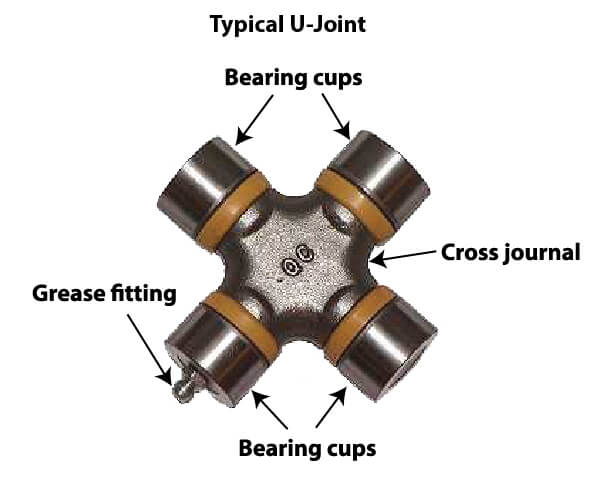
Typical U-joint
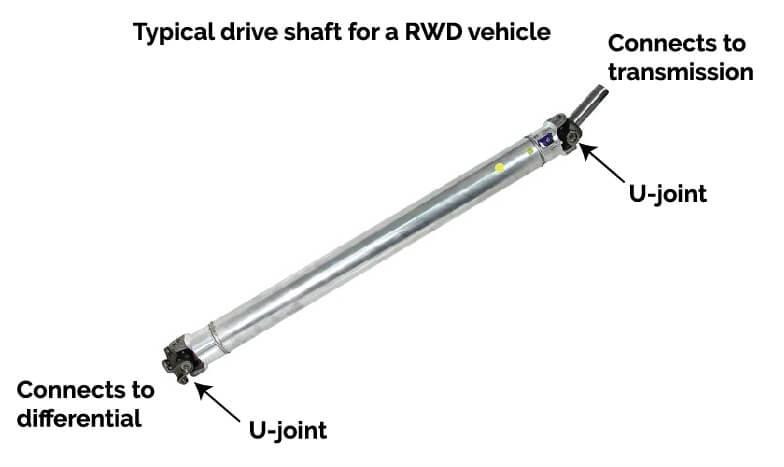
Typical RWD drive shaft with 2 U-joints
They differ from a universal joint (U-joint) usually installed on the drive shaft of rear-wheel drive (RWD) vehicles. U-joints allow the drive shaft to provide power to the rear differential yet still allow the differential to move up and down when going over bumps. U-joints work just fine on a drive shaft of a RWD vehicle because the U-joint angles are the same at each end. If the differential rises by 20°, both U-joints will rotate at the same angle.
Why carmakers can’t use U-joints on FWD vehicles
Front wheels must move up and down and left and right, creating different angles between the inner and outer joints on each drive shaft. FWD vehicles have two drive shafts, one for each front wheel. Each drive shaft has two CV joints. One CV joint on the drive shaft connects to the transmission, and the other to the wheel hub. The CV joints allow the front wheels to move up and down and turn left and right.
If those drive shafts had U-joints instead of CV joints, the U-joints would have to operate at different angles as the driver turned the wheels. In fact, front wheels can turn up to 45° while still being allowed to move up and down simultaneously. U-joints can’t operate at those angles. At less steep angles, U-joints on each end of a drive shaft generate a cyclic vibration. The greater the angle, the greater the vibration. So, obviously, U-joints are unsuitable for use as front axles.
CV joints, on the other hand, can transmit power through variable angles, maintaining a constant rotational speed without vibration or stress.
There are two common types of CV joints used today
Ball-type (Rzeppa-style) and tripod-type
• Ball-type CV Joints— These joints use a series of ball bearings housed within a cage, allowing for flexibility and smooth rotation. They are typically installed in the steering knuckle because they allow maximum rotational and angular movement. However, they can also be used as the inner CV joint mated to the transmission.
• Tripod-type CV Joints— These joints feature three trunnion bearings that slide within a housing, allowing for rotational and angular movement. They are often used in the inner CV joint position, especially in applications requiring greater axial movement.
How a CV joint works
The ball style joint

This image shows the RZeppa patent issued in 1928
The Rzeppa style CV joint is used on the wheel hub side of the drive shaft, also called the outer joint.
Each joint is protected with an accordion style boot, filled with grease and clamped in place with band clamps
The axle shaft is splined to the inner race. As the shaft turns, it applies torque to the inner race, which transfers the torque to the balls and then to the housing, which is splined to the wheel hub to drive the wheels. The entire joint is filled with grease and covered by a pleated rubber boot. The boot is clamped to the housing and drive shaft with special clamps. The Rzeppa CV joint allows a much greater range of motion than a typical U-joint or a tripod joint.
The tripod joint
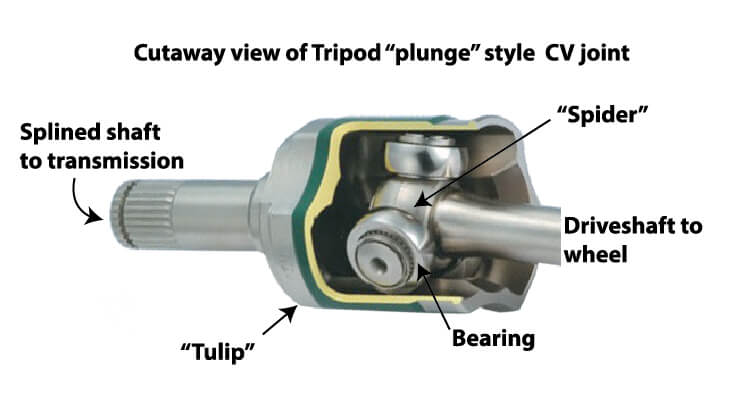
This image shows a cut-away of a plunge-style tripod CV joint.
A tripod or “plunge style” CV joint consists of a housing, also called a tulip. The drive shaft connects to a three-legged “spider” end with bearings. Torque transfers from the transmission to the tulip and then to the bearings and spider. The spider is splined to the drive shaft which transfers the torque to the outer CV joint. The tripod joint is mainly used on the transmission side of the drive shaft. It’s designed to allow the drive shaft to move up and down, as well as in and out to accommodate the elliptical arc of the drive shaft as the wheel travels over bumps.
A tripod CV joint is also filled with grease and protected by a pleated rubber boot.
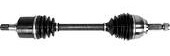
This image shows a complete axle shaft with an inner and outer joint
What goes wrong with CV joints?
A CV joint can last the life of the vehicle because it’s packed with grease. The “wear” portion is the protective rubber boot. As the CV boot ages, cracks develop between the pleats. If those cracks open, the CV joint will fling the grease out of the joint. At that point, the joint is exposed to water, road salt, and grit. If the joint isn’t quickly cleaned, regreased, and rebooted, the grit and salt will corrode the inner workings of the CV joint, causing it to vibrate, make clicking and popping sounds, especially on turns, and eventually fail.
How far can you drive with a torn CV boot?

A torn boot leaks grease
How much of a gambler are you? It’s really that simple. As the inner workings of the CV joint wear, the joint becomes less stable, and the driveshaft eventually breaks. It’s not as simple as just leaving you stranded. The driveshaft usually breaks while it’s spinning, swinging wildly around and damaging all components it contacts. That can include broken fuel and fluid lines, damaged or broken wiring harnesses, and even damage to the transmission case, power steering pump or air conditioning compressor. In short, when a CV joint fails, the spinning drive shaft can easily cause up to several thousand dollars in damage. If you’re a risk taker, feel free to continue driving with a torn CV boot. Otherwise, get it to a shop. Once the boot is torn and the grease is gone, it’s best to replace the entire axle shaft with a rebuilt unit. Replacing just the boot is risky.
©, 2016 Rick Muscoplat
Posted on by Rick Muscoplat