
Wheel Bearing Replacement Cost in 2026
How Much Does Wheel Bearing Replacement Cost? Complete Price Guide
Quick Summary
A humming, growling, or rumbling noise that gets louder as you drive often signals a worn wheel bearing. The price to replace a wheel bearing depends on the bearing type and how difficult it is to remove and replace.
• Typical wheel bearing replacement cost: In 2026, expect roughly $350–$700 per wheel for a typical wheel bearing replacement, including parts and labor:
• Tapered wheel bearings: Usually the least expensive designs to service but are mostly used in pre 1970’s vehicles.
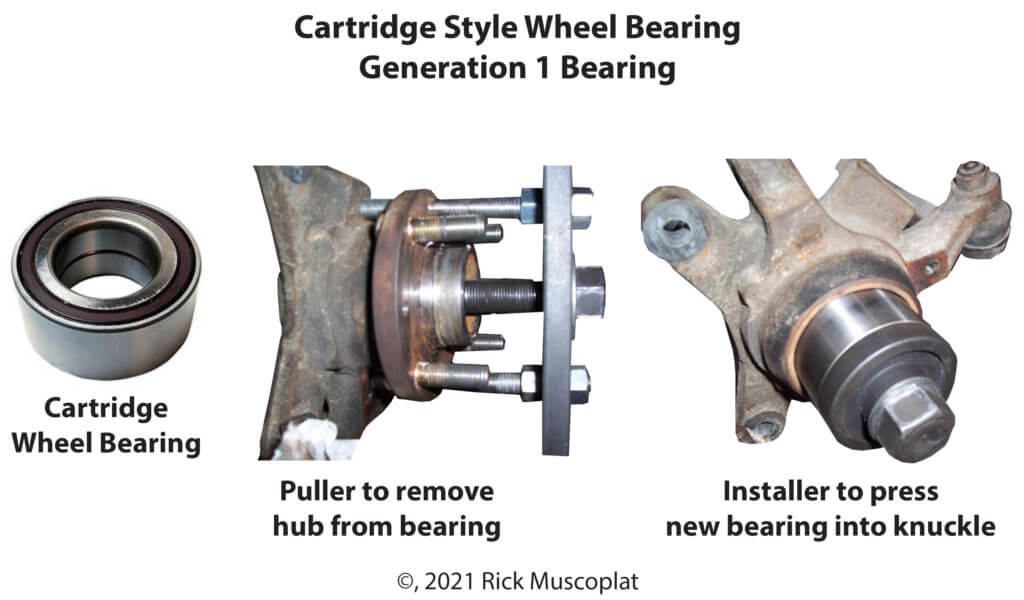
• Cartridge/press-in bearings: Cartridge bearings cost a bit more than tapered bearings but are more difficult to install because they’re pressed into the wheel hub or steering knuckle. With the right tools, you can remove and replace them on the vehicle. Without the proper tools, you must remove the steering knuckle and press the bearing in/out using a stationary press.
• Hub assembly bearings: Easier to install on many vehicles, but the complete hub assembly can cost considerably more than a standalone bearing.
• One bad bearing doesn’t automatically mean you need two: Wheel bearings generally don’t have to be replaced in pairs.
• Part quality matters: The market is flooded with cheap, low-quality bearings from China. In most cases, they barely last a year in normal driving. Saving money on a bargain bearing can become expensive if you have to pay the labor charge again.
• Don’t ignore bearing noise: A deteriorating bearing can eventually affect other components and, if severely worn, vehicle safety.
The four wheel bearing designs you’re most likely to encounter
• Tapered roller bearings
• Cartridge or press-in bearings
• Generation 1 hub bearings
• Generation 2 and Generation 3 hub-style bearings
Each design changes the parts cost, labor time, equipment required, and ultimately the cost to replace a wheel bearing.
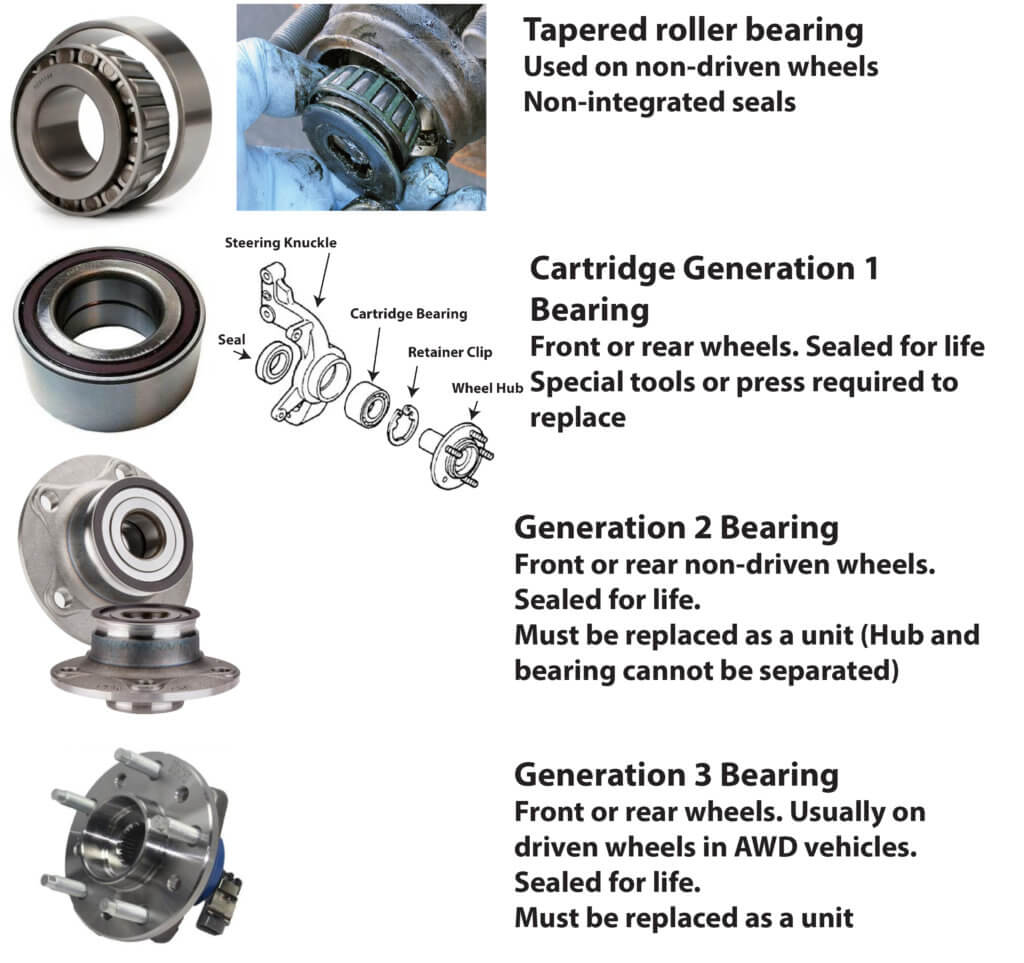
Wheel Bearing Replacement Cost by Bearing Type
Tapered Wheel Bearing Replacement Cost
Tapered roller bearings are the old-school design. You’ll still see them on older vehicles, trucks, trailers, and certain other applications.
From a repair-cost standpoint, I like them because they’re serviceable. An individual tapered bearing can cost around $35 per wheel, although actual parts pricing varies significantly by application and brand. A wheel commonly uses an inner and outer bearing.
Unlike many modern sealed bearings, tapered bearings can often be removed, cleaned, inspected, repacked with fresh wheel-bearing grease, adjusted, and put back into service if they’re still in good condition.
A shop might charge roughly $150 to repack the bearings on one wheel, depending on labor rates and the vehicle.
If the bearings need replacement, a reasonable ballpark for some applications is around $350 per axle, although vehicle-specific pricing can vary substantially.
The big advantage is simple: serviceability keeps long-term wheel bearing repair costs down.
Cartridge Wheel Bearing Replacement Cost
This is where I often see customers surprised by an estimate.
They’ll look up the bearing online, see a part costing perhaps $75–$125, and wonder why the repair quote is several hundred dollars.
The answer is labor.
A cartridge bearing is typically pressed into the steering knuckle. Depending on the vehicle, I may need to remove the knuckle and use specialized bearing tools or a hydraulic press to remove the old bearing and install the new one correctly.
That means you’re not simply paying for a bearing.
You’re paying for:
• Vehicle disassembly
• Rusted or seized component removal when applicable
• Specialized tools or press work
• Correct bearing installation
• Reassembly
• Technician labor and expertise
Labor can easily reach $250–$300 per wheel in some applications and markets, and severe corrosion can push the price higher.
This is also why DIY wheel bearing replacement isn’t always as cheap as it first appears. Pressing a bearing incorrectly can damage the bearing, hub, or steering knuckle before the car ever leaves the garage.
Hub Assembly and Gen 2/Gen 3 Wheel Bearing Replacement Cost
Most modern drivers are more likely to encounter a sealed hub-style bearing.
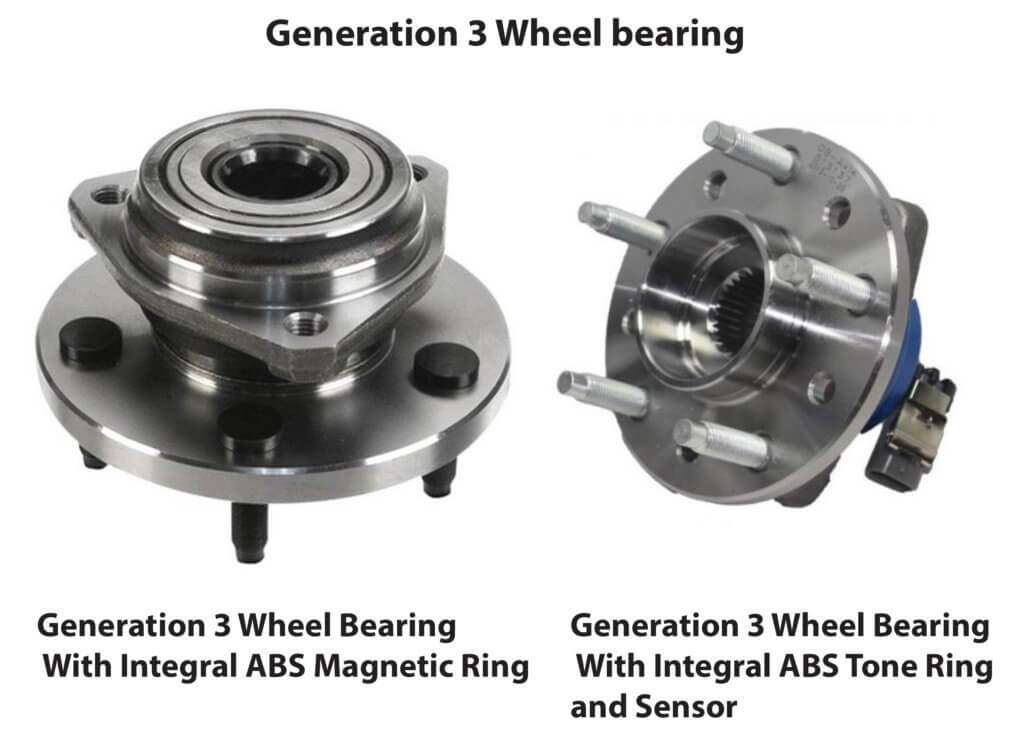
Generation 2 and Generation 3 wheel bearings can integrate the hub, bearing, mounting flange, and components associated with the ABS/wheel-speed sensing system into a single precision assembly.
From my side of the toolbox, some of these are considerably easier to replace than press-in cartridge bearings because the complete assembly bolts to the steering knuckle. The catch is the part price.
A quality modern hub assembly can cost hundreds of dollars. For example, a Gen 3 bearing assembly for certain vehicles can run around $250 for the part alone.
Once you add labor, wheel hub bearing replacement can easily reach $400–$500 per wheel in many situations.
So don’t assume a shorter installation automatically means a cheaper repair. Sometimes you’re trading labor cost for a much more expensive part.
Front Wheel Bearing Replacement Cost vs. Rear Wheel Bearing Replacement Cost
I also get asked whether a front wheel bearing costs more to replace than a rear bearing.
There’s no universal rule.
A front wheel bearing replacement can cost more when the job involves additional steering, brake, axle, or suspension components. But some vehicles use straightforward bolt-on front hub assemblies that are relatively quick to replace.
The same goes for rear wheel bearing replacement cost. A simple rear hub can be straightforward, while other rear bearing arrangements require considerably more disassembly.
The important questions are:
1. Is it a press-in bearing or bolt-on hub?
2. Does the axle shaft have to be removed?
3. How much disassembly is required?
4. Is corrosion likely to complicate removal?
5. Does the replacement include the complete hub assembly?
6. Will an alignment or another related service be necessary?
Those questions tell me far more about the likely bill than whether the bearing is simply “front” or “rear.”
Why Bearing Quality Matters More Than Price
One of the biggest mistakes I see people make when trying to save on wheel bearing replacement cost is choosing cheap bearings. Original Equipment (OE) bearings are usually the most expensive, but there are excellent alternatives from trusted manufacturers like Timken, National, NTN, and SKF that perform nearly as well for less money.
Unfortunately, many parts stores stock low-quality offshore bearings. I’ve seen those start humming within a year and fail completely by year two. If you’re paying labor to have a shop install the bearing, saving a few dollars on the part rarely makes sense. Paying twice for labor hurts far more than paying once for a quality bearing.
How Do I Know If My Wheel Bearing Is Bad?
The classic complaint I hear is some variation of:
“My car sounds like it has really loud tires.”
That’s an important clue because a bad wheel bearing can sound surprisingly similar to aggressive or unevenly worn tires.
Common bad wheel bearing symptoms include:
• Humming or droning that increases with road speed
• Growling or rumbling
• Noise that changes when turning
• Clicking or grinding in some failure conditions
• Steering-wheel vibration
• Excessive wheel play
• Uneven tire wear
• ABS warning light in some vehicles
• Loose or vague steering feel
• Wheel wobble in severe cases
Kelley Blue Book likewise identifies symptoms including humming, growling, clicking, wheel wobble, ABS problems, uneven tire wear, steering vibration, and loose steering.
One warning, though: don’t diagnose a bearing from noise alone.
Tires can create a very similar hum. Brake components, CV joints, and other rotating parts can also make noises drivers mistake for a bad bearing.
A proper diagnosis matters before you start buying parts.
The Real Cost of Delaying Wheel Bearing Replacement
Ignoring a failing bearing is one of the fastest ways to turn a manageable repair into a costly one. As a bearing deteriorates, it can overheat, damage the hub, ruin the ABS sensor, or even cause uneven brake wear. In extreme cases, I’ve seen wheel bearings fail to the point that wheel movement compromises vehicle control.
Replacing a wheel bearing at the first sign of noise or looseness keeps replacement costs predictable and prevents collateral damage that can double or triple the final bill.
How a Mechanic Checks a Bad Wheel Bearing
When I’m diagnosing one, I don’t want to guess based solely on where the driver thinks the sound is coming from. Noise can travel through a vehicle’s chassis and fool your ears.
A technician may:
• Road-test the vehicle
• Listen for changes in noise as the vehicle turns
• Raise the vehicle
• Rotate individual wheels
• Check for roughness or grinding
• Check the wheel for excessive movement or play
• Inspect tires for abnormal wear
• Rule out steering and suspension looseness
Some bearing failures make themselves obvious. Others require more careful diagnosis.
Can You Drive With a Bad Wheel Bearing?
This isn’t a repair I’d recommend ignoring.
A bearing that has just started humming isn’t necessarily going to separate tomorrow, but wheel bearings don’t repair themselves. Once internal wear begins, the condition generally worsens.
As the bearing deteriorates, friction and heat increase. Excessive movement can affect the hub and nearby components, and severe bearing failure can compromise wheel control.
My approach is simple: once a wheel bearing is positively diagnosed as failing, schedule the repair instead of waiting to see how long it lasts.
The longer you delay, the less predictable the final repair bill becomes.
What Happens If You Don’t Replace a Bad Wheel Bearing?
This is where trying to save money can cost you more.
A deteriorating wheel bearing can potentially contribute to:
• Hub damage
• ABS or wheel-speed sensor problems
• Uneven brake or tire wear
• Excessive wheel movement
• Additional heat and friction
• Damage to related components
• Reduced vehicle control in an extreme failure
What could have been a straightforward wheel bearing replacement cost can turn into a larger repair involving additional parts and labor.
I’ve always preferred fixing the bearing while it’s still the main problem.
Should You Replace Wheel Bearings in Pairs?
Some shops recommend replacing wheel bearings in pairs, and the logic sounds reasonable at first. Both bearings have the same mileage, so they should wear out at the same rate. In reality, that’s not always how bearings fail.
Road hazards like potholes, curbs, and debris can damage one bearing while the opposite side remains perfectly healthy. If only one bearing shows noise or play, there’s no mechanical reason to replace the other.
From a cost standpoint, replacing bearings in pairs doesn’t save much money. Labor time is essentially doubled. Paired replacement only makes sense when an alignment is required afterward—then doing multiple bearings at once can reduce overall alignment costs.
OEM vs. Aftermarket Wheel Bearing: Which Is Better?
I don’t automatically insist on an OEM bearing for every vehicle. Instead, I look at the manufacturer, application, warranty, and price difference.
OEM wheel bearings can make sense when:
• The vehicle has a history of being sensitive to aftermarket hub assemblies.
• Sensor compatibility is a concern.
• You want the same supplier specification used by the manufacturer.
• The OEM price isn’t dramatically higher.
A quality aftermarket wheel bearing can make sense when:
• It’s made by an established bearing manufacturer.
• The supplier has a strong reputation for the specific application.
• The savings are meaningful.
• The part carries a solid warranty.
What I try to avoid is the anonymous bargain bearing whose main selling point is being the cheapest option on the screen.
OEM/Tier-1 suppliers (make bearings for automakers, also sell aftermarket):
SKF – Swedish, one of the largest bearing manufacturers in the world, OEM supplier to many brands
Timken – American, especially strong reputation in tapered roller bearings, OEM to Ford, GM, and others
NSK – Japanese, OEM supplier for many Asian automakers
NTN – Japanese, widely used OEM and aftermarket bearing maker
FAG / Schaeffler – German, FAG is Schaeffler’s bearing brand, OEM to European automakers
NACHI – Japanese, respected in tapered roller and hub bearings
Trusted aftermarket/hub assembly brands:
Moog – very well regarded for chassis and hub assemblies
Timken (also strong aftermarket presence)
ACDelco – GM’s OEM/aftermarket parts brand, good reputation
National – long-standing bearing manufacturer
Bosch – strong reputation, especially for wheel bearing/hub units in Europe
Delphi – solid aftermarket reputation, especially for hub assemblies
Brands I won’t buy:
Private label auto parts store brands, except a NAPA Gold part
Can I Replace a Wheel Bearing Myself?
That depends almost entirely on the design and your experience.
A bolt-on hub assembly can be a realistic DIY job for someone comfortable working on brakes, axle nuts, torque specifications, and suspension-related components.
A press-in cartridge bearing is another story.
Pressed hub-and-bearing arrangements may require a hydraulic press and special tools, so they’re often better suited to professional repair.
For DIY work, you’ll potentially need:
• Floor jack and properly rated jack stands
• Torque wrench
• Large sockets
• Breaker bar
• Axle-nut socket where applicable
• Bearing or hub removal tools
• Snap-ring pliers on certain designs
• Bearing press or hydraulic shop press for press-fit designs
• Vehicle-specific service information and torque specifications
And here’s the part that matters most: you have to apply installation force correctly.
You can damage a new bearing during installation and dramatically shorten its life before the vehicle even returns to the road.
Does a Wheel Bearing Replacement Require an Alignment?
Not always.
If you can replace the hub assembly without disturbing alignment-related suspension adjustments, you may not need an alignment.
If the steering knuckle or other suspension components have to be removed or disturbed, checking alignment afterward can be a smart move.
I wouldn’t automatically add an alignment to every wheel bearing replacement price, but I also wouldn’t skip one when the repair procedure or vehicle behavior gives me a reason to check it.
How Long Do Wheel Bearings Last?
There’s no mileage number I trust for every vehicle.
Wheel-bearing life depends on bearing quality, vehicle weight, road conditions, pothole impacts, water intrusion, tire and wheel modifications, installation quality, and how you use the vehicle.
Some wheel bearings last exceptionally long. Others fail much earlier.
I pay more attention to symptoms and inspection results than odometer mileage.
A quiet, tight bearing at high mileage isn’t automatically bad. A noisy bearing at lower mileage isn’t automatically good because it “should have lasted longer.”
Condition beats assumptions.
How to Save Money on Wheel Bearing Replacement
You don’t need to buy the cheapest part to reduce the final repair bill.
I’d focus on these strategies instead:
• Get the bearing properly diagnosed before authorizing replacement.
• Ask whether the quote is for a bearing alone or a complete hub assembly.
• Compare estimates using the same quality of parts.
• Ask which bearing manufacturer the shop plans to install.
• Don’t automatically replace both sides unless there’s a reason.
• Address bearing noise early before related damage develops.
• Ask whether an alignment is actually required.
• Use a reputable independent repair shop when appropriate for your vehicle.
The cheapest quote isn’t necessarily the cheapest repair over the next several years.
Wheel Bearing Replacement Cost FAQ
How much does it cost to replace one wheel bearing?
A useful national ballpark is approximately $350–$750, although some vehicles cost less and others considerably more. Some guides currently estimate $346–$504 for a typical wheel bearing replacement, while others cite a national average of roughly $350 for one wheel.
How much does a wheel hub assembly replacement cost?
Hub assemblies can cost more because you’re replacing an integrated assembly rather than only a bearing. Currently, the average wheel hub assembly replacement costs approximately $512–$652.
Is it OK to replace only one wheel bearing?
Yes, in many cases. If only one bearing is defective and the bearing on the opposite side tests good, replacing only the failed bearing is generally reasonable.
Can bad tires sound like a bad wheel bearing?
Absolutely. Uneven or cupped tire wear can produce a humming or roaring sound similar to bearing noise. That’s one reason proper diagnosis is important.
Is a noisy wheel bearing dangerous?
It can become dangerous if deterioration progresses far enough. Repair a confirmed failing wheel bearing promptly rather than ignore it.
Is a front wheel bearing more expensive than a rear bearing?
Not necessarily. Bearing design, drivetrain layout, labor requirements, and parts cost matter more than simply whether the bearing is at the front or rear.
Final Thoughts: What I’d Budget for Wheel Bearing Replacement
When somebody asks me what they should budget, I don’t want them walking away thinking every wheel-bearing repair costs exactly $350, $500, or any other single number.
I’d start with roughly $350–$500 per wheel as a useful general planning range, then identify the exact bearing design on the vehicle.
If it’s an old-style tapered bearing, the repair may be relatively inexpensive.
If it’s a cartridge bearing pressed into the steering knuckle, expect labor to play a major role.
If it’s a modern integrated hub assembly, the labor might be easier but the part itself can drive the bill higher.
That’s the real lesson behind wheel bearing replacement cost: you’re not buying the same repair on every vehicle.
Get the diagnosis right. Find out which bearing design you’re paying for. Use a quality part. And don’t let a relatively manageable bearing problem turn into a more expensive repair by ignoring the warning signs.
©, 2021 Rick Muscoplat
Posted on by Rick Muscoplat