
Why is the ABS Light On? Common Causes and Solutions
Why the ABS Light Is On and What You Should Do About It
The Anti-lock Braking System (ABS) is a critical safety feature in modern vehicles, designed to prevent the wheels from locking up during hard braking, thus maintaining steering control. When the ABS light on your dashboard illuminates, it signals that there may be a problem with this crucial system. While the light itself doesn’t necessarily indicate an immediate danger, it does mean that your vehicle’s braking system requires attention. Understanding the common causes of an ABS light can help you address potential issues promptly and ensure your vehicle remains safe to drive.
The most common causes of an ABS light on and ABS-related trouble codes stored in the computer
1. Faulty ABS Wheel Speed Sensors—One of the most common reasons for an ABS light to come on is a
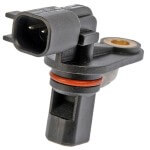
Wheel speed sensor
faulty wheel speed sensor. These sensors are located at each wheel and monitor the wheel’s speed, providing data to the ABS control module. If a sensor is dirty, damaged, or malfunctioning, it may send incorrect signals or none at all, prompting the ABS light to come on.
2. Damaged Wiring or Connections— The wiring harness that runs from the ABS control module to each wheel speed sensor is crucial for transmitting signals from the sensors to the ABS module. Over time, these wires and connectors can become corroded, frayed, or damaged, disrupting the communication within the system.
3. Rust or Debris accumulation on the sensor face or tone ring—The sensor determines wheel speed by monitoring a toothed ring called a tone ring or by sensing alternating magnetic poles
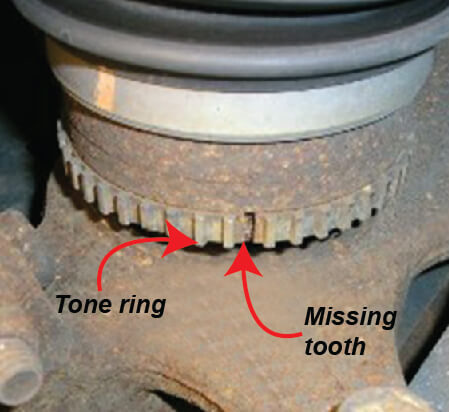
This image shows an ABS tone ring with a missing tooth. That can cause an ABS light to come on.
from the multipole ring on the wheel bearing. Metallic particle buildup on the face of the sensor or on the multipole magnetic ring can cause false ABS activation and also cause the ABS light to come on.
4. Faulty ABS Control Module— The ABS control module processes the data received from the wheel speed sensors and adjusts the braking force accordingly to prevent wheel lock-up. If the module itself is malfunctioning, it may not process signals correctly, leading to the ABS light turning on.
5. Faulty ABS hydraulic unit— The ABS hydraulic unit contains a pump and a series of valves that pulse brake fluid pressure to the wheels. Over time, the valves can clog with debris from the brake system, or the pump can fail.
6. Blown Fuse or Bad Relay— The ABS system is powered by a network of fuses and relays. If a fuse blows or a relay fails, the system may lose power, causing the ABS light to illuminate.
Where to start diagnosing an ABS light on?
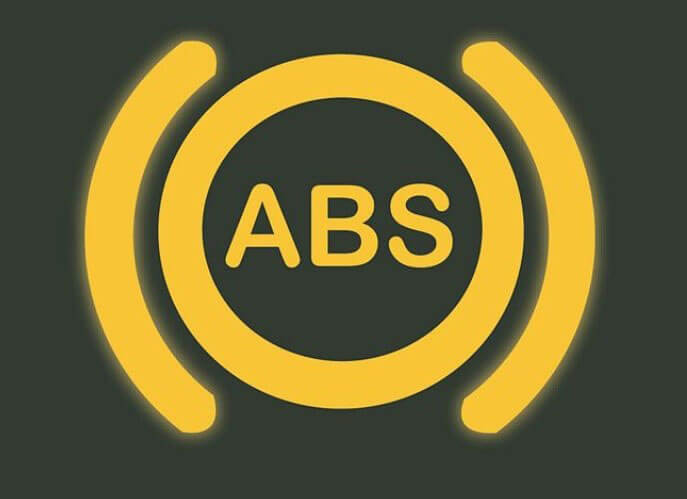
This is the typical ABS Warning Light
The first step in diagnosing an ABS light on condition is to get the trouble codes read. The code will tell you which wheel speed sensor is generating the fault, or whether the problem is in the hydraulic unit, pump, or control module. To get the codes, you’ll need a scan tool that’s capable of reading Chassis “C” codes, Body “B” codes, and sometimes, Network “U” codes.
Here are some common ABS-related trouble codes
C1221 LF WHEEL SPEED SENSOR INPUT SIGNAL IS 0;
C1222 RF WHEEL SPEED SENSOR INPUT SIGNAL IS 0;
C1223 LR WHEEL SPEED SENSOR INPUT SIGNAL IS 0;
C1224 RR WHEEL SPEED SENSOR INPUT SIGNAL IS 0;
C1225 LF EXCESSIVE WHEEL SPEED VARIATION;
C1226 RF EXCESSIVE WHEEL SPEED VARIATION;
C1227 LR EXCESSIVE WHEEL SPEED VARIATION;
C1228 RR EXCESSIVE WHEEL SPEED VARIATION;
C1232 LF WHEEL SPEED CIRCUIT OPEN OR SHORTED;
C1233 RF WHEEL SPEED CIRCUIT OPEN OR SHORTED;
C1234 LR WHEEL SPEED CIRCUIT OPEN OR SHORTED;
C1235 RR WHEEL SPEED CIRCUIT OPEN OR SHORTED
To understand how to two types of wheel speed sensors work, read this before attempting to diagnose the problem
The next step: Clean the sensor face, tone ring and multipole encoder ring
• Clean the sensor face—If you can access the sensor face without removing it, simply wipe any debris off the face. If you can’t access the face, remove it and then clean it.
• Clean the tone ring— Check the tone ring for rust debris or cracks or missing teeth. If you find cracks or missing teeth, replace the tone ring. Use a small wire brush to remove rust buildup from the teeth on the ring. Then clean the sensor face after.
• Clean the multipole encoder ring— Use a soft cloth to remove any metallic debris from the magnetic ring.
How to test a wheel speed sensor

A passive wheel speed sensor produces a sine wave AC voltage as you spin the wheel
• To test a passive wheel speed sensor— Set your multimeter to the lowest AC volts setting. Connect the leads to the two terminals on the wheel speed sensor that’s causing the code. Spin the wheel. You should see a rising voltage with no dropouts. If you see that, try again, but this time, wiggle the wiring harness to the sensor. If that causes drop outs, replace the sensor.
To test an active wheel speed sensor— You’ll need a digital scope to see the square shaped on/off digital pattern. Once again, you’ll looking for a steady reading wtih no dropouts.

An active wheel speed sensor produces a digital square wave.
If the sensors test good, conduct a continuity test on the wiring harness
Get a wiring diagram for your vehicle. Disconnect the wiring harness from the ABS control module or hydraulic unit and each wheel speed sensor. Then conduct a continuity test between the sensors and the control module. Test for continuity and short to ground on each wire pair. Replace the harness if you find opens or shorts.
If the fault is in the control module
Send the control module off to a rebuilder. That’s chepaer than buying a new module and paying to have it programmed. Just search for ABS module rebuilders.
Will my brakes work when I have an ABS light on?
Yes. Your brakes will continue to work but you will not have the anti-lock function.
Why is my Traction Light OFF warning light on?
The traction control system relies on information from the ABS system. When the ABS system shuts off, your traction control system also shuts down and turns on the Traction Light OFF warning light to alert you that you no longer have active traction control.
©, 2018 Rick Muscoplat
Posted on by Rick Muscoplat