
How to Fix a Leaking Coolant Reservoir
How to Fix a Leaking Coolant Reservoir Before It Leads to Engine Damage
Quick Summary
If you need to fix a leaking coolant reservoir, the first step is to determine whether your vehicle uses a pressurized or non-pressurized reservoir. That single detail determines whether the reservoir can be safely repaired or must be replaced. In my experience, most late-model vehicles have pressurized coolant reservoirs that should always be replaced if they’re cracked. While plastic welding can sometimes repair a non-pressurized overflow tank, glues, epoxies, RTV silicone, and tape are only temporary fixes that almost always fail on a pressurized reservoir.
In this guide, I’ll explain how to diagnose the leak, determine if your coolant reservoir is cracked, and decide whether repair or replacement is the best long-term solution.
How to Fix a Leaking Coolant Reservoir
Few cooling system problems fool drivers more than a leaking coolant reservoir.
At first, it seems harmless. You notice the coolant level dropping every few days, add a little antifreeze, and keep driving. The engine doesn’t overheat, so you assume the leak isn’t serious.
Unfortunately, that’s exactly how many major engine repairs begin.
I’ve diagnosed countless vehicles where the owner ignored a small reservoir leak because the engine temperature gauge still looked normal. Weeks later, they were dealing with an overheated engine, a warped cylinder head, or even a blown head gasket—all because a $40 to $100 plastic tank kept leaking.
The good news is that diagnosing a leaking coolant reservoir is usually straightforward. The difficult part is deciding whether it can actually be repaired or if replacement is the only reliable solution.
Why Coolant Reservoirs Leak
Most coolant reservoirs are molded from high-density polyethylene (HDPE), a durable plastic that’s lightweight, inexpensive, and resistant to chemicals.
Unfortunately, it’s not indestructible.
Over thousands of heating and cooling cycles, the plastic slowly becomes brittle. Every time the engine heats up, the reservoir expands slightly. Every time it cools, it contracts again. After years of thermal cycling, small stress cracks begin to develop.
The most common causes of a coolant reservoir leak include:
• Age-related plastic fatigue
• Excessive cooling system pressure
• A failing radiator cap or pressure cap
• Collision damage
• Overtightened mounting bolts
• Manufacturing defects
• Freeze damage caused by diluted coolant
Most reservoirs don’t suddenly split open. They usually begin with a tiny hairline crack that slowly grows larger over time.
Signs Your Coolant Reservoir Is Leaking
One reason reservoir leaks are often overlooked is that coolant evaporates quickly on a hot engine. Instead of finding a large puddle under your vehicle, you may notice much subtler symptoms.
Common signs include:
• The coolant reservoir is losing coolant every few days
• A sweet antifreeze smell after driving
• White or colored coolant residue around the tank
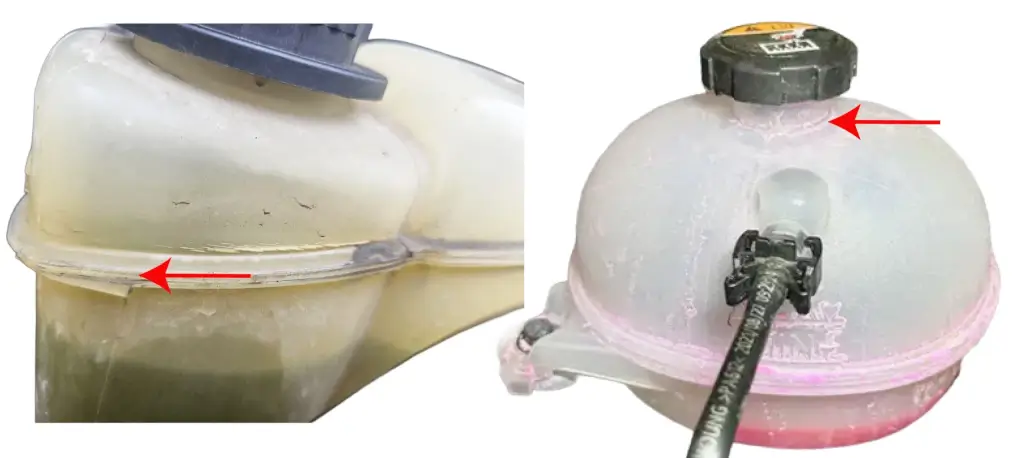
Notice the DRY powdery residue on the coolant reservoir on the right. On the left, notice the split seam
• Wet streaks running down the side of the reservoir
• Steam from under the hood after shutting the engine off
• Low coolant warning light
• Visible cracks near molded seams
I’ve found that many leaks only appear after the cooling system reaches operating temperature and pressure. That means you may inspect the reservoir on a cold engine and see absolutely nothing.
Coolant Leaking but Engine Not Overheating?
The cooling system contains a reserve supply of coolant inside the reservoir. If the leak is small, the radiator may still remain completely full while only the overflow tank loses coolant.
Modern cooling systems can tolerate surprisingly small coolant losses before engine temperatures begin rising. That doesn’t mean the problem is harmless.
Eventually, you’ll experience:
• Rising engine temperatures
• Poor heater performance
• Erratic temperature gauge readings
• Steam from under the hood
• Engine overheating
I’ve seen plenty of engines survive months with a minor coolant leak—and I’ve seen others overheat after a single long highway trip. The difference often comes down to outside temperature, towing, heavy acceleration, or stop-and-go traffic.
Is Your Coolant Reservoir Actually Cracked?
Before replacing anything, make sure the reservoir itself is the source of the leak. Several nearby components can create the appearance of a cracked coolant tank.
I always inspect:
• The reservoir’s pressure cap
• Overflow hose
• Hose clamps
• Coolant level sensor seal
• Radiator hoses
• Thermostat housing
• Water pump
• Radiator end tanks
A cooling-system pressure tester is one of the best diagnostic tools you can own. With the engine cool, apply the specified system pressure and carefully inspect the reservoir for leaks. Hairline cracks that remain invisible during normal inspection often become obvious under pressure.
Using a UV dye kit can make tiny leaks even easier to locate.
Can a Coolant Reservoir Be Repaired?
This is where many internet articles give misleading advice. Technically, yes—a coolant reservoir can sometimes be repaired. Professionally, my answer is much more cautious.
Whether you can repair the tank depends entirely on whether it is part of the pressurized cooling system. That distinction determines whether the repair is likely to last—or fail the first time the engine reaches operating temperature.
So, that’s the first thing I determine before recommending any repair.
If the reservoir is nothing more than an overflow bottle that stores expanding coolant and isn’t under pressure, you can usually melt the crack to seal the leak.
However, if the reservoir is part of the sealed cooling system and holds 15 to 20 psi of pressure, I don’t recommend repairing it. Replace it.
The small amount of money you might save simply isn’t worth risking an overheated engine.
How to Tell If Your Coolant Reservoir Is Pressurized
Fortunately, it’s usually easy to identify a pressurized coolant reservoir.
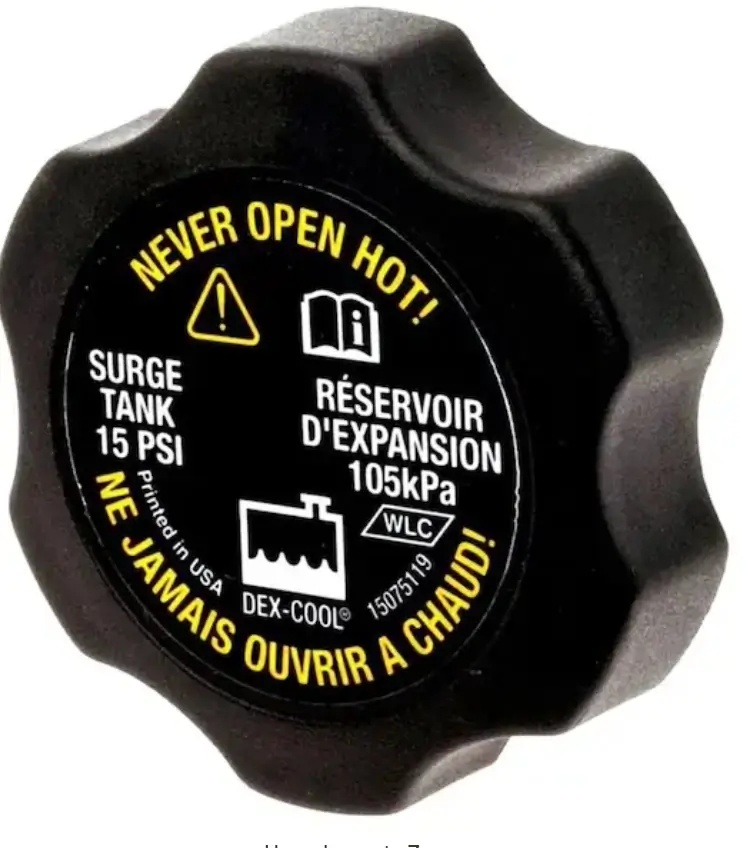
If the reservoir cap has these warnings, it’s a pressurized reservoir and can’t be patched
Look for these signs:
• The reservoir cap is labeled with a pressure rating such as 15 PSI, 16 PSI, or 20 PSI
• The cap warns “Do Not Open When Hot”
• Large radiator hoses connect directly to the reservoir
• The reservoir serves as the cooling system’s fill point
• Removing the cap from a warm engine releases pressure
If you see any of those features, the reservoir is part of the pressurized cooling system. Once it develops a crack, replacement is the only repair I recommend.
Why Glue Never Works
One of the most common questions I receive is whether products like JB Weld, epoxy, RTV silicone, Flex Seal, or plastic repair kits can seal a cracked coolant reservoir. The answer is almost always no, at least over the long term
Modern coolant reservoirs are molded from high-density polyethylene (HDPE).
• HDPE has an extremely low surface energy. That’s great for resisting chemicals, but it’s terrible for adhesives. Almost nothing bonds permanently to it.
Products that commonly fail include:
• JB Weld — it doesn’t expand/contract at the same rate as the HDPE
• Two-part epoxy — it doesn’t expand/contract at the same rate as the HDPE
• RTV silicone — It doesn’t bond well to HDPE
• Polyurethane sealants — They don’t bond well to HDPE
• Super glue — it doesn’t expand/contract at the same rate as the HDPE
• Flex Tape — The pressure-sensitive adhesive can’t handle the heat/cold cycles found in the engine compartment.
• Fiberglass repair kits — it doesn’t expand/contract at the same rate as the HDPE
Some may appear to work for a few days. Some may last several weeks. Eventually, the constant expansion and contraction of the plastic breaks the bond, and the leak returns. If you’re hoping for a permanent repair, adhesives aren’t the answer.
How to Repair a Cracked Coolant Reservoir
If the reservoir is non-pressurized, plastic welding is the only repair method I’ve found that has a reasonable chance of lasting.
Unlike glue, plastic welding actually melts the original plastic together. So, you’re creating a single continuous piece of plastic rather than bonding two pieces with adhesive.
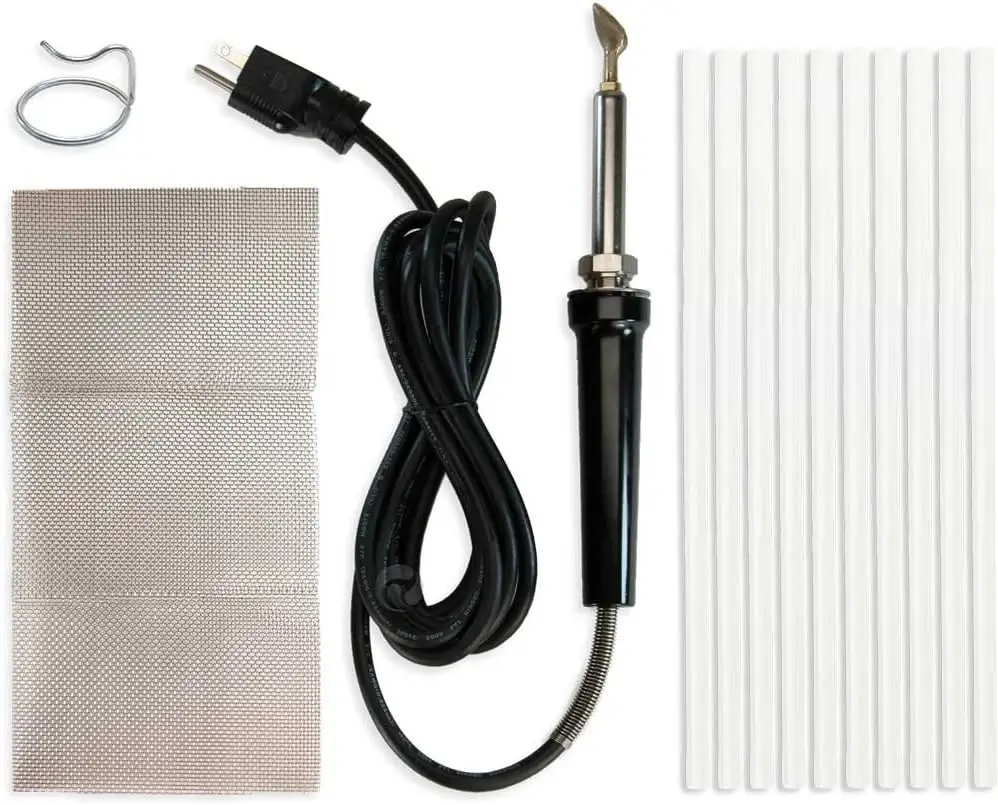
Poly Welder Pro 200 Watt Plastic Repair Kit
Here’s the basic procedure.coolant reservoir, coolant leak, coolant reservoir repair, coolant reservoir replacement, engine overheating, cooling system, antifreeze leak, radiator overflow tank
Step 1: Remove the Reservoir — Drain the coolant below the reservoir level. Disconnect the hoses, unplug the coolant level sensor if equipped, and remove the mounting bolts. Working on a bench is much easier than trying to repair the tank inside the engine compartment.
Step 2: Clean the Plastic Thoroughly — Coolant residue prevents good weld penetration. Wash both the inside and outside of the tank using:
• Hot water
• Degreaser
• Plastic-safe cleaner
Allow the tank to dry completely.
Step 3: Prepare the Crack — Using a rotary tool or utility knife, lightly bevel the edges of the crack. This gives the melted plastic more surface area to bond. Avoid removing too much material. You’re preparing the crack—not enlarging it.
Step 4: Plastic Weld the Reservoir — Using a plastic welding iron or high-powered soldering iron:
• Heat both sides of the crack evenly.
• Melt the original plastic together.
• Add HDPE welding rod as filler.
• Build up the repair gradually.
For longer cracks, I recommend embedding stainless-steel reinforcing mesh into the softened plastic before adding the final layer of filler material. That reinforcement significantly improves strength.
Step 5: Allow the Repair to Cool Naturally — Don’t cool the repair with water or compressed air. Rapid cooling can create internal stresses that weaken the repair. Allow the plastic to cool slowly to room temperature.
Step 6: Pressure Test Before Reinstalling — Even if the reservoir isn’t pressurized during normal operation, I always pressure-test the repair before reinstalling it.
A simple cooling-system pressure tester quickly reveals any remaining leaks.
If the repair seeps coolant during testing, reweld the area before reinstalling the reservoir.
When Plastic Welding Isn’t Worth Trying
Even on a non-pressurized reservoir, I won’t attempt repairs if I find:
• Multiple cracks
• Long stress fractures
• Cracks extending through mounting tabs
• Severe UV deterioration
• Plastic that’s become brittle
• Previous failed repair attempts
At that point, replacement is simply the smarter investment.
Coolant Reservoir Replacement Cost
Many drivers try to repair a cracked tank because they assume a replacement will be expensive. Fortunately, that’s usually not the case.
Typical coolant reservoir replacement cost ranges from:
• Aftermarket reservoir: $30–$120
• OEM reservoir: $70–$250
• Professional installation: $100–$250
• Typical total repair bill: $150–$400
Luxury vehicles and European models often cost more because the reservoir may include integrated sensors, multiple hose connections, or specialized pressure caps.
Considering that replacing a head gasket can easily cost $2,500 to $4,000 or more, replacing a questionable coolant reservoir is inexpensive insurance.
Where To Buy a Replacement Coolant Tank
If your tank cannot be safely repaired, you have three practical options:
1. Junkyard Replacement — I don’t recommend this.
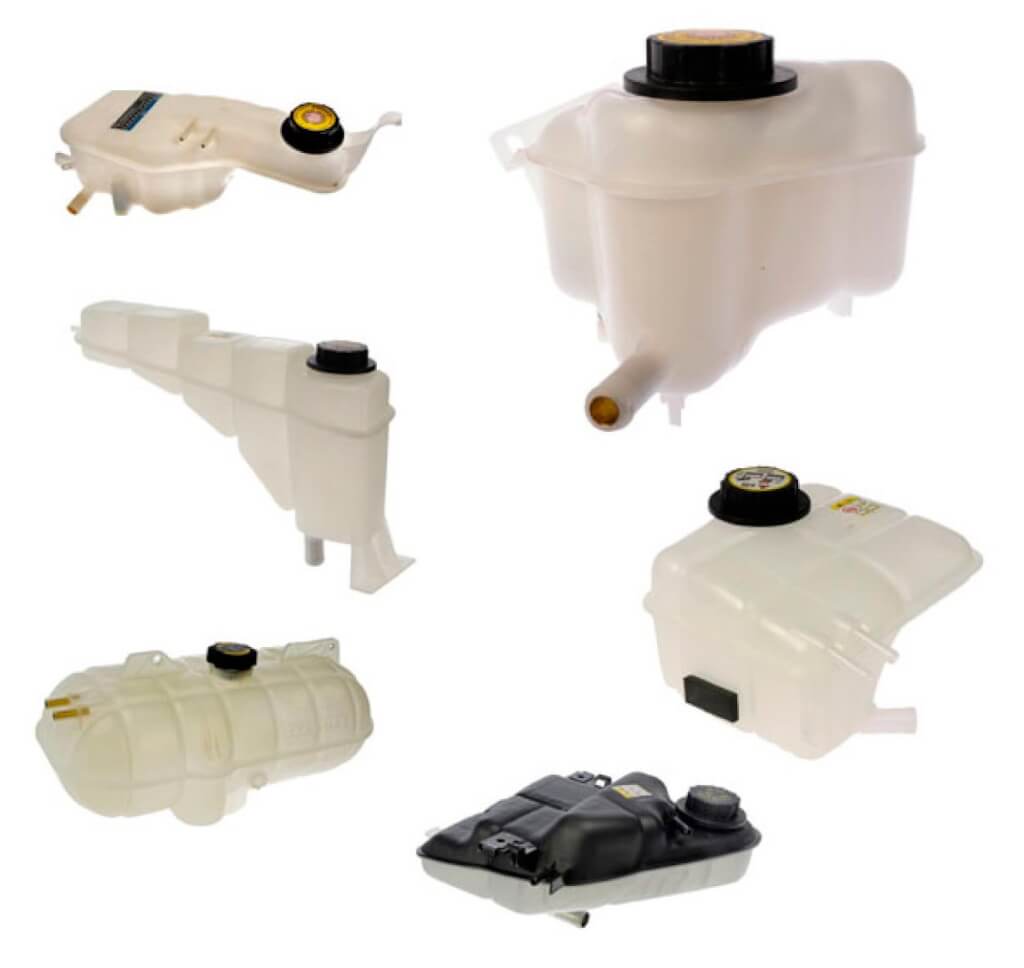
Find an aftermarket coolant tank at DormanProducts.com
You’ll often be picking up a tank that’s the same age—and the same weak design—as the one that just failed.
2. OEM Dealer Replacement — This is usually the most reliable choice. Many automakers update the tank design after early failures, so the new tank may be stronger.
3. Aftermarket Replacement (Dorman, URO, Spectra, etc.) — I’ve had good luck with aftermarket tanks, especially from Dorman Products. (I don’t make any money from this link). Enter your vehicle info on their website, find the correct part number, then compare pricing online.
Should You Buy OEM or Aftermarket Coolant Reservoir?
In my experience, OEM reservoirs usually offer:
• Exact fit
• Updated designs
• Factory-quality plastic
• Longer service life
Quality aftermarket reservoirs from reputable manufacturers can also be excellent values and often cost substantially less.
The key is avoiding the cheapest no-name replacement you can find online.
A poorly molded reservoir can develop leaks long before the original would have failed.
My Professional Recommendation
After years of repairing cooling systems, my advice is simple.
If your overflow bottle isn’t pressurized and has one small crack, plastic welding usually provides a reliable repair.
But if the reservoir is part of the pressurized cooling system—as it is on most modern vehicles—I don’t recommend trying to save it. Replace it.
The cost of a new coolant reservoir is minor compared to the potential cost of engine overheating, warped cylinder heads, or a blown head gasket.
Frequently Asked Questions About Coolant Reservoir Leaks
1) Can I Drive With a Coolant Reservoir Leaking?
It depends on how severe the leak is, but I generally don’t recommend it.
A small crack may only allow coolant to seep out slowly, and your engine may not overheat immediately. However, coolant leaks almost always worsen over time. Once the coolant level drops far enough, air enters the cooling system, reducing its ability to remove heat from the engine.
Driving with a leaking coolant reservoir can eventually lead to:
• Engine overheating
• Heater failure
• Steam from under the hood
• Cylinder head damage
• Blown head gasket
• Complete engine failure
2) Why Is My Coolant Reservoir Losing Coolant?
If your coolant reservoir is losing coolant, don’t automatically assume the reservoir itself is cracked. I’ve diagnosed many vehicles where the leak was actually coming from another cooling system component.
Possible causes include:
• A cracked coolant reservoir
• A leaking pressure cap
• Loose or damaged hose clamps
• A leaking radiator
• Water pump seal failure
• Heater hose leaks
• Thermostat housing leaks
• Internal engine leaks, such as a blown head gasket
3) Can a Coolant Reservoir Leak Without Overheating?
Yes. One of the most confusing symptoms for many drivers is coolant leaking, but the engine is not overheating. That’s actually very common during the early stages of a leak.
The radiator usually remains completely full while the overflow reservoir slowly loses coolant. As long as enough coolant remains in the system, the engine temperature gauge may stay perfectly normal.
4) What Causes a Coolant Reservoir to Crack?
Most coolant reservoirs fail because of age. After thousands of heat-up and cool-down cycles, the plastic gradually becomes brittle.
Hairline cracks usually begin around molded seams, hose connections, or mounting brackets where stress is greatest.
5) How Long Does a Coolant Reservoir Last?
Most original coolant reservoirs last around 15 years, although climate and driving conditions can shorten their life. Reservoirs exposed to frequent heat cycles, extreme temperatures, or repeated overheating often fail sooner.
6) Is It Better to Repair or Replace a Cracked Coolant Reservoir?
This is probably the most important takeaway from this article.
If the reservoir is a Non-Pressurized Overflow Tank, a properly performed plastic weld usually provides a dependable repair.
Pressurized Coolant Reservoir: Replacement is almost always the correct repair.
Attempting to patch a pressurized reservoir with epoxy, silicone, or plastic welding usually ends with another leak—often at the worst possible time.
How to Prevent Future Coolant Reservoir Leaks
One of the best ways to extend the life of your cooling system is to reduce unnecessary stress on the reservoir.
• Replace worn pressure caps.
• Repair overheating problems immediately.
• Check the reservoir for hairline cracks during every oil change.
Preventive maintenance costs very little compared to repairing an overheated engine.
Final Thoughts: Fix the Leak Before It Becomes an Expensive Repair
After decades of diagnosing cooling system failures, I’ve learned that a coolant reservoir leak is never something to ignore.
It may begin as a tiny crack that loses only a few ounces of coolant each week, but that small leak can eventually lead to overheating, warped cylinder heads, or even catastrophic engine failure.
If your coolant reservoir is cracked, determine whether it’s part of a pressurized cooling system before attempting any repair. While plastic welding may work on some non-pressurized overflow bottles, most modern pressurized reservoirs should be replaced rather than repaired.
When people ask me, “Can a coolant reservoir be repaired?”, my answer is always the same:
Sometimes—but only under the right conditions.
If there’s any doubt, replacing the reservoir is almost always the safest and most economical choice. Spending a little money now is far better than paying thousands later for major engine repairs.
When it comes to cooling systems, small leaks have a way of becoming big problems.
Fix them early.
Your engine will thank you.
©, 2013 Rick Muscoplat
Posted on by Rick Muscoplat