
Stop Brake Noise for Good: The Real Causes and Fixes
What Causes Brake Noise? Expert Guide to Quiet Brakes
Quick Summary
When brake pads touch the rotor during braking, the friction creates vibration. As those vibrations transfer through the brake pad to the caliper, they create brake noise. To reduce brake noise, you have to diagnose and eliminate worn brake pads and rotors, pad contamination, missing or worn hardware, lack of lubrication, and improper installation. Almost every type of brake noise can be fixed properly with proper inspection, cleaning, lubrication, and quality parts.
Article
How to Stop Brake Noise: What Causes It and How to Fix It for Good
If there’s one thing that drives drivers crazy, it’s brake noise. It can be a high-pitched squeal or a grinding sound that makes you wince. Or it can come across as a rhythmic scraping that seems to correspond to wheel speed. Over the years, I’ve diagnosed hundreds of brake complaints, and I can tell you this: brake noise is almost never random. There’s always a reason.
Diagnosing the Cause of Brake Noise: Start a Pad and Rotor Inspection
When brake pads wear down to the backing plate,
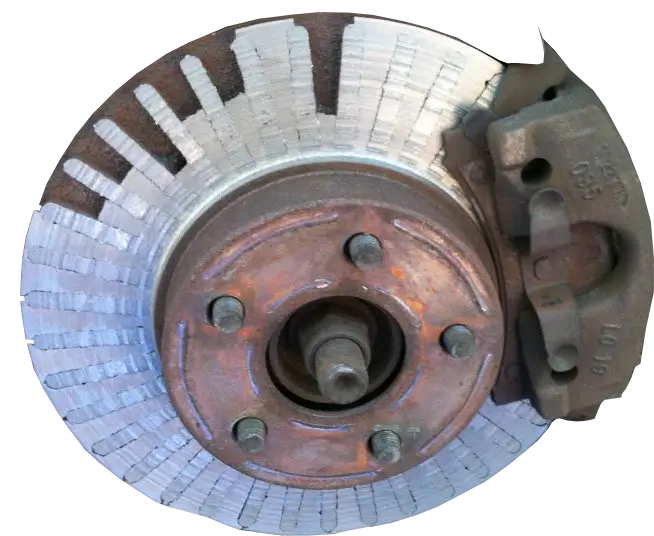
This is what happens to your rotor when the friction material is gone, and you’re braking metal to meta,l
you’ll hear grinding. That’s the sound of metal-on-metal contact. If you ignore it long enough, the rotor gets destroyed. I’ve seen rotors worn down to the cooling vanes—at that point, there’s no saving anything.
Quality pads include wear indicators. These small metal tabs contact the rotor when the pad thickness drops to around 2–3 mm, producing a warning squeal. That squeal is actually helpful—it’s telling you to replace the pads before real damage happens.
To stop brake noise caused by wear:
• Inspect pad thickness.
• Measure rotor thickness with a caliper.
• Replace pads before they hit the backing plate.
• Replace or resurface rotors if below the minimum thickness.
• Ignoring wear doesn’t just create noise—it multiplies repair costs.
Contamination – The Overlooked Cause of Brake Noise
Another major factor in what causes brake noise is contamination. Dirt, road salt, and debris can get trapped between the pad and rotor. That creates grooves and uneven surfaces, which lead to vibration. Rust buildup on rotors is another frequent issue—especially in humid or salted-road climates.
Light surface rust isn’t a problem. But heavy rust scaling will absolutely cause brake noise.
When I’m trying to stop brake noise from contamination, I’ll:
• Lightly sand pad surfaces (100–200 grit).
• Clean rotors thoroughly.
• Replace severely grooved pads and rotors.
WARNING: Soaking brake pads in brake cleaner. Don’t do it. It can degrade the friction material and backing shims. If pads are lightly contaminated, use mild soap and water—not aggressive chemicals.
Missing or Worn Brake Hardware
Brake hardware is one of the most overlooked

High heat degrades the spring tension of the anti-rattle clips and rust can cause the brake pad “ears” to bind
contributors to brake noise. Those small clips, shims, and springs allow pads to slide smoothly and retract properly. When they rust or wear out, pads bind and vibrate. That vibration becomes squeaks and uneven wear.
On drum brakes, worn return springs can allow shoes to drag, creating constant scraping.
If you want to truly eliminate brake noise, replace the brake hardware whenever you replace the pads. Hardware kits are inexpensive—and skipping them is false economy.
On vehicles that don’t use replaceable clips, clean the caliper contact points thoroughly with a wire brush so pads can move freely.
• Insulators, like noise reduction shims or gaskets, that isolate vibration and prevent it from moving from the friction material to the caliper
• Anti-rattle clips or “abutment clips” that eliminate brake pad backing plate vibration transfer to the caliper.
• High-temperature synthetic brake grease applied in areas where the brake pad backing plate contacts the caliper acts as a dampening agent.
If the insulators, clips, and grease are properly installed, a braking system should not generate noise. Yet, even some “perfect” installations generate brake noise. So what’s going on—secondary noise?
Eliminate Brake Noise Due to a Lack of Lubrication at Critical Contact Points
Brake systems require lubrication in two key areas:
• Pad-to-caliper contact points.
• Caliper guide pins.
For pad contact areas, Chris Fix recommends copper-based anti-seize. I disagree. Copper anti-seize is not rated for brake work, and it’s not a very good lubricant. The whole point of using a grease on the back of brake pads, where they touch the caliper, is to dampen vibrations. That’s not what anti-seize is designed to do. For metal-to-metal contact areas, I recommend a moly-based grease or a synthetic high-temperature break grease.
For guide pins, always use a high-temperature silicone brake grease. Dry or seized guide pins cause uneven pad pressure—and uneven pressure creates vibration and noise.
To properly stop brake noise, apply:
• A thin layer of synthetic brake grease under the anti-rattle clips and a light film of moly grease on the pad ears (T-ends) and contact points.
• Silicone grease inside guide pin bores.
• Never lubricate pad friction surfaces.
• Too much grease is just as bad as none. Use a thin, even coat.
Rotor Runout and Installation Errors
If the hub surface is rusty or uneven, the rotor won’t sit flat. That creates rotor runout. Runout leads to rhythmic scraping and pedal pulsation that many people incorrectly call “warped rotors.”
Before installing new rotors, I always:
• Wire-brush the hub face to remove as much rust as possible.
• Apply a light coat of anti-seize to prevent future corrosion. This IS a proper use of anti-seize because it prevents the rotor from seizing to the hub
Proper torque sequence on lug nuts also matters. Uneven torque can distort the rotor and create noise.
Poor Quality Brake Parts Cause Brake Noise
I’ve diagnosed plenty of brake jobs where everything was installed correctly, but the problem was cheap pads. Low-quality pads can contain inconsistent friction materials. Hard particles embedded in the pad can score rotors. Cheap shims may fail to dampen vibration.
Premium pads cost a little more—but they’re engineered to reduce vibration. And since vibration is what causes brake noise, quality matters.
What is secondary brake noise?
Secondary brake noise is vibration that is amplified rather than dampened. In other words, the initially inaudible vibration frequency is now audible. Most people blame the friction material, claiming the brake pads are “too hard” or the rotors are of poor quality.
However, aside from the quality of brake parts, most secondary brake noise is caused by brake components that have deteriorated due to heat and stress, resulting in a loss of tight fit. For example, the brake pad backing plate begins to transfer initial vibration to the caliper abutment (bracket) due to the degradation of the anti-rattle clips or deterioration of the noise reduction shim. Secondary brake noise due to degradation appears as an irritating squeal.
Why is brake noise so common now?
Car makers have reduced the mass of car components to reduce weight and increase gas mileage. The brake rotors on early RWD vehicles were massive. They contained the wheel bearings and seals, which were designed to be machined several times. The rotors in FWD vehicles and all modern vehicles are both smaller and less massive—they’re a fraction of the weight of RWD vehicles, so they can’t dampen the vibrations nearly as well.
The brake balance has changed as well. With the engine and transaxle mounted under the hood, FWD vehicles carry more weight in front than older RWD vehicles, where the transmission, driveshaft, and differential moved more weight to the rear.
So, the front brakes in FWD vehicles perform 80% to 85% of the braking, while the rear brakes provide only 15% to 20%. In contrast, the front brakes in RWD vehicles account for 55% to 60% of braking, with the rears accounting for 40% to 43%. The result is much higher operating temperatures on FWD brakes, which causes glazing and rapid wear.
Technicians sometimes believe switching to a “softer” brake pad will be more forgiving and cure a noise complaint. A softer friction material alters the braking system’s balance and may reduce secondary noise. But that change may also result in more rapid wear or reduced braking performance. Rather than automatically blame the brake pad, you should first examine the noise-reduction features of the entire braking system.
Brake noise in detail
Since each type of brake noise can have different causes, I’ll list the types of noises and refer you to a more in-depth article with diagnostic tips.
• Judder—a low-frequency vibration (0 to approximately 300 Hz) in the mid-5o to 900-decibel range that may include shake or rumbling noise.
Cause: Poor tolerance or fitment—rotor to hub, abutment to the steering knuckle, caliper to bracket, brake pad backing plate to the caliper
See this post on how to eliminate brake judder and brake pedal pulsation
• Squeal— A medium frequency noise in the 300Hz to 5,000Hz range in the 0 to high 50’s dB range.
Causes: Degradation of the caliper piston or the square-cut O-ring that prevents smooth movement in/out of the caliper piston, non-planarity of the rotor face (the rotor face has high and low spots), improper brake pad fit, degraded, missing, or improper noise reduction shims, and worn friction material.
See this post on how to eliminate brake squeal
• Squeak— High-frequency vibration (5 ,000Hz to 12,000Hz ) in the 0 to high 80’s dB range
Cause: If the clips, shims, and grease are in good condition, the cause is molecular vibration within the friction material itself.
Final Thoughts: The Real Way to Stop Brake Noise
If you want to truly stop brake noise, you have to approach it methodically. Brake noise isn’t mysterious. It’s physics. Vibration caused by friction irregularities.
The formula is simple:
Inspect for wear.
Eliminate contamination.
Replace hardware.
Lubricate correctly.
Install parts properly.
Use quality components.
When all those steps are done right, brakes are smooth and quiet.
©, 2019 Rick Muscoplat
Posted on by Rick Muscoplat