
What Is the Blue and White Powder on Battery Terminals?
What is that blue and white powdery stuff on my battery terminals?
Quick Summary
If you’ve opened your hood and discovered blue or white powder on your battery terminals, you’re looking at battery terminal corrosion.
The color gives you a useful clue about what’s happening.
Blue battery terminal corrosion is copper sulfate, which can form when sulfuric-acid-containing battery residue reacts with copper in the battery cable terminal or connector.
White battery corrosion is commonly associated with lead sulfate or other light-colored corrosion products around lead-containing battery components.
• Blue battery terminal corrosion commonly involves copper sulfate or related copper corrosion products.
• White powder on battery terminals can contain lead sulfate and other corrosion products.
• Blue-green deposits generally tell me copper-containing parts of the battery connection are involved in the corrosion.
• Corrosion can increase electrical resistance between the battery post and cable connection.
• Heavy corrosion can contribute to slow cranking, starting problems, charging issues, voltage drop, and damaged battery cables.
• If corrosion returns quickly after a thorough cleaning, I start looking for an underlying problem such as electrolyte leakage around a battery post or case.
• Cleaning the powder solves the visible problem; finding out why the battery terminals are corroding helps keep it from coming back.
If there’s one point I want you to remember, it’s this: battery corrosion is a symptom. The color can provide clues, but you still need to find the cause.
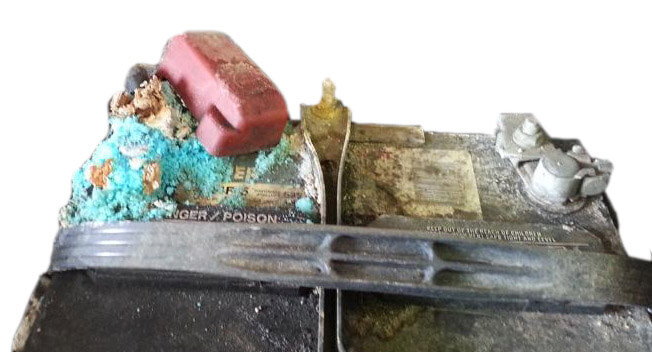
Battery terminal corrosion
What Is the Blue and White Powder on Battery Terminals?
I’ve opened plenty of hoods and found a battery that looks like somebody dumped colored powder around the terminals.
Sometimes it’s chalky white.
Sometimes it’s bright blue.
Other times it’s blue-green, turquoise, or a mixture of several colors.
The powder is battery terminal corrosion produced by chemical reactions involving the battery, its electrolyte, moisture, and the metals used in the battery posts and cable terminals.
The color of the deposits can change depending on which metals are reacting.
That’s why I pay attention to color—but I don’t stop my diagnosis there.
Many battery cable assemblies contain copper because copper is an excellent electrical conductor.
Unfortunately, once acidic contamination reaches those copper-containing components, corrosion can begin.
That familiar blue or blue-green material is therefore a clue that copper in the battery connection is being attacked.
Why Does the Blue Powder Form On the Battery Terminal?
Blue powder on the battery terminal means that 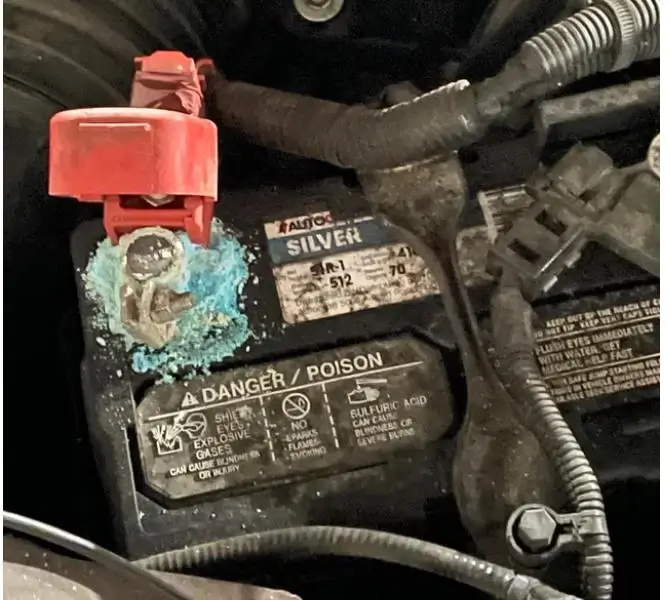 electrolyte (battery acid) has contacted the copper in the battery terminal. If you see that, start inspecting the battery case near the post for signs of acid leaks.
I look for:
• Wetness around the battery post
• Electrolyte residue on top of the battery
• Corrosion between the post and terminal
• A deteriorating seal around the battery post
• Damage to the battery case
• Corrosion extending into the battery cable
• Loose or damaged cable terminals
• Evidence of excessive battery gassing
The blue powder itself isn’t the entire diagnosis.
Think of it as evidence left behind by the chemical reaction.
What Is the White Powder on Battery Terminals?
White battery corrosion can be confusing
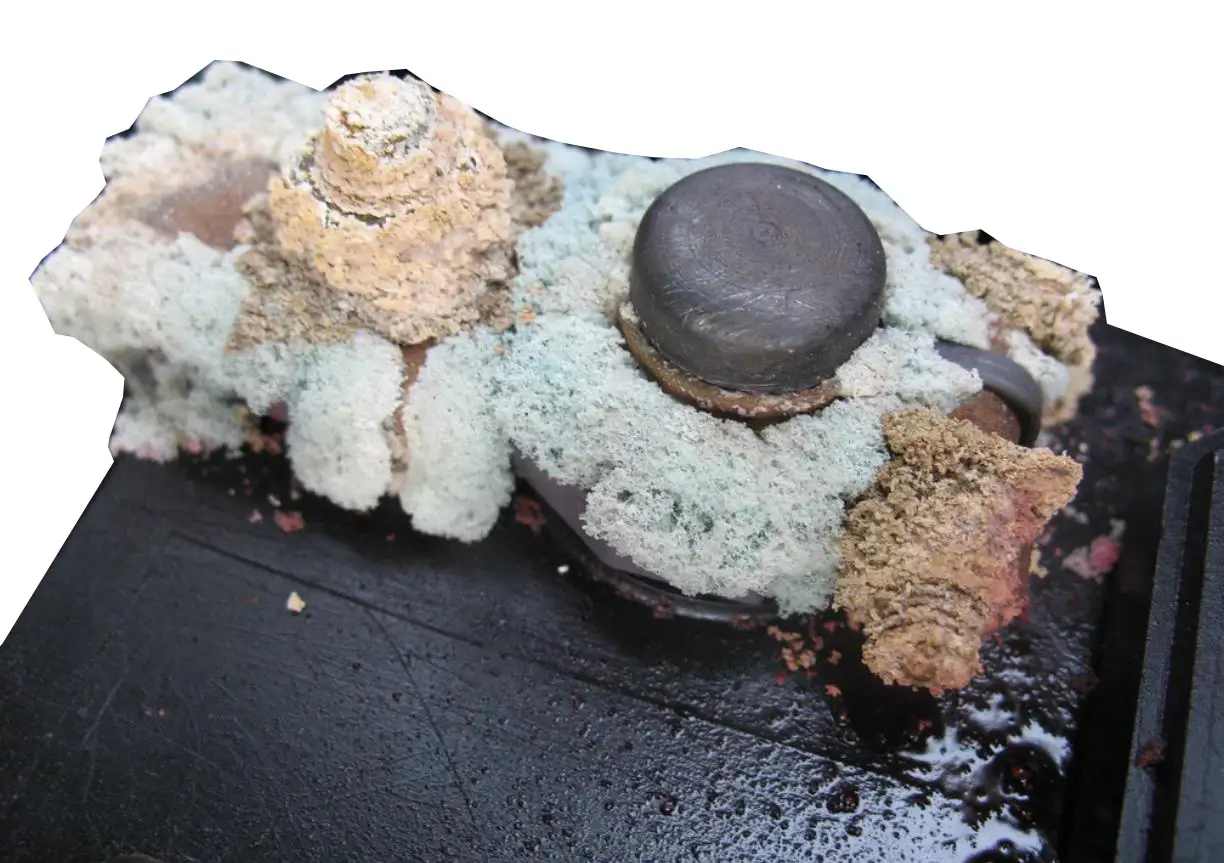
Notice the corrosion and the wetness on the top of the battery. This car battery is leaking between the case and the post
because several corrosion products can look white, gray, or off-white.
In a conventional lead-acid automotive battery, white powder around a battery terminal can include lead sulfate and other lead-related corrosion products.
Your car battery contains lead components and sulfuric-acid-based electrolyte. Under the right conditions, chemical reactions can produce lead sulfate.
That’s one reason white, chalky material is commonly found around corroded lead-acid battery connections.
Does White Powder Mean My Car Battery Is Bad?
Not automatically.
This is an important distinction.
Finding white corrosion on a battery terminal tells me there is corrosion occurring. It doesn’t, by itself, prove the battery needs replacing.
I want to know:
• How old is the battery?
• Does the corrosion return after cleaning?
• Is the battery holding a proper charge?
• Is there moisture around the battery post?
• Is the battery case cracked or swollen?
• Are the terminals clean and tight?
• Is the charging system operating correctly?
• Has corrosion traveled underneath the cable insulation?
Those answers tell me much more than color alone.
Understanding what triggers this corrosion is key to preventing it. Let me break it down for you:
Several factors can lead to battery terminal corrosion. Here are the most common causes:
What Causes Battery Terminal Corrosion?
1. Electrolyte Leakage Around the Battery Post
This is one of the first places I look when corrosion keeps returning.
A conventional car battery contains an electrolyte made from sulfuric acid and water.
The battery post passes through the battery case. If the seal around that post deteriorates or electrolyte finds a path outside the battery, acidic material can reach the battery terminal.
When that material contacts copper-containing components, blue or blue-green corrosion products can develop.
This is especially important when you see wetness around the battery terminal in addition to corrosion.
2. Battery Age and Post-Seal Deterioration
Car batteries live in a difficult environment.
They’re exposed to:
• Heat
• Cold
• Vibration
• Charging and discharging
• Engine-compartment temperature changes
• Years of expansion and contraction
Over time, the battery can deteriorate.
If the seal around a post starts allowing electrolyte or acid residue to escape, cleaning the terminal may temporarily make everything look good.
Then the blue or white corrosion comes back.
When I see battery corrosion that keeps coming back, I don’t keep reaching for the cleaning brush indefinitely.
I look for the leak.
3. Charging-System Problems
Battery charging conditions can also contribute to corrosion.
Excessive charging can increase battery gassing and heat, creating conditions that may accelerate electrolyte loss or corrosion.
That doesn’t mean every corroded battery has a bad alternator.
It means recurring or unusually severe corrosion gives me a reason to check the charging system instead of assuming the battery terminals simply need another cleaning.
Modern vehicles can use computer-controlled charging strategies, so charging-system diagnosis should be based on the manufacturer’s specifications rather than one universal voltage number.
4. Heat and Temperature Changes
Heat speeds up chemical reactions.
Under-hood temperatures can become extreme, especially during hot weather and demanding driving conditions.
Repeated heating and cooling can also contribute to battery aging and deterioration.
Over time, that can increase the likelihood of:
• Electrolyte loss
• Battery deterioration
• Post-seal problems
• Increased corrosion
• Shorter battery life
Heat may not directly explain every blue deposit you see, but it can accelerate the conditions that allow corrosion to develop.
5. Moisture, Humidity, Salt, and Contamination
The environment around the battery matters too.
Moisture can encourage electrochemical corrosion, and contaminants can make the situation worse.
I pay particular attention to vehicles exposed to:
• High humidity
• Road salt
• Coastal salt
• Dirt and grime
• Repeated temperature swings
• Moisture inside the engine compartment
If acidic battery residue is already present, moisture and conductive contamination can accelerate corrosion.
Can Blue Battery Corrosion Cause a Car Not to Start?
It can.
Your starter motor needs substantial current to crank the engine.
A heavily corroded connection has high electrical resistance that lowers cranking and charging voltage
You may have a battery with usable stored energy but still experience:
• One click when turning the key
• Rapid clicking
• Slow cranking
• Intermittent cranking
• No cranking at all
That’s why you should check battery terminals and cable connections during a no-start diagnosis.
Don’t automatically condemn a battery until you know the electrical connections can carry current properly.
Can Battery Terminal Corrosion Cause Battery Drain?
I’m careful with this question because battery drain and poor battery connections aren’t the same problem.
Terminal corrosion primarily increases electrical resistance. That can interfere with starting and with the battery receiving an adequate charge.
A battery that repeatedly goes dead may have another issue, such as:
• A weak battery
• Charging-system fault
• Parasitic electrical draw
• Poor cable connection
• Excessive resistance in the charging circuit
• Vehicle sitting for long periods
So if your battery keeps dying and you also see corrosion, don’t assume removing the blue powder automatically solves the battery-drain problem.
Test the entire starting and charging system.
How battery corrosion happens — the chemistry behind the corrosion
When your battery sits in a discharged state, white powder forms on the negative battery terminal
• The white powder is lead sulfate.
Sulfate crystals form on the battery’s lead plates. When the battery sits discharged long enough, lead sulfate starts to cover the top of the plates and eventually creeps up to the battery post through a gap between the case and the post.
How lead sulfate forms
It forms when you combine lead, sulfuric acid, and water:
• Lead (Pb) + Sulfuric Acid (H2SO4) + Water (H2O) = Lead Sulfate (PbSO4).
If your battery terminals are made with aluminum, the powdery substance can also contain aluminum sulfate.
Blue powder on car battery terminals is copper sulfate
It’s formed when you combine copper, sulfuric acid, and water with electrical flow
Copper (Cu)+ sulfuric acid (H2SO4) + Water (H2O) + electrical flow = Copper Sulfate (CuSO4) & Sulfur dioxide (SO2)
Consequences of Battery Terminal Corrosion
Battery terminal corrosion can have several negative effects on your vehicle’s performance:
1) Poor Electrical Connections: Corrosion acts as an insulator, reducing the effectiveness of the connection between the battery terminals and the cables. This can cause difficulty starting the vehicle, dim headlights, and other electrical issues.
2) Reduced Battery Life: Corrosion can cause the battery to work harder to deliver power, leading to increased wear and tear on the battery and a shorter lifespan.
3) Damage to Electrical Components: In severe cases, the increased resistance caused by corrosion can lead to overheating of the electrical connections, potentially damaging the battery cables and other electrical components.
4) Complete Battery Failure: If the corrosion is left untreated, it can eventually lead to the complete failure of the battery, leaving you stranded with a vehicle that won’t start.
How to Prevent and Address Battery Terminal Corrosion
Preventing battery terminal corrosion is key to ensuring your battery’s longevity and reliable performance. Here are some steps you can take:
• Regular Inspections— Check your battery terminals regularly for signs of corrosion. If you notice any buildup, clean the terminals promptly with a baking soda and water mixture, which neutralizes the acid. Scrub the terminals with a wire brush, rinse with water, and dry thoroughly before reconnecting the cables.
• Apply a Protective Coating— After cleaning the terminals, apply a thin layer of petroleum jelly or a specialized battery terminal protectant to help prevent future corrosion. These coatings create a barrier between the metal terminals and the environment, reducing the likelihood of corrosion.
• Secure the Battery Terminals— Ensure that the battery terminals are securely fastened to prevent vibration and movement. Loose terminals can lead to electrolyte leakage and increased corrosion.
• Avoid Overcharging— Overcharging your battery can cause the electrolyte to expand and leak, leading to corrosion. Use a quality battery charger with an automatic shut-off feature to prevent overcharging.
If you clean your battery terminals and posts using the cleaning method shown here and the corrosion returns quickly, that indicates you’ve got a leaking battery. If the battery is under warranty, return it and get a new battery.
There is no way to fix the leaks because the lead posts and plastic case have different expansion-contraction rates.
©, 2020 Rick Muscoplat
Posted on by Rick Muscoplat