
Why auto start stop doesn’t doesn’t wear out your starter
Your auto start-stop starter doesn’t wear out faster because it isn’t a traditional starter
Start-stop saves gas by shutting down the engine when you’re at a stop. The engine starts again as soon as you release your foot from the brake pedal. While this system’s environmental and economic benefits are evident, a common concern among drivers is whether the frequent starting caused by these systems could wear out the vehicle’s starter faster. To address this concern, it’s essential to understand how auto start-stop systems work, how they differ from traditional starting mechanisms, and what implications they have for the longevity of your vehicle’s starter motor. The starters used in start-stop systems are completely different than the ones used on non-start-stop vehicles.
Start-Stop Starter Motors Are Rated For 10-20 Times The Number Of Cycles of an Ordinary Starter
Most ordinary starter motors are built to last for 20,000- 40,000 cold start cycles. But start stop starter motors are rated to provide 300,000 to as many as 600,000 cycles. In this article I’ll explain what’s different about a start stop starter motor that allows them to operate through that many cycles without failing early.
Here’s What’s Different About Start-Stop Starter Motors
1) Reinforced Pinion Gear Mechanism: Start-stop starters use stronger pinion gears with more teeth up to 14, compared to conventional starters that have only 8 to 11 teeth), and engagement systems to handle frequent cycling.
2) Enhanced Solenoid: More durable solenoids with higher-grade materials to withstand repeated activation.
3) Gear Reduction: An enhanced heavy duty planetary design reduces rotation speed to ensure longer life and lower motor torque. The gears are designed for high duty cycles and longer life
4) Larger Permanent Magnets: Start stop starter use significantly larger permanent magnets to provide a stronger magnetic field for lower amperage draw, lower heat, longer life and quicker starts
54) Copper segments are larger and contain more copper than conventional commutators to provide a longer wearing surface for brushes.
6) Upgraded Brushes and Commutator: Special brush materials (often silver-graphite alloys) that have lower wear rates during frequent use.
7) Improved Bearings: Friction reducing needle bearings instead of sintered bronze bushings. Plus, better lubrication systems for extended life.
8) Advanced Heat Management: Additional cooling features to dissipate heat generated by frequent operation.
For example, the Valeo i-StARS (integrated Starter Alternator Reversible System) combines starter and alternator functions is rated for Rated for 600,000+ cycles in some models, while reducins noise and vibration during restart operations
The Continental Enhanced starter systems designed for 500,000 cycles.
The Hitachi advanced starter motors with ratings of 350,000+ cycles
Here’s why auto start stop starter systems don’t wear out the starter faster
1) The starter is built to handle at least 300,000-500,000 start cycles— Traditional starters are designed to last for 20,000-40,000 cycles.
2) After the initial cold start, all subsequent starts are hot restarts. Hot restarts are much easier on the starter and engine. Even though the start counts as a full cycle, it’s nor a full load cycle, like a cold start. In other words, a hot restart versus a cold start isn’t an apples-to-apples comparison
3) Start stop starter motors have a different gear ratio to reduce motor rpms, power usage and wear— Start stop starters employ a larger starter drive gear and a lower gear reduction system. That allows the starter to turn slower, reducing wear on the brushes and bearings.
4) Slower coast-down speed reduces brush wear— Since 90% of starter motor brush wear occurs as the starter motor has stopped cranking and is coasting down to a full stop, carmakers dramatically reduce brush wear by slowing the rotation speed during cranking, which also reduces the coast down speed. In addition, carmakers beefed up the armature and brushes.
5) Start stop starter motor brushes are different as well— A start stop starter motor uses a different combination of carbon and copper brushes to increase longevity and reduce commutator wear.
6) The starters use needle bearings instead of oil-impregnated bushings— Traditional starter motors rely on oil-impregnated bushings and
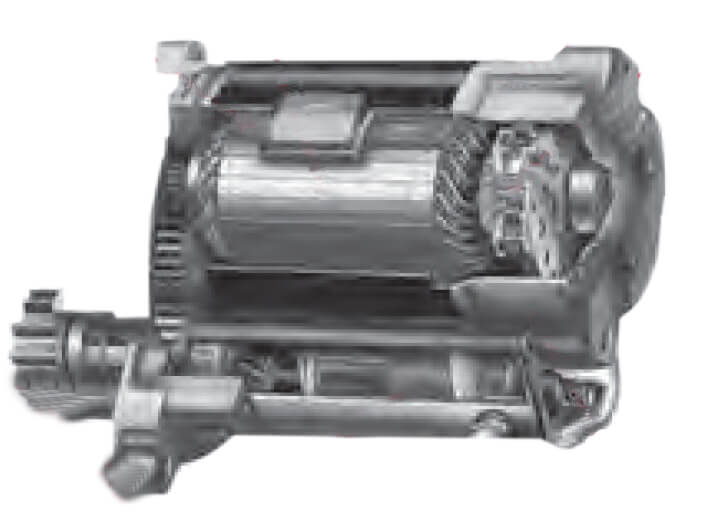
gear reduction start stop starter
would wear out quickly in this application. So the motors used for start stop are equipped with high quality needle bearings.
Start stop starters are faster acting
Some starters are equipped with a ‘tandem solenoid’ designed to engage more smoothly in scenarios where the engine is about to stop and then the driver accelerates again. That would occur if the driver has decided to stop but, for whatever reason, has a change of mind, such as when the traffic moves off unexpectedly. The tandem solenoids are there to synchronize the starter’s speed with the engine before the second smoothly engages the gear.
How does start stop work?
The vehicle computer detects when the car is stationary or out of gear. Before it shuts off the engine, it checks the battery charge level to make sure it has enough power to restart the engine. If the battery is low, it will not shut down the engine. Then it stops fuel delivery and spark. The process happens automatically, but drivers can choose whether the system is active or disabled by pushing their car’s stop-start button; a capital A with an arrow circling clockwise.
Start Stop effects on engine life
Car makers have gone to great lengths to avoid accelerated engine wear in start stop engines.
The biggest issue car makers face is how to maintain start up lubrication during the many start stop operations. In a traditional engine, the crankshaft and camshafts are separated from their bearings by hydrodynamic lubrication (pressurized oil centering the shaft between the smooth bearings) and boundary lubrication (the oil film that remains when oil pressure is gone).
In a start stop engine, the crankshaft and camshafts would normally fall onto the bottom bearing surface when the engine shuts off. If boundary lubrication isn’t adequate, the shafts will wear out the bearings.
To prevent that, start stop engines use a different bearing material that is self lubricating to resist start up wear. In fact, Federal Mogul has developed a new bearing coating material called Irox for start stop applications. The bearing has a polymer coating that contains iron oxide (rust) particles which are actually surprisingly slippery. The new coating is so slippery that the coefficient of friction of an Irox bearing is 50% lower than a conventional aluminum bearing, ensuring it will last the life of an engine equipped with stop-start.
Low-friction oils help prolong engine life
The newer synthetic oils have boosted additive packages that reduce oxidation and friction and have increase anti-wear properties.
Start/stop facts
• Corroded battery terminals or poor battery termination installation can deactivate the start/stop system
• The HVAC system is connected to the start/stop system. The start/stop system will not work until the engine is warmed up and the passenger cabin is warmed up. That’s to avoid passenger discomfort.
• The start/stop system will not shut off the engine if the vehicle’s AC is set to the HIGH setting.
• If the engine is stopped, the system compares the cabin and air duct temperatures. If it concludes that the cabin temperature will rise too much with the engine off, it will keep the engine running.
•The AC evaporator coils in start/stop vehicles is different than conventional vehicles. the fin and tube designs are different and the evaporator core is insulated more fully to stay cold longer. Unfortunately, the insulation makes them more difficult to replace.
©, 2020 Rick Muscoplat
Posted on by Rick Muscoplat