
How to Charge a Car Battery the Right Way
The Expert Guide to Charging a Car Battery Safely
Quick Summary
There’s a right way and a wrong way to charge a car battery. Charging your car battery at too high a voltage or amperage can damage it. In most cases, a low current and voltage for a more extended period is the best way to recharge without damage. In other words, if you want your battery to last, you can’t rush the charging process.
Learn How to Charge a Car Battery Without Making These Common DIY Mistakes
When a car battery is dead, the temptation is strong to slap on a charger, crank it up, and hope for the best. I get it—you want to get back on the road. But after decades of diagnosing battery failures, I can tell you this with absolute confidence: rushing the process is one of the fastest ways to destroy a perfectly recoverable battery.
To properly charge a car battery, you have to understand what’s actually happening inside it. Charging isn’t just about dumping electrons back in. It’s about reversing chemical damage, restoring plate surface area, and slowly re-saturating the lead plates. Think of the lead plates as if they’re a dry sponge. You can splash water on the surface and make it look wet, but until it soaks all the way through, it’s not really full. That’s exactly how the lead plates in car batteries behave—and it’s why knowing how long to charge a car battery matters so much.
How Car Batteries Actually Recharge: The Three Charging Phases Explained
Every modern battery charger that’s worth owning follows the same basic strategy. The charger proceeds in three distinct phases.
The Reconditioning Phase: Undoing Sulfation Damage — When a battery is discharged, sulfate crystals form on the plates. Those crystals are non-conductive, and the longer the battery sits dead, the harder they become. This is why a dead battery often “tests bad” even though it’s physically intact.
The first step when you charge a car battery is reconditioning. The charger starts at a very low voltage and current to gently break down those sulfate crystals and return them to the electrolyte. This phase takes patience—and this is where many people make their first mistake.
• Mistake #1: Using High Voltage and High Current to Speed Things Up
Cranking a charger to maximum output feels productive, but it’s exactly the wrong move. High resistance from sulfate crystals, combined with high current, generates heat, which warps the plates. Once that happens, battery capacity is permanently reduced.
If you’re serious about learning how long to charge a car battery, here’s the rule I live by: low and slow always wins. Any charger that doesn’t follow the reconditioning phase does more harm than good.
The Bulk Charging Phase: Where Most of the Energy Goes In — Once the sulfate crystals are reduced, the charger moves into bulk mode. This is where about 80% of the battery’s capacity is restored. The charger delivers high amperage at relatively low voltage, allowing energy to flow quickly without overheating the plates.
For a deeply discharged battery, bulk charging alone typically takes five to eight hours. That’s a critical piece of understanding how long to charge a car battery, because many people stop right here—long before the job is finished.
• Mistake #2: Manual Mode Charging With High Amps and High Volts
Manual mode is where DIYers unintentionally kill batteries. In manual mode, many chargers output the maximum voltage and current simultaneously. That’s not what bulk charging requires.
If you want to charge a car battery safely, automatic mode is your friend. Intelligent chargers regulate voltage and current independently. Manual mode doesn’t—and that difference matters.
The Absorption Phase: The Most Skipped—and Most Important—Stage —Absorption is where patience pays off. During this phase, the charger increases the voltage and gradually reduces the current to saturate the plates fully. This is where battery capacity is restored—not just surface charge.
Absorption can take seven to ten hours for a deeply discharged battery. If you cut this short, sulfation begins all over again. Anyone asking how long to charge a car battery needs to understand that absorption time is not optional—it’s essential.
• Mistake #3: Trying to Charge a Car Battery by Driving the Vehicle
One of the biggest myths in automotive repair is that driving will fully recharge a dead battery. It won’t. The problem with driving the vehicle to recharge a dead battery is that you never drive long enough to complete all three phases.
Even if you manage to complete the recondition phase, you’ll never complete the bulk charging mode, which means you’ll never even enter the absorption mode. So your battery will be in a constant state of discharge.
Why Your Alternator Should Never Be Used as a Battery Charger
Modern alternators can produce huge amperage—but only briefly. Forcing them to recharge a dead battery overheats the diodes and stator windings. That’s a costly mistake.
A good battery charger costs under $75. A failed alternator can cost $800–$1,000 to install. I’ve seen this mistake more times than I can count.
Idling Is the Worst Way to Charge a Car Battery
At idle, your alternator produces roughly 35% of its rated output. Charging a dead battery at idle would take four to ten hours—and you still wouldn’t complete absorption. Meanwhile, the alternator is working its hardest at the worst possible RPM.
If you’re serious about learning how long to charge a car battery, idling should never be part of your strategy.
• Mistake #4: Charging Without Cleaning Battery Terminals
Corrosion adds resistance, and resistance creates heat. Before you charge a car battery, take ten minutes to clean the terminals and posts. That simple step improves charging efficiency and protects both the battery
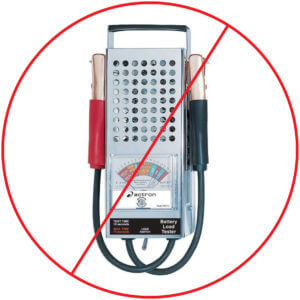
An old-fashioned battery tester
and the charging system.
Always Inspect and Test Before Charging
Never charge a battery that’s frozen or physically damaged. Bulged sides mean internal plate damage—replace it, period.
I also strongly recommend using a modern conductance tester rather than an old “toaster” load tester. Proper testing tells you whether charging is even worth attempting.
Dirty battery terminals can kill your battery and your charging system. Here’s how to clean battery terminals.
For more information on what causes battery sulphation, see this post.
Start with a visual inspection and battery test
Never attempt to recharge a battery until you’ve checked for
freezing. Look at the case and check for bulges. If you see bulged sides, you’re buying a new battery—PERIOD. If there’s no sign of freezing, use a modern battery tester to check it’s internal condition. Don’t rely on one of these ancient “toaster” testers that just heats up wire elements. You need a modern battery tester that tests internal resistance and conductance.

Modern intelligent battery tester. This one is made by Solar. It’s the BA9 battery tester
Set up the battery tester
Program the tester to match the battery type in your car. Choose either standard lead-acid (SLA) or absorbed glass mat (AGM). This is important because the tests differ by type. Then enter the battery’s cold-cranking amp rating (CCA)—find it on the battery label. Start the test and read the result.
For more information on testing a car battery, see this post.
Why Old-Style Battery Chargers Are Dangerous
Older linear chargers weren’t designed for modern maintenance-free or AGM batteries. Some output up to 20 volts—enough to warp plates, boil electrolyte, and damage vehicle electronics.
If you care about charging a car battery safely, retire the antique charger. Modern batteries demand intelligent charging.
More on the battery reconditioning phase
As shown in the chart below from Solar, a car battery charger with a reconditioning feature initiates recharging at approximately 4 V and 7 A. That’s called the energizing phase. Then it boosts the charging current to approximately 13.5 A while slowly ramping the voltage to a peak of approximately 14.5 V in phase 3. In the third, or absorption, phase, it maintains a constant voltage while ramping down the current. The 4th phase lowers the voltage slightly and the current a bit more. In the 5th or resting phase, it drops current flow to 0 while maintaining around 12.5 volts. The 6th phase exercises the battery by pulling a load on the battery until it reaches the final restoration phase, where it raises amperage and voltage one last time.
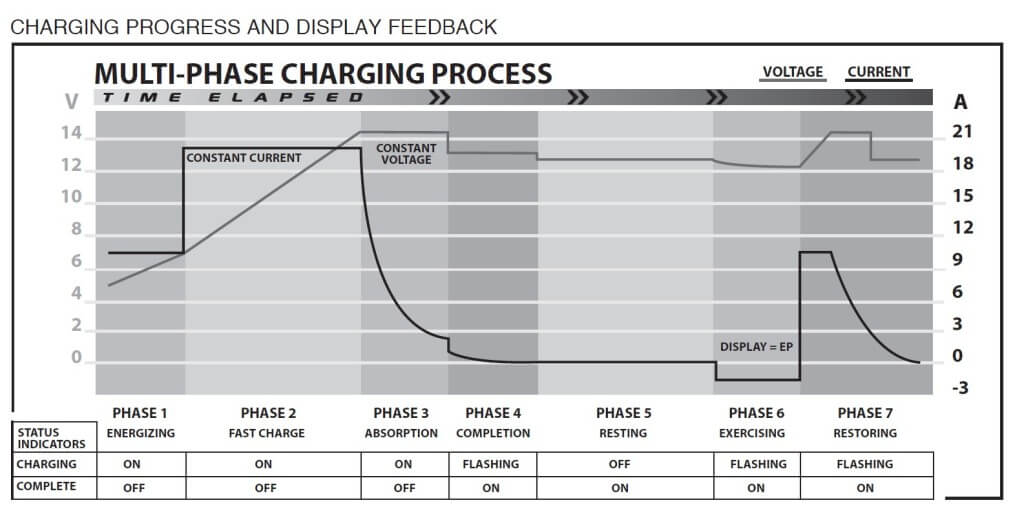
Notice the charging pattern for reconditioning a battery
Where can I get an intelligent battery charger?
Several reputable companies make intelligent battery chargers. Here are a few.
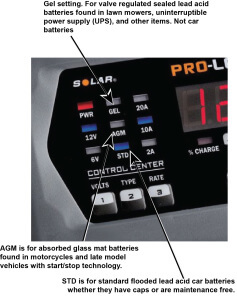
Buy a battery charger with settings for standard flooded lead-acid, GEL, and AGM
Solar Pro Logix
The Solar Pro Logix battery charger shown below has a “recondition” cycle for severely discharged and sulfated batteries. That reconditioning cycle can bring them back to life. You can use it to charge traditional “flooded” lead-acid batteries, as well as gel-cell and absorbed glass mat (AGM) batteries. Many electric start lawn mowers use gel-cell batteries and motorcycles are now using AGM batteries.

One example of a logic-based battery charger that’s safe for modern vehicles
CTEK Model CT5 TIME TO GO
TheCTEK Model CT5 TIME TO GO charger works with SLA, absorbed glass mat (AGM), GEL, Maintenance Free, and Calcium (Ca-Ca).
The unit includes

CTEK CT5 Time To Go battery charger
LEDs that indicate how much longer it will take to charge your battery. Plus, it tells you when the battery is charged enough to try starting.
Schumacher SC1359
The SC1359 intelligent charger has a 15A rapid charge mode and a 3A maintainer feature. It’s microprocessor-controlled and automatically adjusts the amperage rate to charge and maintain your vehicle battery. The charger works with SLA, AGM and GEL batteries.

Schumacher SC1359 Battery Charger
Can a jump start damage your car? See this post
What’s the average life of a modern car battery? Clue, it’s shorten than you think. See this post.
Replacing your car battery? Times have changed. Follow this new procedure.
© 2012 Rick Muscoplat
Posted on by Rick Muscoplat