
Rack and Pinion Boot Leak: The Root Cause
What Causes a Rack and Pinion Boot Leak?
As someone with years of hands-on experience in automotive repair, I’ve encountered many rack and pinion issues. Among the most common concerns drivers face is a rack and pinion boot leak, which is a sign of deeper problems within the steering system. If you’ve noticed fluid around your steering rack boots or have been told there’s a “rack pinion leak,” you’re likely wondering what’s causing the issue and how to address it. Let me walk you through the causes, symptoms, and steps to resolve this problem.
Why Do Rack and Pinion Boots Leak?
A rack and pinion boot leak can occur for several reasons. These boots aren’t designed to hold fluid; their primary purpose is to act as a barrier against external contaminants.
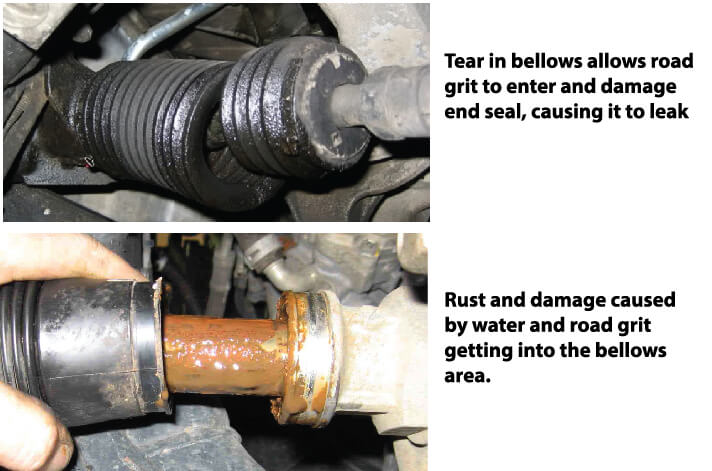
The rack and pinion boots protect the inner tie rod joint and the internal seals by keeping roadway contaminants out. If the boot tears or becomes dislodged, water, salt, and grit can get inside, causing premature tie rod end failure and rack seal failure.
If you’re noticing fluid leaking from the boots, the leak is coming from inside the rack.
1. Internal Seal Failure— The most common cause of a rack pinion leak is the failure of internal Teflon seals. In the image below, you’ll see three seals: two end seals and one center seals. These are high-pressure seals made from Teflon. The Teflon seals are heat-shrunk during assembly, forming a tight fit to the rack cylinder walls to retain the high-pressure fluid.
• Torn or damaged boots allow water, salt, and road grit to pass through the nylon bushing and wear out the Teflon seals.
• Worn, oxidized, or contaminated power steering fluid can decrease seal lubrication, causing wear and leaks.
• High-pressure conditions: Excessive hydraulic pressure caused by a failing power steering pump, stuck pressure relief valve or holding the steering in a full lock position can stress the seals, leading to leaks.

When these seals fail, power steering fluid leaks into the boots. Since the boots aren’t designed to hold fluid, they may swell, tear, or allow fluid to escape.
2. Excessive Wear on the Rack
The rack itself can wear out over time, especially if the system hasn’t been well-maintained. A worn rack can lead to uneven pressure on seals, causing them to fail and creating a pathway for hydraulic fluid to escape into the boots.
What Is a Rack and Pinion?
Carmakers have used two types of steering gears over the last four decades: 1) Recirculating ball steering gears are more commonly used on some light-duty trucks and mostly on medium and heavy-duty trucks. 2) Rack and pinion steering gears are used on all cars, CUVs, and most SUVs produced in the last 30 years.
Rack and pinion systems offer direct and precise control over the vehicle’s wheels. The linear motion of the rack ensures that small inputs at the steering wheel result in predictable and proportional changes in wheel direction. This precision translates into:
• Better cornering: The system responds quickly to steering inputs, making it easier to navigate tight turns.
• Enhanced handling: Drivers experience a more connected and responsive feel, improving overall vehicle control.

To learn how a rack and pinion steering gear works, see this article.
Partial Photo Credit to AA1car.com
©, 2024 Rick Muscoplat
Posted on by Rick Muscoplat