
Water Pump Leak Symptoms You Should Never Ignore
The Real Causes Behind a Water Pump Leak
Quick Summary
The symptoms of a water pump leak usually start small—coolant loss, minor overheating, or crusty residue—and then snowball into major engine damage if ignored. In my experience, most water pump failures trace back to coolant neglect, running low on coolant, air in the system, or using the wrong coolant. Catch the leak early, confirm the source, and fix it before it takes out bearings, seals, or the engine itself.
Water Pump Leak Symptoms: What Your Engine Is Trying to Tell You
After decades of diagnosing cooling system problems, I can tell you this: a water pump leak gives you plenty of warning—if you know what to look for. The most common symptoms of a water pump leak are a coolant reservoir that keeps dropping even after you top it off, unexplained overheating at highway speeds, and puddles of coolant under the front of the engine.
What throws many drivers off is that the symptoms of a water pump leak don’t always occur at once. I’ve seen pumps seep slowly for months, leaving only a chalky residue near the pump or timing cover. By the time the leak becomes obvious, the pump bearings are often already damaged.
Overheating is another red flag. If the cooling system is otherwise full and the radiator fans are working, persistent overheating strongly points to a water pump leak or internal pump damage. Add in the sweet smell of coolant after shutdown, and the diagnosis becomes even clearer.
Cavitation damages water pumps. To learn more about what causes cavitation, read Understanding Water Pump Cavitation: Causes and Effects
Symptoms of a water pump leak
• Coolant reservoir is low and is low again after refilling
• Engine is overheating even at highway speeds
• Puddles of coolant under the vehicle
What parts fail in a water pump
• Seal wear
• Bearing wear
• Impeller wear or disintegration
• Cavitation damages the pump housing
What Actually Fails Inside a Water Pump
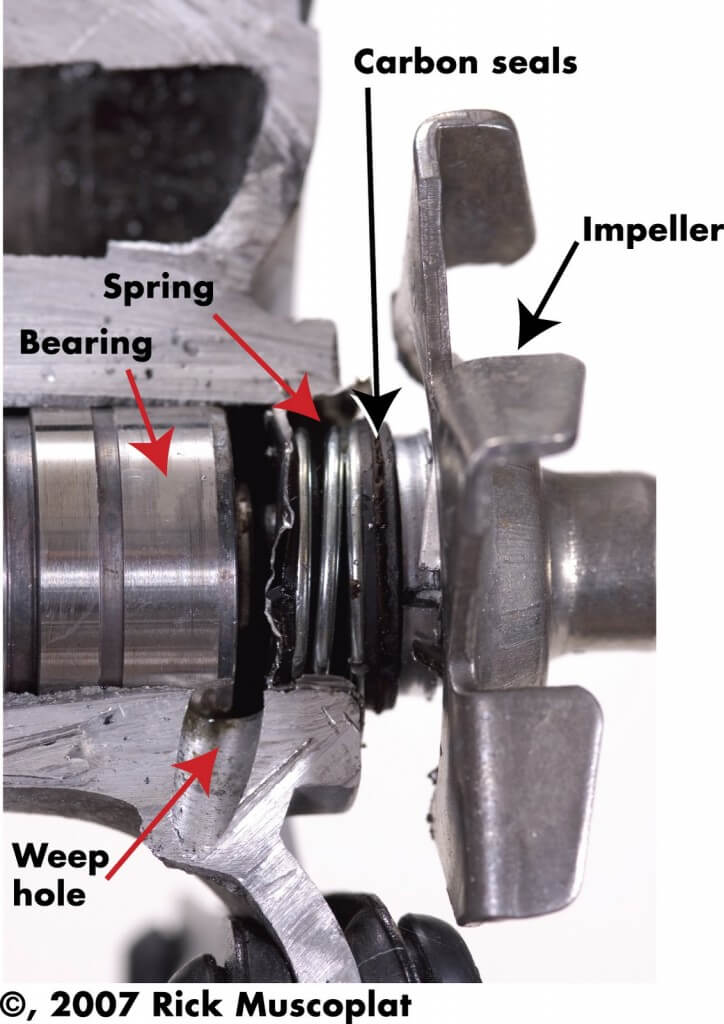
A water pump looks simple from the outside, but internally it relies on a delicate balance of seals, bearings, and coolant chemistry. Most water pump leak cases start at the seal. That seal rides on a polished shaft and depends on clean, properly formulated coolant for lubrication.
Once the seal begins to wear, coolant escapes. That leak then contaminates the bearing, washes out lubrication, and allows the shaft to wobble. At that point, the symptoms of a water pump leak accelerate quickly. The impeller may also suffer, especially if corrosion or cavitation is present, reducing coolant flow and increasing engine temperature.
The #1 Cause of a Water Pump Leak: Coolant Neglect
If I had to name one root cause behind most water pump leak failures, it would be neglected coolant. Engine coolant doesn’t just prevent freezing—it lubricates the water pump and protects the entire cooling system from corrosion.
The base chemical in coolant doesn’t really “wear out,” but the additives absolutely do. Once those anti-corrosion and lubricating additives are depleted, rust and scale begin forming inside the system. Those abrasive particles chew away at seals, bearings, and impellers, eventually creating a water pump leak.
Every time I see repeated symptoms of a water pump leak, I ask one question first: “When was the coolant last changed?” The answer is often “I don’t know.”
Why Driving With a Coolant Leak Destroys Water Pumps
Running low on coolant is a fast track to pump failure. When coolant levels drop, the pump bearings lose both cooling and lubrication. That heat buildup accelerates wear, causes shaft play, and destroys the seal.
This is why ignoring early symptoms of a water pump leak is so dangerous. What could have been a manageable repair turns into a full pump replacement—or worse, an overheated engine with warped components.
Cavitation: The Silent Water Pump Killer
Air pockets or flow restrictions in the cooling system can cause cavitation. Cavitation creates microscopic vapor bubbles that implode against the impeller and housing. Over time, this erosion wears away at metal surfaces, leading to overheating, reduced flow, and eventually a water pump leak.
Whenever I diagnose unexplained symptoms of a water pump leak, I check for trapped air, clogged passages, or improper bleeding after coolant service. Cavitation damage is often visible once the pump is removed. For more information on cavitation and what it does to water pumps, see this post
How Using the Wrong Coolant Causes Water Pump Leaks
Coolant choice matters far more than most people realize. Older green coolant relied on silicates for corrosion protection. Those silicates formed a protective coating quickly—but they were abrasive and short-lived. As that coating broke down, the particles scoured water pump seals and bearings, leading to a water pump leak.
Modern engines use Organic Acid Technology (OAT) or Hybrid Organic Acid Technology (HOAT) coolants. These formulas last longer and are far gentler on seals. Carmakers also redesigned internal seals to work specifically with these coolants.
If you pour old-school green coolant into an engine designed for OAT or HOAT, you’re practically inviting early seal failure and classic symptoms of a water pump leak. I’ve seen this mistake wipe out pumps in under a year.
Stick to the manufacturer’s recommendation. Despite marketing claims, there is no true “universal” coolant.
Owners of Toyota and Honda vehicles are best served by buying factory coolant directly from the dealer. General Motors vehicles typically use Dex-Cool, which is widely available—but still must be changed on schedule.
How I Diagnose a Water Pump Leak
When I’m tracking down a water pump leak, I start with a pressure test on a cold engine. Pressurizing the system reveals slow leaks that would otherwise go unnoticed. I inspect the pump’s weep hole, gasket surfaces, and nearby components, because coolant can travel before it drips.
I also check belt alignment and tension. A misaligned belt can overload bearings and accelerate seal wear, creating the exact symptoms of a water pump leak that people mistake for a gasket failure.
Fixing a Water Pump Leak the Right Way
Once a water pump leak is confirmed, replacement is the only real fix. Seal conditioners and stop-leak products might temporarily slow the drip, but they often do more harm than good by clogging passages and heater cores.
Whenever I replace a pump, I also inspect the drive belt, tensioner, and coolant condition. Refilling with the correct coolant and properly bleeding the system is critical. Skipping that step is how air pockets form—and how repeated symptoms of a water pump leak show up months later.
Modern coolants use organic acid anti-corrosion technology to avoid pump leaks and wear
Organic acid technology (OAT) is used in most new engines. OAT lasts much longer than silicates but takes longer to passivate metal components. So, some carmakers recommend a hybrid organic acid technology (HOAT) coolant that contains a low dose of either silicate or phosphate. Low-dose silicate or phosphate works quickly to passivate while reducing coolant abrasiveness.
What’s important for you to know is that when carmakers changed 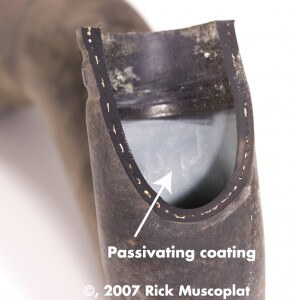 to OAT or HOAT, they also changed the composition of critical engine seals, like the seal inside the water pump and intake gaskets. So, if you replace OAT, HOAT, or low-silicate coolant with the old green stuff, you risk early failure of your pump and other engine seals. Don’t do it!!
Stick with your car maker’s recommendations. Contrary to claims by coolant manufacturers, there is no such thing as a universal replacement coolant. See this article on universal coolants.
Toyota and Honda owners should buy their coolant directly from the dealer. GM’s Dex-Cool is available at most auto parts stores.
© 2012 Rick Muscoplat
Posted on by Rick Muscoplat